We strongly condemn the use of ad blockers as they harm the digital ecosystem and the creators who rely on advertising revenue.
Ads are getting heavier and intrusive, and most of them are disguised as third-party trackers. Apart from slowing down the browser, ads also compromise user privacy. Not to mention, recent reports suggest that ad blockers keep users safe from cyber criminal attacks such as “malvertising” which are malware disguised as ads. So if you want a safe and fast web browsing experience, here are the 10 best ad blockers that you can use in 2026.
Best Ad Blockers Compared in 2026
uBlock Origin continues to be the best ad blocker as it uses fewer system resources and blocks nearly all ads. For Chrome, I would recommend uBlock Origin Lite which complies with the MV3 framework. You can also take a look at Adblock and Adblock Plus if you want an ad-free experience on the web.
| Ad Blockers | AdBlock Tester Score | Best For | Chrome MV3 |
|---|---|---|---|
| uBlock Origin | 95/100 | Advanced ad blocking, best for Firefox, Chrome users can install uBlock Origin Lite | No, uBlock Origin Lite supports MV3 |
| AdGuard | 92/100 | DNS-level blocking, cross-platform | MV3 |
| AdBlock | 92/100 | Chrome users, and beginners | MV3 |
| Adblock Plus | 90/100 | Best for browsers based on Chromium, compatible with MV3 | MV3 |
| Ghostery | 88/100 | Track and inspect trackers | MV3 |
| Privacy Badger | 78/100 | Best extension for privacy-first ad and tracker blocking | MV3 |
| Brave Shields | 94/100 | Built-in ad blocking inside Brave browser, granular controls to block ads and trackers | No |
| Adblock for YouTube | 85/100 | Block YouTube ads and annotations | MV3 |
| Blockify | 82/100 | Block Spotify ads | MV3 |
| NextDNS | N/A | DNS-level ad blocking, similar to cloud pi-hole | N/A |
How We Tested These Ad Blockers?
We tested these ad blockers on our Windows PC and Android phone through a rigorous evaluation process. Instead of relying on synthetic benchmarks, we checked their performance in real world browsing conditions.
Our Testing Criteria
First of all, we tested each ad blocker on AdBlock Tester which gives a score out of 100. It tests how the ad blocker handles banner ads, pop-ups, video ads, and tracker scripts. Next, we visited multiple ad-heavy websites to check how well these ad blockers work in those environments. Some ad blockers also let you remove an element manually which is an added bonus.
After that, we observed how these tools handle cookie consent banners, and malicious ads. And most importantly, during the testing, we checked whether these ad blockers impact the overall performance or not. We measured CPU usage, memory consumption, and page load times. Finally, we checked compatibility with Chrome’s MV3 API restrictions before finalizing the list.
Best Ad Blockers Reviewed
Here are the best ad blockers you can use across multiple platforms and devices:
1. uBlock Origin — Best Free Ad Blocker Overall
uBlock Origin is ranked among the best ad blockers for web browsers. It’s free and open-source and supports many web browsers including Edge, Firefox, Opera, and even Safari. It’s actively maintained by its lead developer, Raymond Hill. Among all the ad blockers, uBlock Origin is found to be the most memory-efficient and consumes much less CPU resources.

uBlock Origin blocks ads based on multiple filter lists including EasyList, EasyPrivacy, Peter Lowe’s Blocklist, Online Malicious URL Blocklist, and its own, uBO filter lists. As a result, not just ads, but uBlock Origin blocks trackers, coin miners, popups, annoying anti-blockers, and malware sites as well.
uBlock Origin Lite for Chrome (Manifest V3)
For Google Chrome, the developer has built uBlock Origin Lite (Download) which complies with the MV3 API restrictions. Google is already enforcing Manifest V3 extension support so you can no longer use the more capable uBlock Origin on Chrome.

With the new Lite version, there are some limitations. There is a cap on static rules, no support for dynamic filtering, and slower filter list updates. Despite all that, uBlock Origin Lite is a powerful ad blocker for Chrome as it doesn’t impact the system performance while offering the best protection from ads.
| Pros | Cons |
|---|---|
| Completely free and open-source | uBlock Origin Lite has limited capability on Chrome |
| Lowest memory and CPU usage | Not compatible with MV3 |
| Block ads, trackers, miners, and malware |
2. AdGuard — Best Premium Ad Blocker
You must have AdGuard as a DNS resolver, but it also offers extensions to block ads on web browsers and it’s easily one of the best ad blockers. It blocks all kinds of intrusive ads and removes annoying web elements from the web page. From banners to pop-ups, video ads, and malicious ads, AdGuard blocks them all.

It also offers inherent browsing security and stops you from visiting phishing and malicious sites. Not only that, AdGuard blocks web analytics tools and online trackers to protect your privacy. And it has also built a new MV3 Beta extension to comply with Google’s Manifest V3 policy for extensions.
| Pros | Cons |
|---|---|
| System-level ad blocking | Can be overwhelming for beginners |
| MV3-compliant | |
| DNS-level filtering |
3. AdBlock — Best for Beginners
AdBlock is another top ad blocker for browsers. While it blocks ads on nearly all websites, AdBlock goes one step further and blocks ads on YouTube too. Google is indeed cracking down on several YouTube ad blockers, but AdBlock continues to find some workarounds to make it work.

Apart from that, AdBlock removes pop-up ads, annoying banners, video ads, third-party trackers, malicious ads, crypto miners, and more. It also allows users to customize the filter list and whitelist websites to support a website through ads. In terms of performance too, AdBlock is not a memory hog and uses minimum resources.
| Pros | Cons |
|---|---|
| Extremely easy to set up and use | Fewer advanced features than uBlock Origin |
| Strong YouTube blocking | |
| Lightweight and efficient |
4. Adblock Plus — Best for Acceptable Ads Control
Adblock Plus is one of the best ad blockers and it’s a hugely popular cross-platform extension that blocks ads on web browsers. It’s available on Chrome, Firefox, Safari, Opera, and Edge. Along with ad-blocking on websites, it also blocks YouTube ads and pop-ups. The extension removes ad banners, video ads, and malware posing as ads. As a result, it frees up crucial resources and improves the performance of the browser.

Keep in mind that Adblock Plus is criticized for allowing certain types of ads that are part of the Acceptable Ads initiative. It’s turned on by default, but you can choose to opt out. Besides that, you can choose to whitelist websites that you want to support through ads.
| Pros | Cons |
|---|---|
| Block all kinds of ads and trackers | Some privacy filter disabled by default |
| Wide browser compatibility | Struggles with YouTube |
| Acceptable ads support |
5. Ghostery — Best for Tracker Visibility
Ghostery is one of the oldest ad blockers for web browsers, and it’s available on Chrome, Firefox, Safari, Opera, and Edge. It’s also open-source and completely free to use. It not only blocks ads but also stops third-party trackers from collecting your data and improves your privacy on the web.

Ads are getting much heavier nowadays, so Ghostery blocks all of them to improve the performance. It’s particularly helpful in blocking intrusive cookie pop-ups, which are frankly annoying and automatically dissents to online tracking. You can also choose to find the tracker information for each website and allow certain ones if you need them.
| Pros | Cons |
|---|---|
| Real-time tracker visibility | Less aggressive ad blocking |
| Open-source and completely free | No system level blocking |
| Automatic cookie consent rejection |
6. Privacy Badger — Best for Privacy-First Users
If you are conscious about your online privacy, you must check out Privacy Badger. It’s an extension developed by the Electronic Frontier Foundation (EFF) and aims to protect user privacy on the web. It’s not an ad blocker per se, but blocks all kinds of visible and invisible trackers on the web. However, by doing so, all kinds of ads are also blocked since most ads or scripts are disguised as third-party trackers.
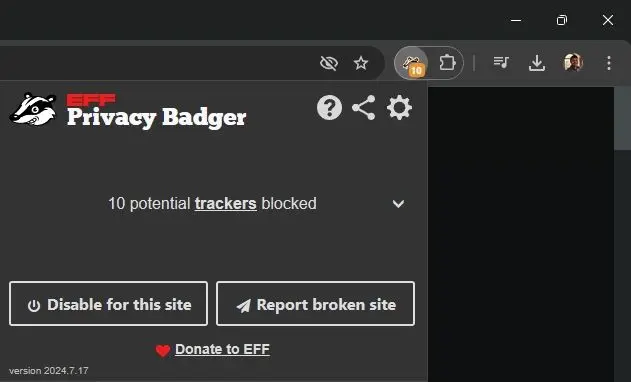
Privacy Badger does send a signal denying consent to tracking through Do Not Track and Global Privacy Control. However, when websites still track you, the extension blocks them right away. So if you want more of a privacy tool rather than an ad blocker, Privacy Badger is for you.
| Pros | Cons |
|---|---|
| Developed by the EFF | Not a full ad blocker |
| Privacy-first approach, Send Do Not Track signals | Static blocklists |
| Lightweight to use |
7. Brave Shields — Best Built-In Ad Blocker
Brave Shields is a built-in ad and tracker blocker that comes with the Brave browser. Unlike many extension-based ad blockers, it works at the browser engine level, which means it can completely bypass Manifest V3 limitations and blocks ads effectively. Sure, you will have to switch your browser to Brave to be able to use it.
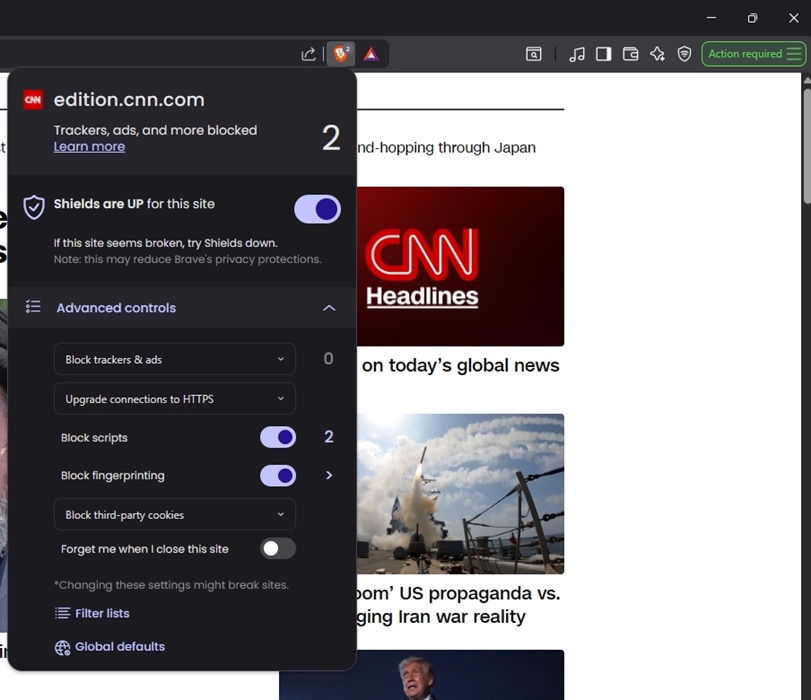
However, you don’t need to install any extension or configure any settings. It works right after the installation. Apart from that, Brave Shields blocks third-party ads, trackers, cross-site cookies, fingerprinting scripts, and phishing attempts. You can use either the Standard mode or the Aggressive mode which blocks all kinds of ads and trackers.
| Pros | Cons |
|---|---|
| Built-in ad blocking in the Brave browser | Requires switching to Brave |
| Bypasses MV3 restrictions | Aggressive mode may break some sites |
| Great performance on AdBlock Tester |
8. Adblock for YouTube — Best for YouTube Ad Blocking
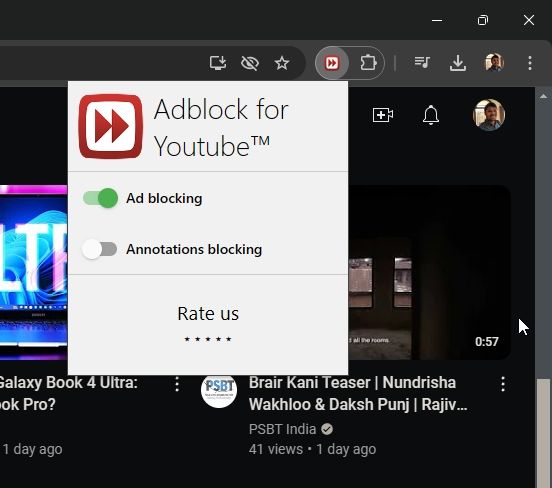
While Google is ramping up to block ad blockers on YouTube, there are a few extensions that still work. One such extension is Adblock for YouTube and it’s highly rated as the best ad blocker for YouTube. It blocks banner ads, ad-clips, and even pre-roll ads on YouTube which usually play in the beginning. It also blocks YouTube ads on external sites, which is great. That said, some users report that the extension no longer works, but go ahead and try it out.
| Pros | Cons |
|---|---|
| Free and lightweight, highly rated | Struggling to detect YouTube ads in 2026 |
| Block YouTube ads, ad-clips and pre-rolls | |
| Block YouTube ads on external websites |
9. Blockify — Best Spotify Ad Blocker

Blockify is a Spotify ad blocker, specifically written to remove audio ads in between songs. You can get rid of constant interruptions on Spotify using this extension. That said, keep in mind that it only works on Spotify web player (open.spotify.com). Apart from that, the extension has been designed primarily for Chrome, but it will also work on other Chromium-based browsers like Edge and Opera.
| Pros | Cons |
|---|---|
| Remove Spotify ads effectively | Only works on Spotify web player |
| Free to use | Not a general ad blocker |
| Doesn’t break the Spotify web player |
10. NextDNS — Best DNS-Based Ad Blocker
Finally, NextDNS ranks among the best ad blockers because its filtering service blocks ads, trackers, and malware at the DNS level. As a result, it blocks ads not only in browsers, but also in apps and other programs. And you can use NextDNS on your Windows PC, Mac, Android, and iPhone. It’s basically a cloud-hosted Pi-hole that filters content even before it reaches your device.
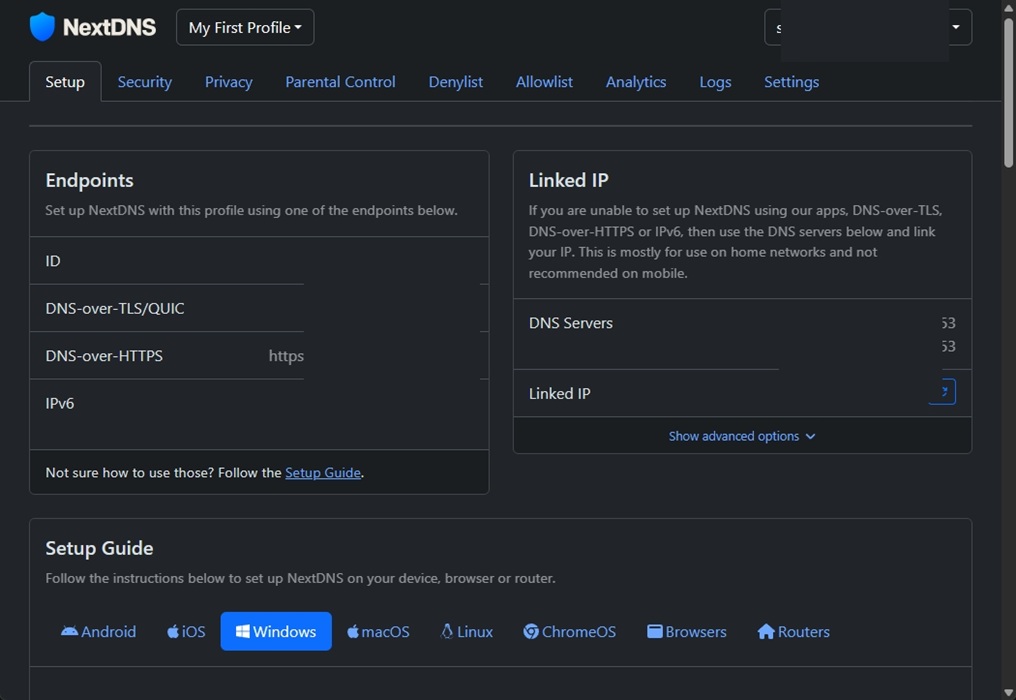
In fact, you can directly configure NextDNS on your router to block ads and trackers from your whole network. You will not see ads on your smart TV, IoT devices, game consoles, and more. By the way, it uses DNS-over-HTTPS so all your traffic is encrypted. Next, through its web dashboard, you can customize the blocklist, add more protection, add or deny rules, and do much more.
| Pros | Cons |
|---|---|
| Block ads and trackers across all apps and networks | Empty ad spaces may be visible |
| Works on every device | |
| Advanced DNS-level ad and tracker blocking |
Best Ad Blockers by Browser
The best ad blocker depends on which web browser you use. After Google’s Manifest V3 restrictions, ad blockers don’t enjoy the same freedom as before. For instance, uBlock Origin now doesn’t work on Chrome, but it’s great on Firefox. So to find out the best ad blockers by browser, follow the below guide.
Best Ad Blocker for Chrome
Our Pick: AdBlock or uBlock Origin Lite
While Chrome’s Manifest V3 has made uBlock Origin incompatible, you can use the new uBlock Origin Lite extension to block ads in Chrome. You can also try AdBlock which offers YouTube blocking out of the box.
Best Ad Blocker for Firefox
Our Pick: uBlock Origin
uBlock Origin is simply the best ad blocker on Firefox. It still supports the older Manifest V2 framework which allows the extension to fully block ads and trackers without any restrictions. On top of that, you get fast page loads with minimal impact on your system.
Best Ad Blocker for Safari
Our Pick: AdGuard
AdGuard is the only great ad blocker on Safari. It works like an app and does DNS-level blocking on macOS and iOS. For Safari users who want a system-level ad blocker on Apple devices, you can’t go wrong with AdGuard.
Best Ad Blocker for Edge
Our Pick: Adblock or Adblock Plus
Despite being a Chromium browser, Edge still supports Manifest V2 extensions, and you can still try uBlock Origin. However, Adblock and Adblock Plus are equally capable extensions and they are fully compatible with Edge. You can use one of these extensions to block ads and trackers inside the Edge browser.
Best Ad Blockers for YouTube
YouTube ad blocking has become nearly impossible as Google is going after ad blockers using anti-adblock detection and issuing DMCA takedowns against project developers. In addition, YouTube is adding server-side ad insertion which stitches ads directly into the video stream. This makes it harder to detect ads from video streams.
That said, there are still some extensions that work decently well. I would highly recommend using Adblock for YouTube which is a dedicated extension for ad blocking on YouTube. It has more than 372,000 ratings on the Chrome Web Store with an average 4.4 rating. So, go ahead and try this ad blocker for YouTube. Apart from that, you can check out AdGuard, Brave Shields, and uBlock Origin on Firefox.
What is Manifest V3 and How Does It Affect Ad Blockers?
Manifest V3 (MV3) is Google’s major overhaul of the Chrome extension platform and it replaces the MV2 framework for extensions. MV3 replaced the powerful webRequest API, which allowed extensions to modify network requests in real-time. Instead of that, extensions now have access to the restrictive declarativeNetRequest API.
Google claims that it’s done to improve performance and security, but the net effect is that ad blockers like uBlock Origin was severely limited with this action. Besides that, under MV2, extensions could dynamically intercept network requests, apply complex filtering, and update rules on the fly. But MV3 caps extensions at around 30,000 static rules and there is no support for real-time interception.
While under MV3 basic ad blocking works, the advanced techniques are severely limited. To sum it up, if you want maximum ad blocking power, you can use Firefox with uBlock Origin, which still supports MV2. You can also try the Brave browser, which is a capable alternative to Chrome and it has built-in support for ad blocking via Brave Shields.
Ad Blocker vs VPN with Ad Blocking — Which is Better?
Several VPN providers now bundle ad-blocking features that work at the network level, filter DNS requests, and block known ads and trackers. VPN services say that with the VPN subscription, you get both privacy and ad blocking. While the premise is interesting, there is a catch. It can’t perform cosmetic filtering, meaning it can’t remove empty spaces left by blocked ads.
Next, VPNs can’t match the depth of filter lists, generally used by ad blockers. At best, you can use VPNs to block ads system-wide, but ad blockers inside web browsers offer much more powerful capabilities. In addition, dedicated ad blockers don’t route your private traffic through VPN servers, which is an added security and privacy protection.
The bottom line is that you should use a dedicated ad blocker inside your browser while VPN-based ad blocking should be used as a complementary tool for system-wide blocking.
Which Ad Blocker Should You Use?
With so many options out there, it becomes confusing to choose the right ad blocker. So, in this section we have made things simpler for you and you can easily find the best ad blockers that match your needs.
- Best for Chrome: Adblock and uBlock Origin Lite
- Best for Firefox: uBlock Origin
- Best for YouTube: Adblock for YouTube and Brave Shields
- Best for Spotify: Blockify
- Best for Privacy: Ghostery and Privacy Badger
- Best for Mobile: AdGuard, Brave Browser, and NextDNS
- Best for Advanced Users: uBlock Origin and NextDNS
- Best for Whole Network: NextDNS or Pi-hole
Final Verdict
The ad-blocking landscape is fragmented right now as Google has enforced its Manifest V3 framework. There is no single best ad blocker that works on all devices and for everyone. It all depends on your choice of browser, and on which platform you are. Despite that, we have tried to include something for everyone.
So that wraps up our list of the best ad blockers for web browsers. I suggest not installing ad blockers from shady developers, as they can be used to collect your browsing data instead of blocking ads. Anyway, that is all from us. If you have any questions, let us know in the comments below.
No, ad blockers, in fact, improve page loading speeds by removing ads, scripts, video payloads, and trackers. While ad blockers use minimal CPU and RAM, they are much better than ad-heavy pages which slows down your computer.
No, uBlock Origin is no longer available on Chrome after Google enforced MV3 restrictions. You can, however, use uBlock Origin Lite from the same developer which is compatible with MV3.
On Chrome, uBlock Origin Lite or Adblock are two great free ad blockers. And on Firefox, you can install the popular uBlock Origin extension.
Yes, but most of the YouTube ad blockers don’t work now. Google is now injecting ads directly into video streams, which is hard to detect and remove.






 Nadeem Sarwar