There are some genuinely good Google alternatives out there, like Microsoft Bing, DuckDuckGo, Brave Search, and even ChatGPT search if you are looking for a conversational search engine. Some are privacy-focused, providing results without tracking your every move on the web, while others offer better results that actually answer what you are searching for. So if you are tired of Google’s low-quality results on the web, here is a list of the best search engines to use in 2026.
Overview of the Best Google Alternatives in 2026
Before we jump into the details, here’s a quick overview of the best Google alternatives in 2026. We have also mentioned who each one is best suited for, along with its pricing.
| Google Alternatives | Best Suited for | Pricing |
|---|---|---|
| Bing | Users looking for a full-fledged, feature-rich experience akin to Google, or those invested in Microsoft Windows and its services | Free, includes personalized ads |
| DuckDuckGo | Those who prioritize privacy-first searching and want a simple, no-tracking Google alternative for everyday use | Free |
| Brave Search | People who want a privacy-first search engine with AI summaries, especially those who already use the Brave browser | Free |
| Startpage | Anyone who wants Google-level search results without sacrificing privacy | Free |
| Qwant | European users who want a privacy-focused Google search alternative with a straightforward interface | Free |
| Perplexity AI | Students and researchers who want an AI-powered search engine for cited sources and accurate data | Free, Paid plan starts at $20/month |
| ChatGPT Search | People who want quick answers for specific queries in a conversational manner rather than in a data-first approach | Free, Paid plan starts at $20/month |
| Wolfram Alpha | Students, researchers, engineers, and analysts who need precise answers instead of web results | Free, Pro plan starts at $9.99/month |
| Ecosia | Those who want a search engine that supports environmental causes while still offering an everyday search experience | Free, accepts donations |
| Swisscows | People who want a safe, clean search experience with strong data protection by default | Free, paid plan starts at $4.99/month |
Why You Should Look for a Google Search Alternative?
Google has sort of become the pseudo-monopoly when it comes to search engines, coming as the default in many browsers and mobile operating systems. This dominance has allowed the company to play by its own rules, forcing tracking on its users and offering poor AI-generated results. This has caused a lot of frustration among users. So, if you have also been having the same problems with Google, this could be a good enough reason to look for a Google alternative.
Best Search Engines to Use as a Google Alternative in 2026
Bing and DuckDuckGo pop up as the obvious options when it comes to a Google alternative, but there are some other good options that we have mentioned below. Take a look.
Bing – Next Best Alternative to Google
Microsoft’s Bing search is nowhere near as big as it once used to be; however, it remains one of the best Google alternatives out there. Not only does it bring tons of features like Google, but it also looks good. Bing’s homepage has an ever-changing background consisting of places, animals, people, sports, etc. Like Google search, Bing includes the ability to use operating calculations, sports scores, flight tracking, product shopping, translate, conversions, spell check, and more.

It also has baked-in support for Copilot AI to provide summaries of search results from multiple sources. Just like Google’s AI mode. It does feature Bing Ads. However, you can set preferences for most of them, and they are not as annoying as Google Search ads. Bing also integrates easily with Facebook and into Apple and Windows-based devices. Also featuring its own standalone mobile applications, Bing is easily a viable Google alternative.
| What We Liked | What We Didn’t Like |
|---|---|
| Strong image and video search results | Ads can feel prominent |
| Deep integration with Windows, Edge, and Copilot AI | Weaker results for niche queries |
| AI-powered answers and summaries | Heavily tied to Microsoft’s ecosystem |
| Offers Bing rewards to regular users |
Top Privacy-First Google Alternative Search Engines
Bing is also as aggressive as Google when it comes to collecting your data. So, if you want a privacy-focused search engine, then you should go with DuckDuckGo or Brave Search. Here’s a closer look at these Google alternatives.
DuckDuckGo: The Gold Standard for Anonymity
DuckDuckGo has established itself as one of the best privacy-oriented alternatives to Google search. It’s results from many different sources, and it does not keep track of your searches. It uses its own web crawler, like DuckDuck bot, which it uses to aggregate data from multiple sources before ranking its search results.

Those search results are then displayed privately to the end-user. This is entirely open-source, and the code is even available on GitHub. DuckDuckGo is a proxy-based search engine where the user’s search queries are left untracked. All in all, DuckDuckGo looks and feels more like how Google used to be 10 years back. That is why I love using it as my primary search engine for the most part.
| What We Liked | What We Didn’t Like |
|---|---|
| Strong privacy protection | Relies partly on Bing for indexing |
| Clean, clutter-free interface | Weaker local and real-time results like news |
| Built-in tracker blocking | |
| Transparent privacy policies |
Brave Search: The Rising Independent Powerhouse
The people behind the Brave browser, the well-known privacy-focused alternative to Chrome, also came up with their in-house search engine called Brave Search. It is built on the foundation of preserving user privacy, only collecting limited data to improve search results, rather than serving ads and recommendations.
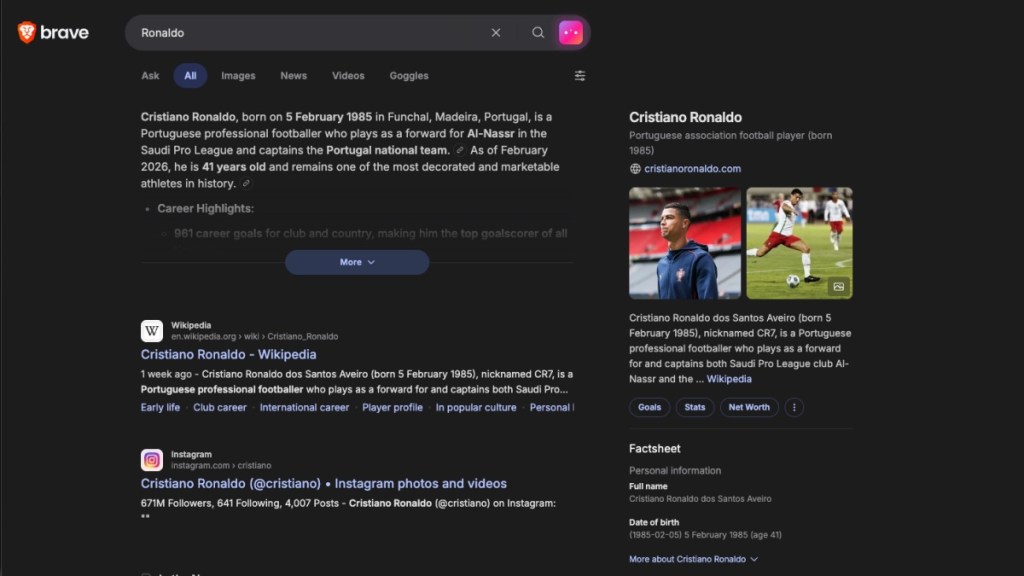
Its layout looks quite simple and easy to glance at. There’s even a Brave Ask mode, powered by AI, to get deeper insights on any topic. Plus, it shows a short snippet of the answer from multiple sources, similar to Google’s AI overviews. Brave Search also features Goggles. An innovative feature that lets you customize your search rankings. Like, you can choose whether you want more tech blogs or less pinterest posts.
| What We Liked | What We Didn’t Like |
|---|---|
| Uses its independent search index | Smaller index than Google for niche searches |
| Strong privacy protections | AI summaries still feel experimental |
| Clean interface with minimal tracking | |
| Good for tech and web-focused queries |
StartPage: Google Results without the Tracking
IxQuick was one of the search engines that showed its own results on the page. Later, IxQuick launched a second search engine called StartPage, which used to include Google’s search results but didn’t allow Google to track its users. Finally, both these search engines merged into one and now operate under the same name.
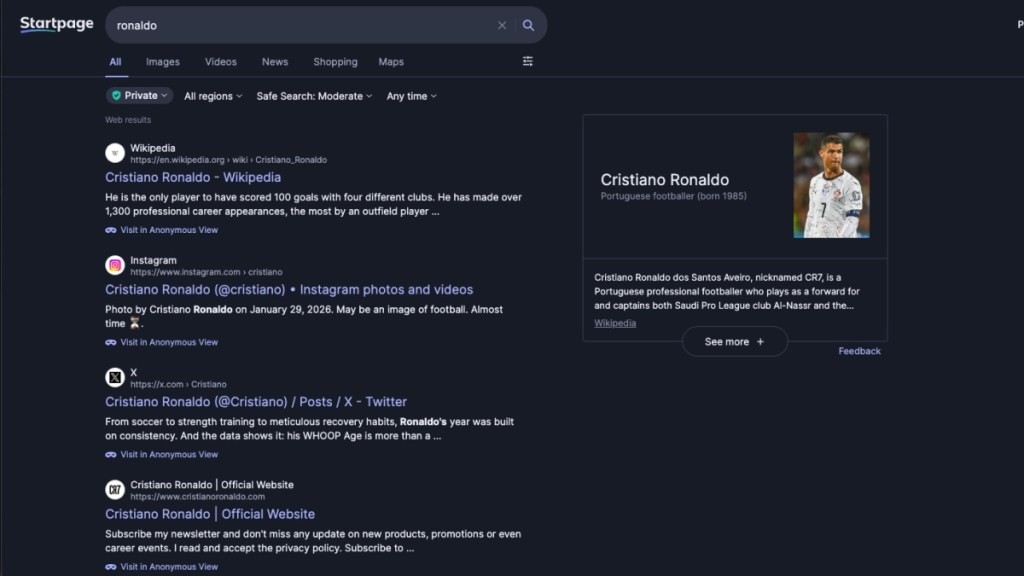
On one hand, you are not being tracked, while on the other and you are receiving accurate search results as they are being pulled directly from Google Search. StartPage neither stores users’ data nor lets websites track them. It brings a feature called “Anonymous View” which protects users from websites when they click on any search result. If you wanta Google alternative that offers privacy with the search result quality of Google,1 then StartPage is the best search engine to go with.
| What We Liked | What We Didn’t Like |
|---|---|
| Delivers Google-quality search results | Limited features than Google |
| No user tracking or search history storage | Slower result loading at times |
| Simple, familiar interface | |
| Anonymous View option for safer browsing |
Qwant: Best for Europe Centric Private Search
Qwant is another privacy-focused search engine that promises never to save your search data or harvest your personal data for ad targeting. Despite being privacy-friendly, Quant is quite rich in features. One of my favorite features of Quant is its “quick search shortcuts” feature, which lets you quickly search for products and content on specific websites like YouTube, Amazon, and more.

I also love Quant’s Panoramic search feature, which basically means that Qwant delivers all its results on a single web page, whether they are websites, social networks, pictures, videos, shopping, music, or more. Overall, I quite like Qwant, and its search results are also quite accurate. This is why I refer to it as one of the better privacy-centric Google alternatives for those residing in Europe.
| What We Liked | What We Didn’t Like |
|---|---|
| Strong privacy with no user tracking | Limited to only Europe |
| Clean, light interface | Smaller index compared to Google and Bing |
| GDPR-focused operations | |
| Decent news and social content |
Best AI-Powered Search Engines
With the advent of AI, standard search engines might feel outdated and less interactive. So if you want a conversational AI alternative to Google, then you can check out the Perplexity of ChatGPT search.
Perplexity AI: Best for Research & Citations
We already recommend Perplexity AI as the best AI tool for research and the best AI tool for students in 2026. The reason is simple: it offers accurate information with correct sources and citations. This means that there is a very limited chance of hallucinations and getting irrelevant results, which is something even Google’s AI overviews suffer from.

Moreover, it is quite natural in conversations. So you can ask the AI to simplify, summarise, or even offer a more detailed answer. Though it might sound a little robotic, its value is in its information, not in its behaviourism. So, if you need an AI-powered Google alternative with the most accurate research, then Perplexity is the go-to option that I suggest.
| What We Liked | What We Didn’t Like |
|---|---|
| Excellent AI-powered answers with cited sources | Can miss niche or very recent sources |
| Great for research, summaries, and follow-up questions | Advanced search features require paid plan |
| Clean, simple interface | |
| Supports conversational follow-up questions |
ChatGPT Search: Best for Conversational Queries
ChatGPT search is another great Google alternative and has lately become quite popular among users. The simple reason for this is its conversational capability. It responds in natural language, so the results feel less like some random data and more like a lesson taught to you by a friend. Ask it about anything, in any way or form, and 85% of the time, it will understand the context and provide the right answer.
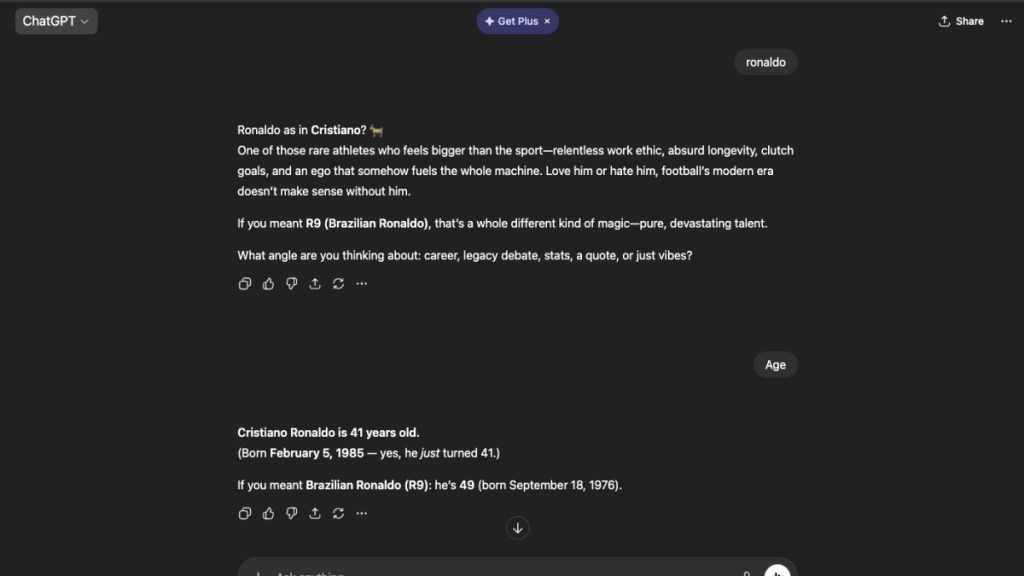
This is what makes it one of the best AI search engines out there. However, unlike Perplexity, ChatGPT is more likely to hallucinate and share wrong information. Even though the data might be up to date, the result may not be. Also, it does not offer glanceable results. You will have to provide prompts on the kind of information you are looking for, which might be tiresome for some people.
| What We Liked | What We Didn’t Like |
|---|---|
| Conversational search experience | Not ideal for research |
| Useful for research, planning, and ideation | Can hallucinate and provide wrong or outdated information |
| Good at explanations, comparisons, and follow-up queries |
Best Specialized Google Alternatives
Besides the one mentioned above, there are also search engines that specialize in specific scenarios, like finding a maths solution, or even an environmentally friendly search engine. Here are some other Google search alternatives I wanted to include in this list.
Wolfram Alpha – Best for Maths and Science
Wolfram Alpha is one of the best maths AI tools, but it can also do a lot more. It is also a powerful search engine. Wolfram Alpha mainly curates its data, instead of just caching web pages. This search engine curates data from a lot of reputed and trustworthy college publications/libraries, Crunchbase, FAA, Best Buy, and many other sources.

Wolfram Alpha comes up with results that are computational facts. On the home screen are some of the examples of searches through which Wolfram Alpha could assist. If you look up a University on Wolfram Alpha, it curates all of the key information like enrollment numbers/Tuition Fees/location, etc., and all the essential data is curated and presented in a single spot.
| What We Liked | What We Didn’t Like |
|---|---|
| Best for math, science, and factual computation | Not designed for general web search |
| Highly reliable, structured data | Pro features require a subscription |
| Handles equations, units, and statistics exceptionally well | |
| Trusted academic tool |
Ecosia: Best Google Alternative Eco-Conscious Users
If all you want is a simple and lightweight Google alternative, Ecosia would be a decent substitute. It has a clean appearance and offers search results with fairly good accuracy. Just like Google, Ecosia also saves your activity to offer more personalized search results. However, if you don’t want the search engine to save your activity, you can choose to disable the personalized search results.

On the customization front, Ecosia has looked quite competent compared to Google. It shows search suggestions under the search box as you type. Thus, it becomes a bit convenient to search for anything. Not just that, it even allows you to ban objectionable content. But what has caught my eye in Ecosia is the commitment to donate the generated money to a cause that plants trees.
| What We Liked | What We Didn’t Like |
|---|---|
| Uses ad revenue to fund tree-planting | Search results depend largely on Bing |
| Privacy-friendly with limited tracking | Limited advanced search features |
| Familiar search experience powered by Bing |
Swisscows: Best Google Alternative for Music Search
Whether you aren’t satisfied with the privacy policy of Google or are hunting for a privacy-centric web browser, Swisscows would be a trusted contender for your needs. Touted to be a family-friendly and semantic search engine, it allows you to surf the web with enhanced privacy.

Swisscows states that it doesn’t collect, store, or track users’ data. And going by the track record, it can be trusted to browse the web without worrying about data trackers. Though its searches aren’t as fast and on-point as those of Google, they are up to the task. Swisscows search engine also offers a VPN to let you browse anonymously by keeping your personal information hidden.
| What We Liked | What We Didn’t Like |
|---|---|
| Strong privacy protections with no user tracking | Limited index compared to major search engines |
| safe-by-default search results | |
| Based in Switzerland with strict data protection |
How to Choose the Right Google Alternative for You
Choosing which search engine is best for you depends on multiple factors and your preferences. Here are some things to consider if you are looking for a Google alternative in 2026:
- Privacy or Personalized results: Google offers more personalized results as it tracks your entire search journey. Refining results based on exactly what you are clicking and looking at. Privacy-focused search engines like DuckDuckGo and Brave Search avoid this, but in turn, offer less personalized information.
- Accuracy of data: Not every search engine provides accurate data. This is especially true for AI Google alternatives like ChatGPT, which can hallucinate. So you need to pick which search engine provides more accurate data.
- What is your use case? Finally, it all comes down to how you use a search engine. If you need more glanceable information, you should go with Bing or Startpage. If you want data-backed results, go with Perplexity, and if you need mathematical answers, Wolfram Alpha is the best pick.
Happy with These Google Alternative Search Engines?
Now that we’ve come to the end of the best Google Alternative article, how many of these search engines have caught your attention? Do check them out and let us know which Google alternative search engine you’re going to use. Also, if we missed any search engine that should be on the list but isn’t, let us know in the comments section down below.
Both in terms of accuracy and intelligence, Bing appears to be the best alternative to Google. Though DuckDuckGo and Yahoo! Search also have the features to stand out.
As we have mentioned in this roundup, there are several search engines in the market. As Google dominates the sphere with more than 90% market share, many people believe that Google is the only search engine in the market.
No. DuckDuckGo was founded by Gabriel Weinberg, an entrepreneur who had previously launched Names Database. The company is located in Valley Forge, Pennsylvania (United States).
Most web browsers allow you to change search engines. For instance, if you want to use other search engines in Google Chrome, click on More > Settings. Now, click on the down arrow next to the Search engine and then choose a preferred search engine.
Well, the straightforward answer to this question is – No. When it comes to offering fast and accurate search results, Google is by far the best in the business. However, on the security and privacy front, DuckDuckGo has a clear edge over Google.