Duolingo is considered the best language learning app for both beginners and advanced users. New language apps have also appeared including Babbel and Memrise which offer novel teaching methods for language learning. So, in this article, I have curated the eight best language learning apps for Android and iOS after testing a dozen of them. On that note, let’s check them out.
Best Language Learning Apps Compared
I have compared the top language learning apps in the table below. Take a quick look to understand the difference between the apps, their pricing, limitations, and more.
Language Learning Apps Best Suited For Limitations Pricing Duolingo Beginners and casual learners who want a gamified experience Free tier shows ads and limits mistakes Free (ad-supported), $12.99 per month Babbel For learners who want dialogue and grammar-focused lessons for practical conversation Smaller language catalogue $8.95 per month on 12-month plan Pimsleur Audio-based learners, best for speaking and listening practice Less visual content $20 per month Memrise Best for vocabulary retention, listening to native speaker clips Less emphasis on grammar Free, $25 per month Drops Best for busy individuals, learn visually, 5-minute sessions, build world banks Lacks grammar depth $11 per month Rosetta Stone Immersive learning experience, strong pronunciation, good for long-term learning More expensive $14.95 per month Mondly Learn phrases, best for beginners, AR/VR features, quick conversations Advanced features behind paywall Free, $14.90 per month Busuu Structured lessons, community support, native speaker feedback, built on CEFR standard Core learning behind paywall Free with ads, $12.99 per month
Duolingo vs Babbel vs Memrise: Detailed Comparison
I have compared the top three language learning apps — Duolingo, Babbel and Memrise — in a table below. You can take a glance and find the standout features, weaker areas, pricing information, and more.
Criteria Duolingo Babbel Memrise Standout features Gamified experience with bite-sized lessons, streaks, AI-powered bot, core experience for free Structured and conversation-first lessons, strong focus on grammar, practical dialogues, and track your progress Best for vocabulary building, native-speaker video clips, repetition system for retention, AI tutor Weaker areas Limited grammar explanations No free tier No longer offers community-created courses Free tier Yes (ad-supported) No (first lesson free) Yes Pricing $12.99 per month $8.95 per month for a 12-month plan $25 per month Languages offered 40+ languages 13 languages 34 languages Speaking and conversation focus AI roleplay for speaking practice Primarily designed for dialogue and conversation Listen to native videos Vocabulary learning Medium Medium High
How We Tested the Best Language Learning Apps?
To find the best language learning apps, I spent a week testing various apps in this category. First off, I tried to find a free language learning app that offers generous limits, and in this case, I found Duolingo to be the best. Secondly, I looked for apps which don’t rely on traditional language translation methods and resource materials for learning grammar, pronunciation, etc.
After extensive testing, I picked only those language learning apps that offer novel ways to teach language. For example, visual and interactive methods often have better retention for building vocabulary. Game-like elements also help users to keep them motivated.
Next, if an app offers an AI chatbot to practice lessons or converse through voice, it goes a long way in building confidence to speak the target language. All these criteria were used to pick the best language learning apps.
Best Free Language Learning Apps
Duolingo is the only app that offers core language learning features for free. So in this section, I have explained how beginners can use this app to learn different languages.
Duolingo
Duolingo is one of the most popular apps for language learning and it offers a generous free version so I started my journey with this app. I was actually impressed to see how much Duolingo offers without charging any fee. I must say that its approach to language learning via a game-like approach is quite interesting. I was coming back to Duolingo for streaks, leaderboards, and achievements.

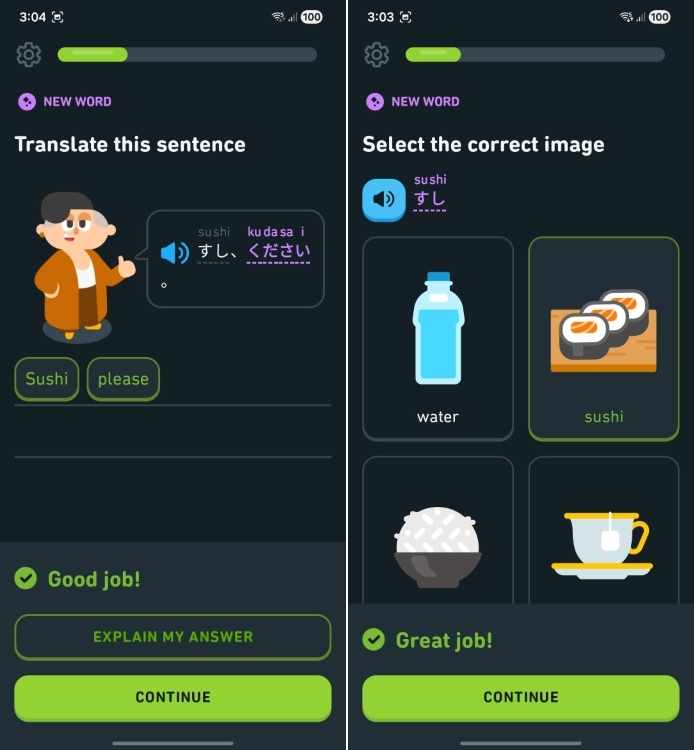
It made language learning like playing a mobile game. And the bite-sized lessons are great for those who have a busy schedule. It introduces vocabulary and grammar of a language through visual associations and repetitive tasks. That said, the free version includes ads and a heart system that limits mistakes, but you get all the core learning experience for free. In effect, Duolingo is one of the best apps for students who want to learn languages for free.
Pros Cons Free version offers core learning experience Ads in free version with mistake limits 40+ languages support Perfect for beginners
Pricing: Free (ad-supported), $12.99 per month
Best Language Learning Apps for Speaking
You should try the fantastic Babbel app if you are looking to improve your speaking skills. Following that, Pimsleur is also a great audio-focused app for language learning.
Babbel
If you are looking for the best language learning app for speaking, I would highly recommend Babbel. I started testing Babbel on my Android phone and found that its approach to language learning is different as it emphasizes on real-world communication. Unlike Duolingo’s gamified approach, Babbel teaches you phrases that you can start using in conversations. For English speakers, it offers great grammar explanations in a concise manner.
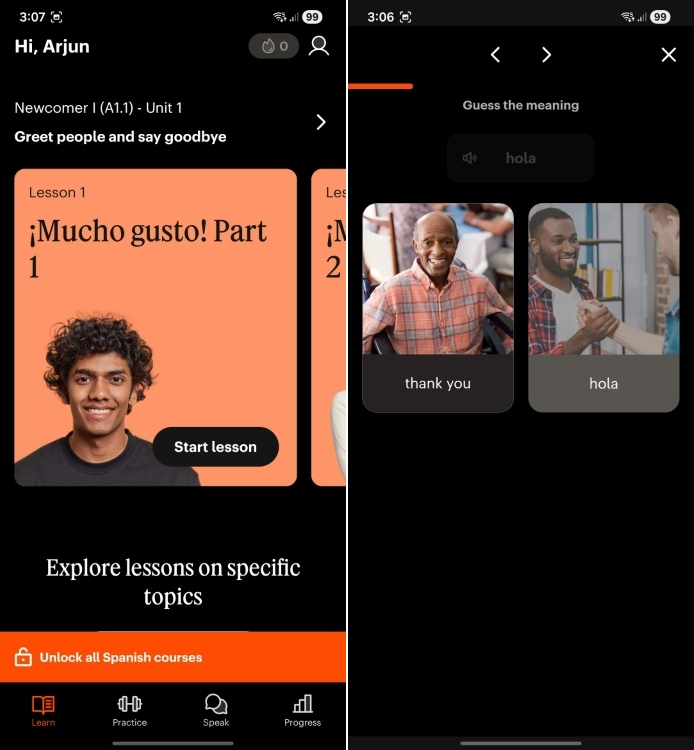
And if you get the paid subscription, you can have live classes with certified instructors. Babbel recently added an AI conversation partner and it helped me practice dialogues in my free time. Not to mention, there is an integrated podcast that you can listen to improve your comprehension. Basically, if you want a Duolingo alternative, Babbel is the one app you should try.
Pros Cons Courses designed by language experts 13 languages support Focused on practical conversation AI conversation partner
Pricing: $8.95 per month on 12-month plan
Pimsleur
Next, I found the Pimsleur app on Play Store which uses audio-based methods to force you to speak out loud constantly. For speaking foreign languages, Pimsleur builds confidence faster than any other language learning app. I had a 30-minute lesson in which you go through realistic dialogues in hands-free mode and speak sentences and phrases.
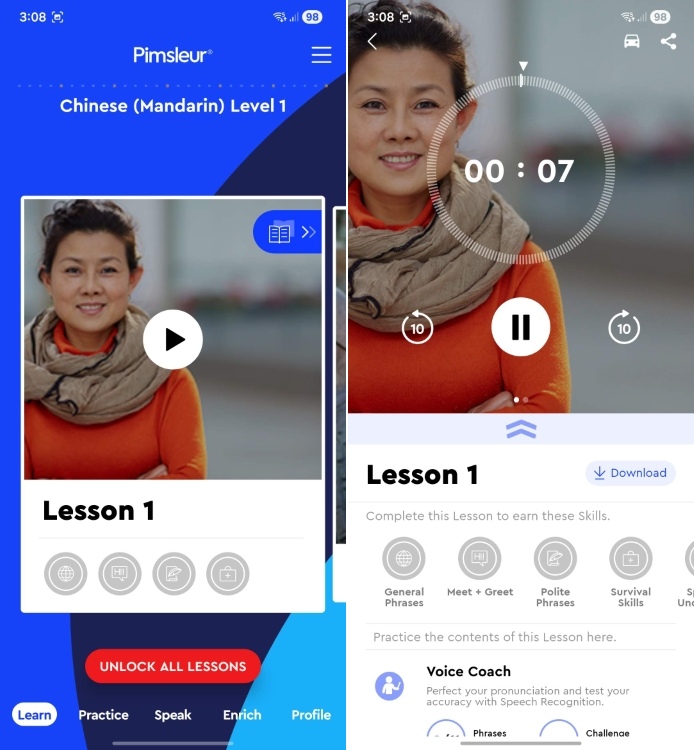
You may have seen other apps teaching reading and writing first, but Pimsleur begins with speaking and listening. This allows you to build vocabulary that stays with you in long-term. Not to mention, Pimsleur packs a voice coach AI which gives feedback on your pronunciation to sound more natural. I would say for speaking fluency, you should definitely try Pimsleur.
Pros Cons Exceptional app for speaking development Not for visual learners Learn while commuting or multitasking Voice coach AI
Pricing: $20 per month
Best Language Learning Apps for Vocabulary
For vocabulary building, Memrise is easily the best language learning app. Not to mention, the new Drops app has become quite popular among young users for learning new words.
Memrise
Memrise is another popular app for language learning and it’s highly rated on both Google Play Store and Apple App Store. In my testing, I found that Memrise uses native speaker videos for vocabulary retention. For instance, you watch real people using words in different context with facial expressions, gestures, and natural speech patterns. This helps you retain words in your long-term memory.
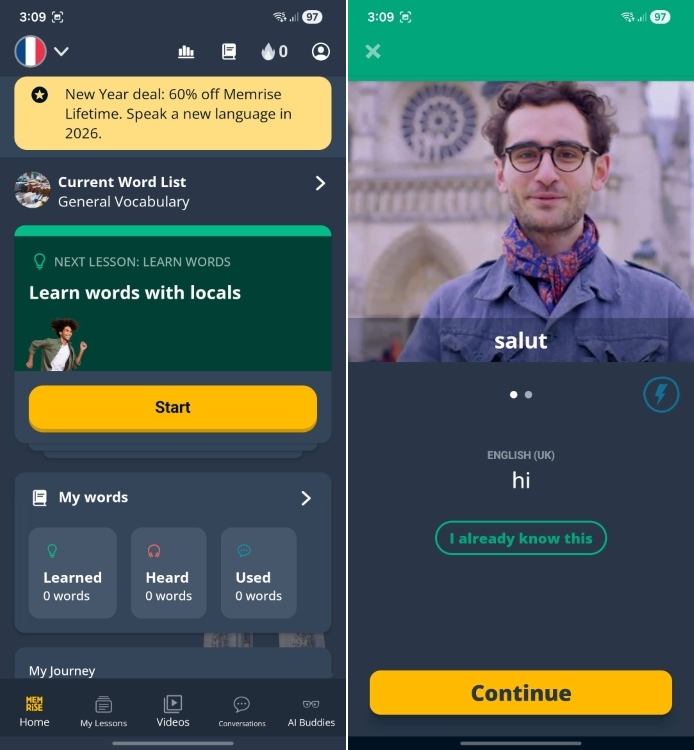
And when you are just about to forget a word, Memrise surfaces it naturally through a repetition system. This way, you not only learn the words, but also how to pronounce them in real conversations. You naturally start organizing your vocabulary through practical scenarios like ordering food or navigating airports. And yes, there is an AI-powered MemBot chatbot to practice new words.
| Pros | Cons |
|---|---|
| Huge library of native speaker videos | Limited grammar instructions |
| Space repetition system (SRS) | |
| MemBot AI for conversations |
Pricing: Free, $25 per month
Drops
Drops is a beautiful language learning app designed to enhance your vocabulary. The moment I installed the app, I found that its learning approach is entirely visual. You learn a different language through images and illustrations. This way, you create a mental connection between words and visuals and it helps you remember those words. You also start thinking directly in the foreign language instead of translating your thoughts to another language.
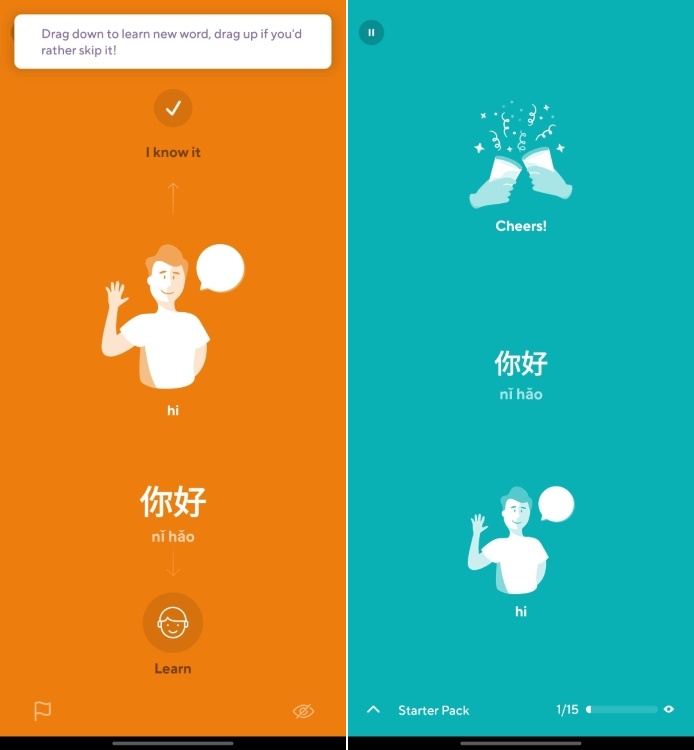
Drops doesn’t teach you grammar, but through visual interactions, you grasp how the language works and expand your vocabulary as well. It has more than 180 topics for vocabulary expansion. And for free users, Drops offers a 5-minute daily session, but I would suggest getting the paid plan to take advantage of all features.
Pros Cons Beautifully designed app Focused on vocabulary mostly Visual learning through images Quick 5-minute options
Pricing: $11 per month
Best Language Learning Apps for Fluency
To improve fluency, I would highly recommend Rosetta Stone as it offers an immersive learning experience. You can also try Mondly and Busuu, which are highly rated on app stores for language learning.
Rosetta Stone
Rosetta Stone is one of the oldest apps for language learning and it now offers an immersive learning experience to improve fluency. After I installed the app on my phone, it took me through a method called Dynamic Immersion that directly took me to the target language. It basically forces your brain to make connections through images, context, and intuition. Believe me, it will feel very challenging in the beginning, but you will start comprehending words in no time.

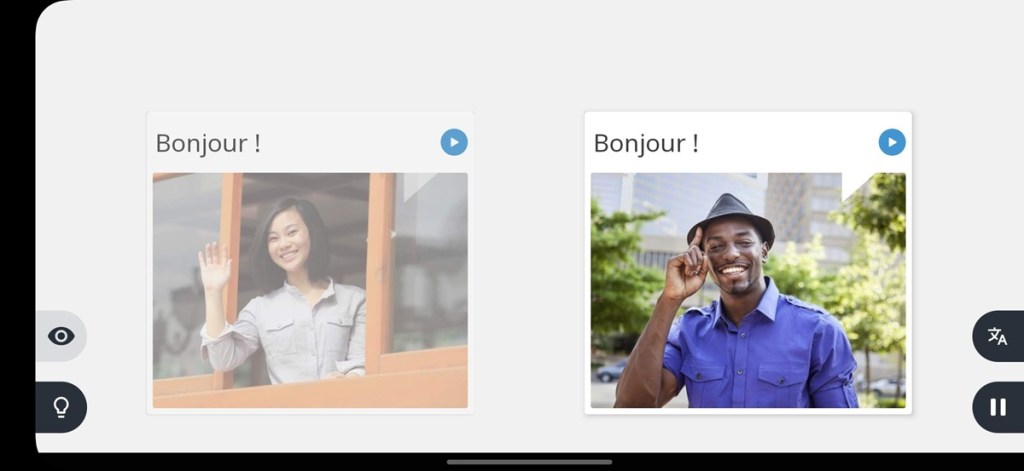
I also want to particularly mention its TruAccent speech recognition technology which catches your pronunciation errors with high precision. You might be making subtle mistakes while speaking, but it will still catch them. Moreover, if you want traditional resources to learn languages, you can access phrasebooks, stories, and audio companions.
Pros Cons Dynamic Immersion for true learning experience More expensive than competitors TruAccent technology for precise pronunciation Live tutoring with native speakers
Pricing: $14.95 per month
Mondly
Mondly ranks among the best language learning apps for fluency as it uses game-like elements to motivate you in the long run. Similar to Duolingo, Mondly offers weekly quizzes, monthly challenges, and interactive dashboard to create a progress system that you can keep track of. It entices you to improve your fluency game.
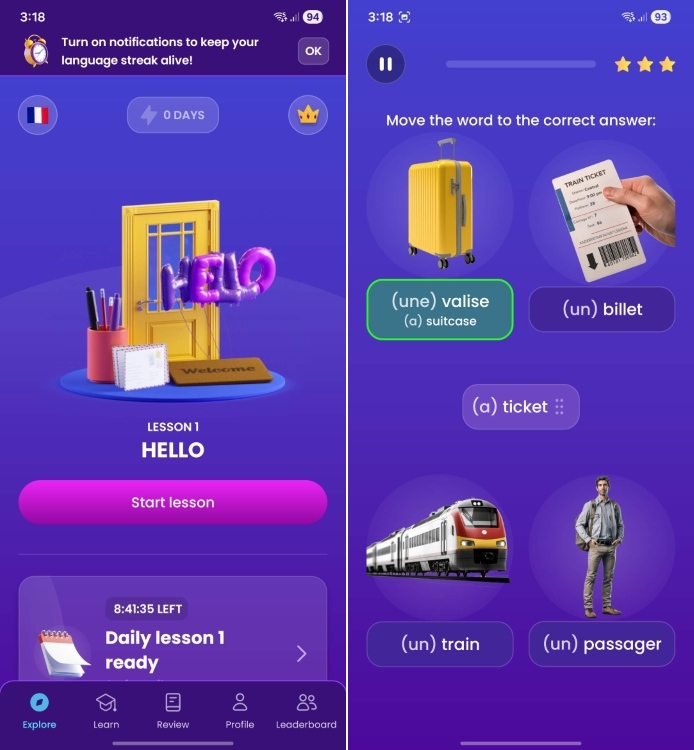
While I used the free version of the app, the paid version unlocks access to 41 languages with a single subscription. And you can also converse with the AI chatbot to practice lessons. Mondly also offers an AR/VR feature that creates an immersive learning environment. You can tap on words to learn parts of speech, and tense through virtual interaction.
| Pros | Cons |
|---|---|
| All languages under one subscription | AI conversation feels scripted |
| AR/VR features | |
| Maintains engagement with the learner |
Pricing: Free, $14.90 per month
Busuu
Busuu is the final app that I picked after testing a dozen of language learning apps. It’s built on the CEFR (Common European Framework of Reference for Languages) standard and has courses from A1 beginner level to C1 advanced level. For learning and speaking European languages, Busuu is an excellent app. It comes with a dashboard where you can track your progress and watch native speaker videos to learn vocabulary and accent.
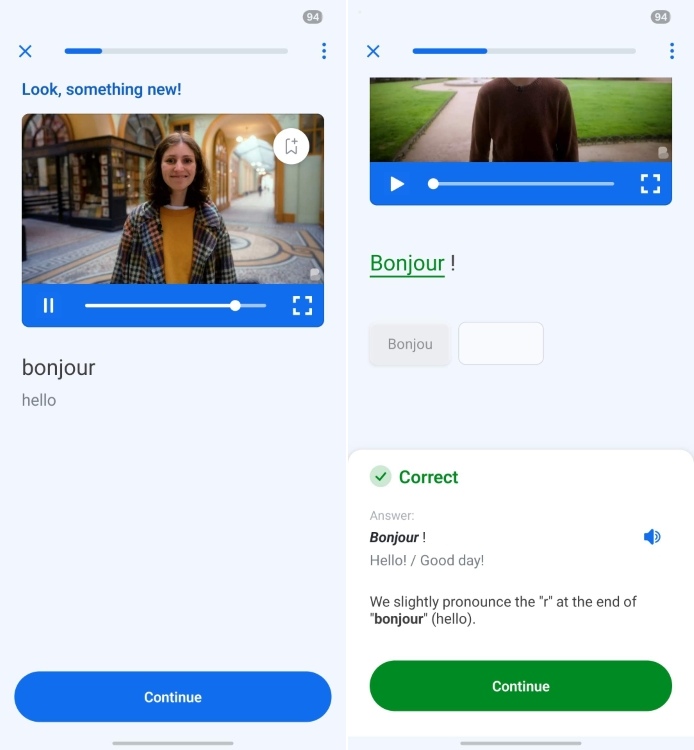
What is interesting about Busuu is that it asks you to submit written and spoken exercises, which are checked by native speakers. Through this human feedback, you get important instructions on how to improve your language, which is more valuable than automated AI-powered systems. To sum up, if you are looking for certificate-worthy language learning courses, you can check out Busuu.
Pros Cons Built on CEFT standard Only 14 languages covered Native speaker feedback Large community of users
Pricing: Free with ads, $12.99 per month
How to Choose the Best Language Learning App
You should choose a language learning app based on what goal you want to achieve. For instance, I have selected language learning apps for vocabulary building, fluency, speaking, free features, and more. You should choose a suitable app that fits your need. Next, you should identify your language proficiency level before choosing an app, whether you want a beginner-friendly app or for advanced learning.
Moreover, there are now audio-focused apps like Pimsleur to improve speaking while visual learners should prefer something like Drops or Memrise. In addition, consider how much time you can commit to an app. Some apps have bite-sized lessons for busy individuals while some apps require at least a 30-minute commitment.
So these are the eight best apps for language learning, available on Android and iOS. If you are a beginner, I would highly recommend Duolingo, followed by Babbel and Memrise. With some determination, you can learn a foreign language in no time. In case I have missed out on something, please let me know in the comments below.
After testing a dozen of apps, I have found that Duolingo is the best app for language learning. You can also check out Babbel and Memrise.
I have found that Duolingo is great for beginners and intermediate level users while Babbel is for those who are looking for grammar depth and structed lessons with conversation practice.
Duolingo is cheaper than Babbel. The former costs $12.99 per month whereas Babbel costs $17.95 on a monthly plan.