Most Android users have never changed their default web browser, but there are some great options that offer better performance, privacy controls, and features. In fact, some browsers load webpages much faster than Chrome while consuming less memory. So, in this article, we have tested and ranked the 10 best Android browsers across various categories. You will find some excellent AI browsers too on this list. On that note, let’s check out the list.
Overview of Best Android Browsers
Google Chrome remains the top Android browser, followed by Brave browser which offers privacy protections, great performance, and native blocking of ads and trackers. Mozilla Firefox is a great choice if you want to install desktop extensions on Android.
| Android Browsers | Speed | AI Features | Privacy Score |
|---|---|---|---|
| Google Chrome | Fast | Gemini AI | 3/10 |
| Brave Browser | Fast | Leo AI | 8/10 |
| Mozilla Firefox | Moderate | None | 7/10 |
| Microsoft Edge | Fast | Copilot AI | 4/10 |
| Vivaldi | Moderate | None | 6/10 |
| Firefox Focus | Very fast | None | 9/10 |
| DuckDuckGo Browser | Fast | Duck.ai | 9/10 |
| Tor Browser | Slow | None | 10/10 |
| Opera Mini | Very fast | Aria AI | 5/10 |
| Samsung Internet | Fast | Galaxy AI | 6/10 |
How We Tested the Best Android Browsers?
To evaluate and find the best browsers for Android, we installed each browser on the Google Pixel 10 and Samsung Galaxy S23. We tested all the browsers on Android 16 and ran Speedometer 3.0 and JetStream 2 to measure web performance across various tasks. Besides benchmarks, we checked how fast browsers loaded web pages when connected to the same Wi-Fi network.
In addition, we also measured energy consumption, CPU utilization, and RAM usage across all the web browsers. Finally, we ensured that all browsers must support modern security and privacy standards. Web browsers must enforce HTTPS, block cross-site trackers, and prevent fingerprinting methods.
Chrome vs Brave vs Firefox: Android Browser Comparison
We compared Chrome, Brave, and Firefox on Android across various benchmarks and real-world tests to see how well they perform on web-browsing tests. You can take a look at the below to understand the difference between all three browsers.
| Category | Chrome | Brave | Firefox |
|---|---|---|---|
| Speedometer 3.0 | Highest | Close second | Moderate |
| JetStream | Highest | Competitive | Low |
| Real-World Page Speed | Fast | Fastest | Moderate |
| Battery Usage | Higher | Most efficient | Similar to Chrome |
| RAM Usage | High | Low | Medium |
| Ad-blocking | No | Yes | Yes |
| Extension Support | No | No | Yes |
| Website Compatibility | Best | Great | Good |
Top Android Browsers in 2026
Google Chrome is simply the best Android browser as it offers amazing cross-syncing features across devices. Apart from that, Brave is a compelling browser on Android with great performance and privacy features. You can also take a look at Mozilla Firefox if you want to install desktop extensions on your Android phone.
Google Chrome — Best Overall Browser
When it comes to web browsers, not just Android browsers, Google Chrome is the undisputed king. In terms of mobile browsers, Chrome leads by a whopping 67% market share, and for good reasons. Chrome is deeply integrated into the Android ecosystem, having seamless Google account syncing, and performance that is nearly unmatched.
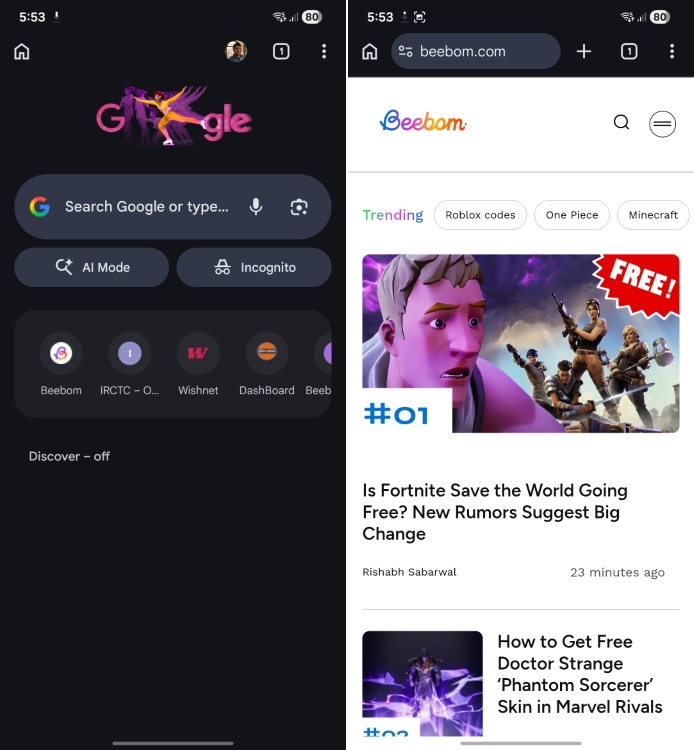
Chrome is optimized for a range of Android devices, including low-end to high-end phones. That said, Chrome is criticized for being a memory hog, and for its data collection practices. Despite all that, users prefer Chrome as it’s easy to use, compatible with nearly all websites, and offers continuous security updates, protecting the user from various online attacks.
| Pros | Cons |
|---|---|
| Best website compatibility, great performance | High RAM usage |
| Enhanced security | Heavy data collection |
| Best Google ecosystem sync |
Pricing: Free
Brave Browser — Best for Privacy & Ad-Blocking
Brave is one of the best Android browsers and a potential alternative to Chrome if you deeply care about privacy. It’s built on Chromium and offers the same site compatibility as Chrome, but with native ad blocking, and tracking prevention. It also disables all kinds of fingerprinting techniques on websites, by default. The browser has something called Brave Shields which blocks all kinds of trackers and ads, resulting in faster performance.
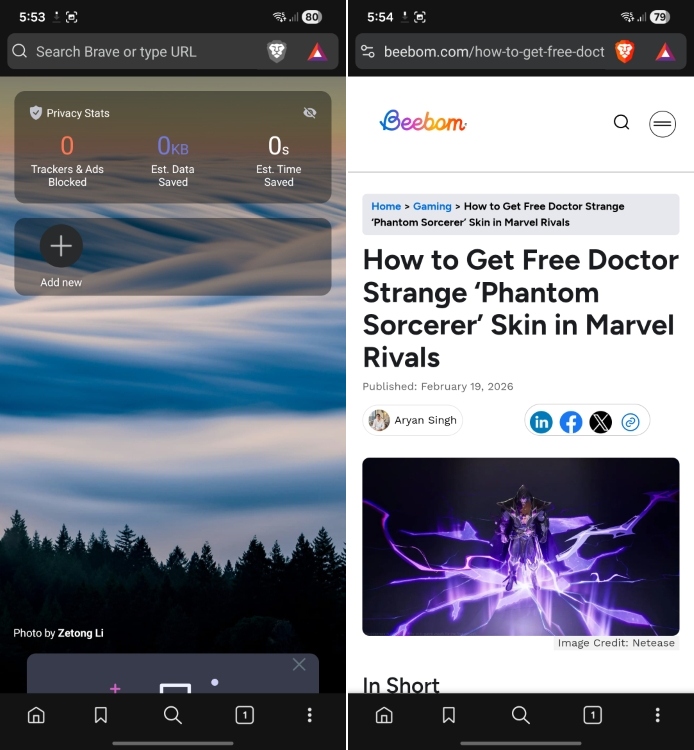
It also has a Brave Rewards program, which allows users to earn BAT tokens for viewing opt-in ads. Some users don’t like it, but it’s a unique feature. And for those who want extra security, it supports IPFS and Tor tabs natively, so that is great. Overall, if you want better privacy and faster performance on Android, Brave is a great browser to pick.
| Pros | Cons |
|---|---|
| Built-in tracker and ad blocking | Crypto/BAT features look cluttered |
| Leo AI assistant | |
| Native Tor window support, faster load times |
Pricing: Free
Mozilla Firefox — Best for Desktop-Class Extensions
Mozilla Firefox has gone through a lot of changes in recent years, but it’s still one of the best Android browsers in the market. It’s one of the few mobile browsers that allow you to install Firefox extensions on Android devices. It means you can install many web extensions and improve your experience on Android, whatever way you like.
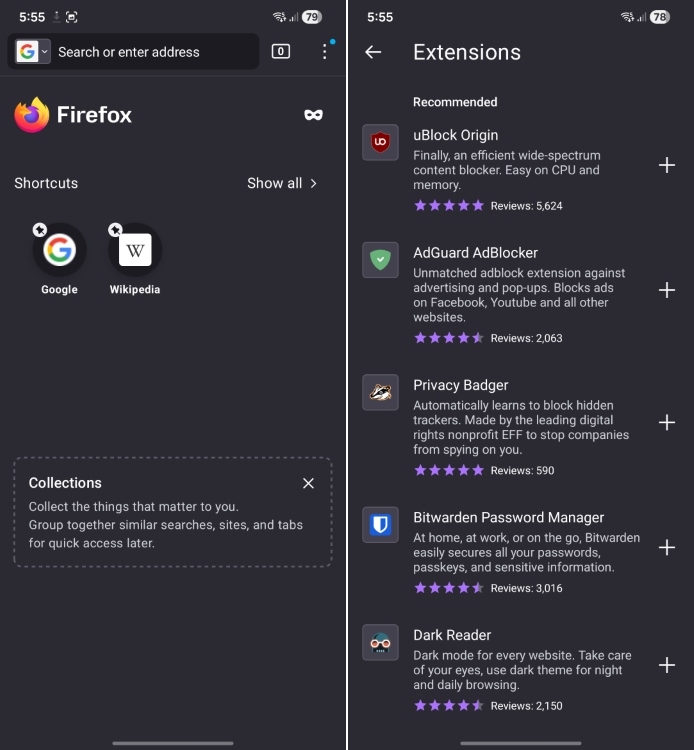
Unlike other Chromium-based browsers, Firefox uses its own GeckoView rendering engine. I wouldn’t say it’s faster than Chromium, but Firefox has held its own throughout many years. On top of that, Firefox comes with Enhanced Tracking Prevention which blocks trackers, cross-site cookies, and cryptominers out of the box. If you are looking for a non-Chromium Android browser, take a look at Firefox.
| Pros | Cons |
|---|---|
| Full extension support on Android | Slower performance engine than Chrome |
| Powered by Gecko engine | |
| Strong built-in privacy protection |
Pricing: Free
Microsoft Edge — Best for AI Features (Copilot)
Microsoft Edge has become one of the best AI browsers on Android with deep Copilot integration. While Microsoft is being aggressive in packing a lot of AI features, some of them are useful. It’s also based on Chromium so in terms of website compatibility, you are sorted. In addition, Edge uses lower memory than Chrome, which is great.
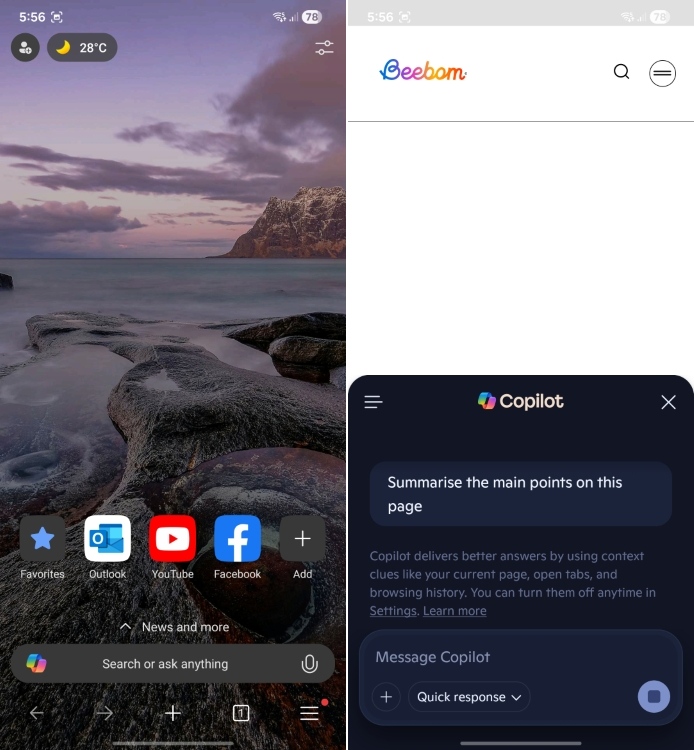
As for AI features, Edge can summarize web pages, generate content, and answer questions on any webpage without leaving the context. You can even club multiple webpages and ask questions across various tabs. And if you use Edge on Windows or macOS, the syncing feature is great as it comes with its own password manager, bookmarks, browsing history, etc. Finally, you can now install web extensions on Edge for Android.
| Pros | Cons |
|---|---|
| Deep AI integration with Copilot | Feels bloated with features |
| Summarize web pages, chat with PDFs and across tabs | |
| Extension support on Android |
Pricing: Free
Vivaldi — Best for Power Users & Customization
Vivaldi is a niche browser on Android, but it has amassed a loyal userbase, thanks to the endless customization options it offers. It has been developed by former Opera engineers, and the main point of Vivaldi is to let user tweak every aspect of the browsing experience. You can change the position of the address bar, add per-site settings, configure tap strip, and more.
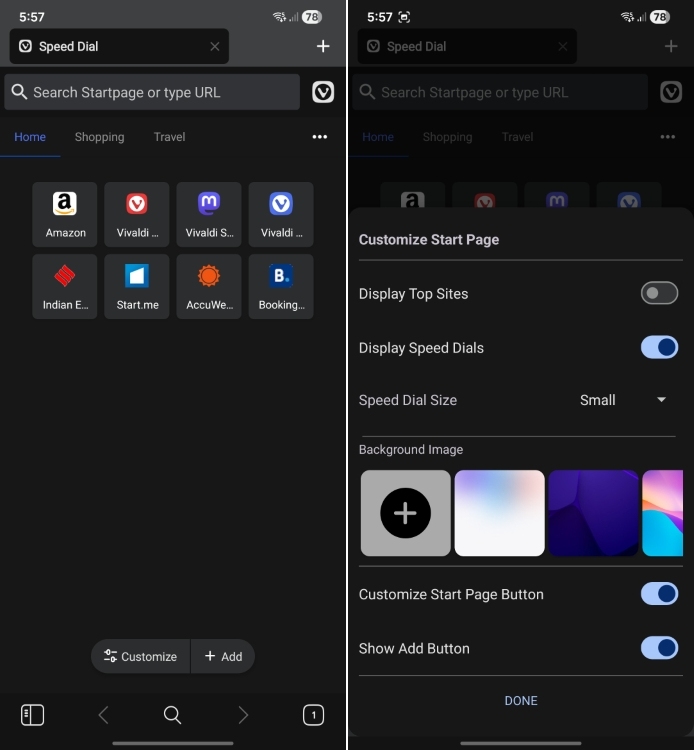
There is even a built-in note taking feature, a reading list, calendar features, Vivaldi Mail, and Feed Reader integration. Next, if you use a foldable or large Android device, Vivaldi’s two-level tab stacking system is powerful and you can do a lot more on the larger screen. Finally, Vivaldi claims that it doesn’t sell user data and offers ad-blocking controls as well.
| Pros | Cons |
|---|---|
| Most customizable browser on Android | Resource heavy on older devices |
| Built-in notes, reading list, mail, and RSS reader | |
| Excellent for Android foldables and large screens |
Pricing: Free
Best Android Browsers for Privacy-Conscious Users
If you care about your privacy, I would highly recommend Firefox Focus as it treats every session private. Other than that, you can consider the DuckDuckGo browser which offers a seamless private browsing experience on Android.
Firefox Focus
Unlike the full-fledged Mozilla Firefox, Firefox Focus is a lightweight web browser for Android that is designed for privacy-conscious users. It’s built with a single principle that the browser leaves nothing behind. It’s like the incognito window is the default on Firefox Focus. Every session is treated private by default and there are no tabs, history, bookmarks, or cookies.
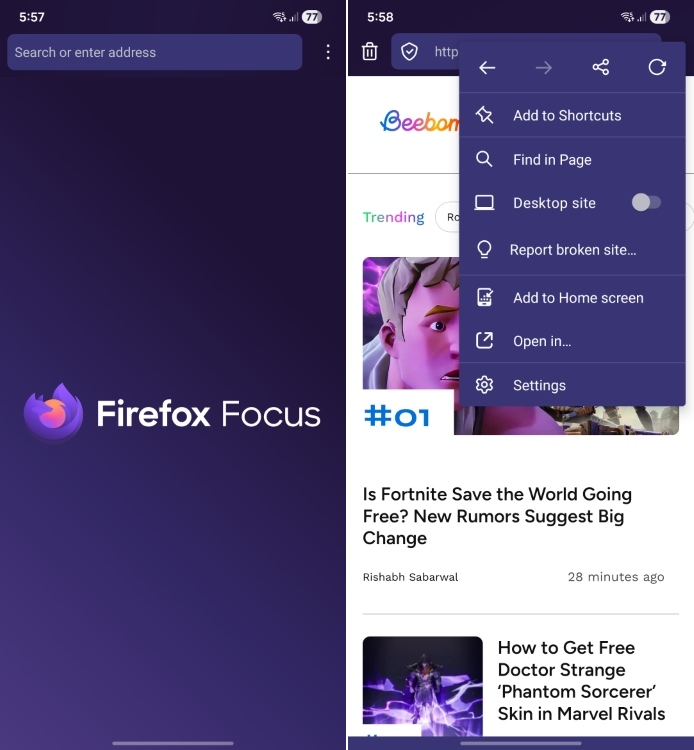
It also automatically blocks trackers, ads, analytics, social media trackers, and even web fonts which are used for fingerprinting. It results in a browser that is very fast and private. Having said that, it’s not for everyday use as it won’t save your login sessions and you will have sign in every single time. So if you want a simple privacy-focused browser for Android, pick Firefox Focus.
| Pros | Cons |
|---|---|
| Private browsing by default, one-tap erase button | Not for everyday use |
| Extremely fast loading | |
| Light on resources |
Pricing: Free
DuckDuckGo Browser
DuckDuckGo is popular for its privacy-focused search engine, but its web browser on Android is also quite good. It takes away the complexity of private browsing and simply offers a browser that is private by default, without having to tweak each setting. With over 50 million installs, DuckDuckGo browser has become the most downloaded privacy-focused app on Android.
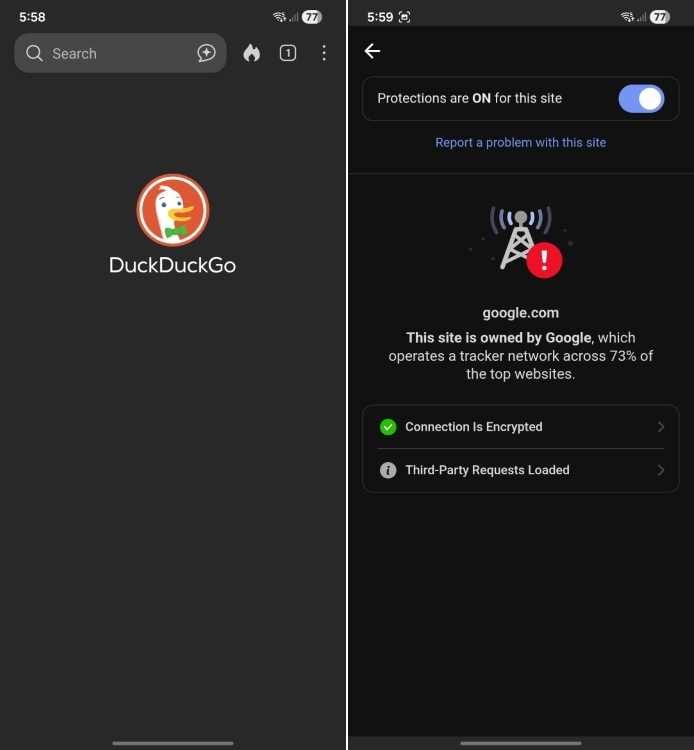
It blocks trackers, enforces HTTPS everywhere, and strictly applies global privacy control (GPC) signals by default. Basically, every website is told to not sell your data. And just like Firefox Focus, there is a Fire button that erases all your tabs and browsing data. The best part about this web browser is that its email protection service removes hidden trackers from email links before you click them.
| Pros | Cons |
|---|---|
| Private web browsing without any complexity | DuckDuckGo search engine less reliable than Google |
| Email protection removes tracker links | |
| Fire button to instantly erase data |
Pricing: Free
Tor Browser
Tor browser is not for everyone, but if you want maximum privacy safeguards on Android, you should definitely use it. It has been developed by the Tor Project which is a US-based non-profit. It’s built on Firefox’s backend and hardened with NoScript. The browser routes traffic through at least three independent relays to make IP-based identification impossible.
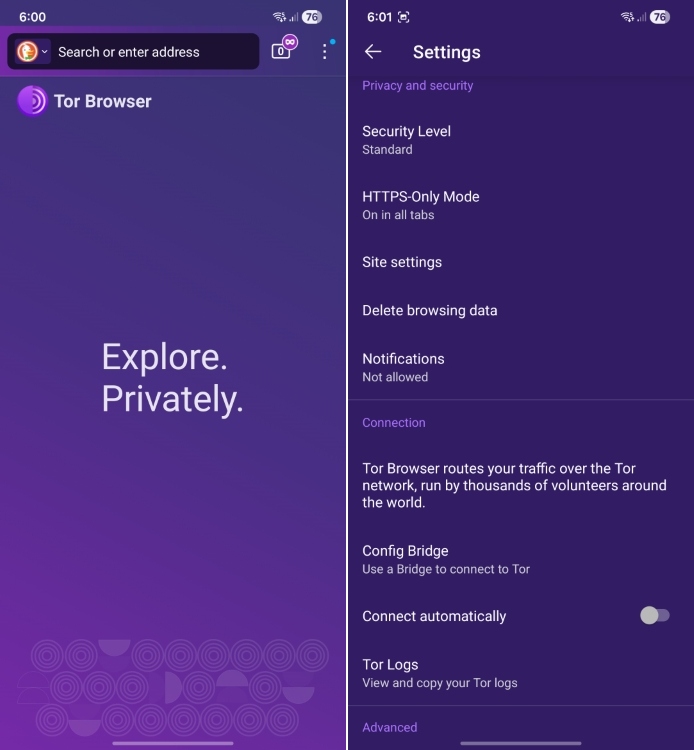
It also disables JavaScript on untrusted websites, block WebRTC leaks, canvas fingerprinting, and other advanced tracking vectors. Journalists, activists, and privacy researchers use the Tor browser in high-risk environments. That said, its performance is slow since it routes the traffic through multiple layers. In addition, many websites block Tor exit nodes so keep in mind.
| Pros | Cons |
|---|---|
| Top-class IP anonymity via Tor network | Slower than other web browsers |
| Hardened against fingerprinting and tracking | |
| Free and open-source |
Pricing: Free
Fastest Android Browsers for Low-End Devices
Opera Mini is the top choice for low-end Android phones as it compresses the webpage to save data and reduce hardware usage. You can also try Samsung Internet if you use a mid-range Samsung phone.
Opera Mini
For low-end Android devices, Opera Mini is a great browser as it uses less data and hardware resources to load webpages. It has a core technology that compresses webpages by up to 90% through Opera’s proxy servers. After that, the compressed webpage is delivered to your device. In fact, Opera Mini can load webpages even on 2G and 3G networks.
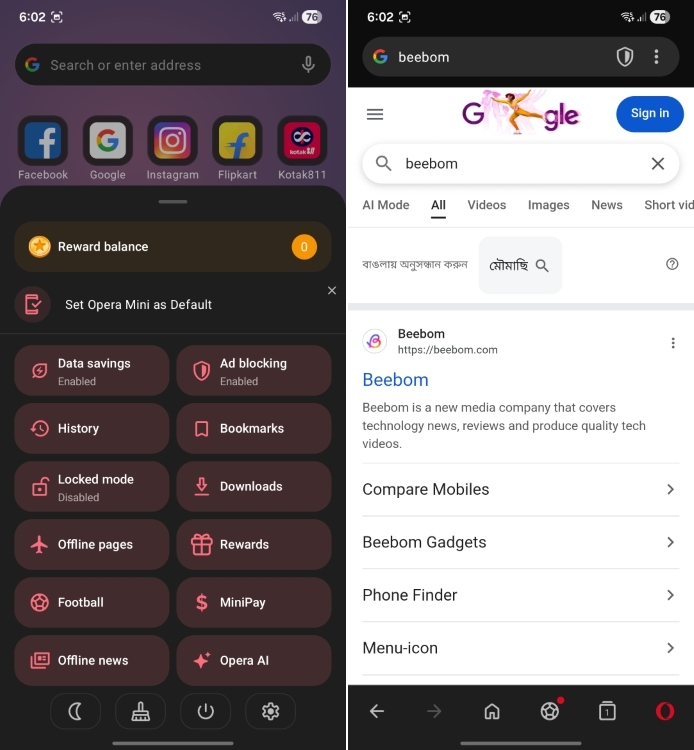
And despite being a lightweight browser, Opera Mini brings a built-in ad blocker, offline page saving feature, night mode, a native video player, and a data savings dashboard. What is interesting is that Opera Mini also gets access to Aria AI assistant, even on low-spec hardware.
| Pros | Cons |
|---|---|
| Compresses webpages by 90% | Traffic routed through Opera proxy servers |
| Best browser for low-end Android devices | |
| Works well on 512MB RAM |
Pricing: Free
Samsung Internet
If you use a mid-range Android phone from Samsung’s A and M-series lineup, I would suggest using the Samsung Internet browser. It’s highly optimized for phones running One UI and uses much less resources, thanks to hardware-level optimization. Samsung says that its browsers offers smoother scrolling, faster page rendering and lower background memory usage compared to Chrome, on the same hardware.
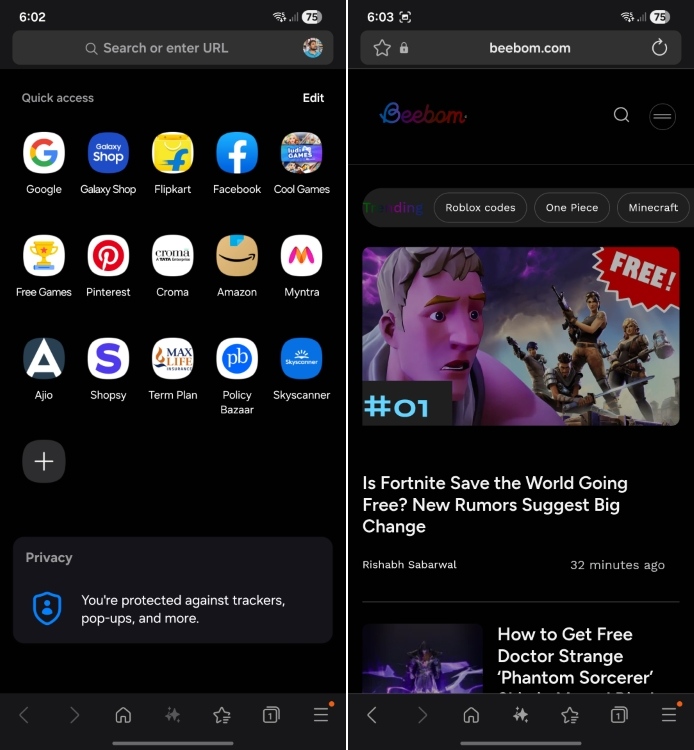
Apart from that, Samsung Internet also offers several features including a Secret mode with biometric lock, dark mode support, ad blocker, DeX mode, and Samsung Pass support. To sum up, if you use a budget Samsung device, it’s best to use the preinstalled Samsung Internet than go for a third-party browser.
| Pros | Cons |
|---|---|
| Best for Samsung A and M-series devices | Slow updates |
| Uses less CPU resources and RAM | |
| Dark mode support |
Pricing: Free
How to Choose the Right Android Browser for You?
For most users, I generally recommend Google Chrome as it’s easy to use, performs really well, and offers great security protections. However, if you want the same performance and compatibility with better privacy safeguards, I would recommend switching to Brave. And if you want to move away from Chromium browsers altogether, simply pick Mozilla Firefox. It also offers desktop-class extensions.
And for privacy-conscious users, both Firefox Focus and DuckDuckGo Browser are great. I would recommend the Tor browser to someone who wants foolproof anonymity on the web. Finally, Opera Mini is a solid choice if you have a low-end Android device and want to save data.
Mozilla Firefox lets you install desktop extensions on Android without any issues. You can also use Microsoft Edge on Android to install web extensions.
If you are looking for an Android browser with a free VPN, then I would highly recommend the Opera browser. It offers generous limits and fast performance.
You can check out Brave or use Mozilla Firefox with uBlock Origin extension to disable ads on Android.