
The New York Times has a wide collection of daily games. Whether you enjoy word puzzles, logic games, or number challenges, there’s something for everyone. Two popular games from this collection are Pips and Connections. While both are very different in terms of gameplay and mechanics, both have found their niche audiences. So, if you’re wondering which one you should play, let’s take a close look at how NYT Pips and Connections compare.
Pips vs Connections in a Nutshell
Apart from being a part of the NYT Games collection, NYT Pips and Connections don’t have much in common. Pips is a logic puzzle category where you need to place dominoes in the correct positions while satisfying different conditions on the grid. Connections, on the other hand, is a word puzzle where you need to group words based on their common connections.
NYT Pips comes with a minimalistic, crossword-esque design, whereas Connections features 16 words arranged in a rectangular grid. With that said, here is a quick comparison of NYT Pips and Connections:
| Feature | Pips | Connections |
|---|---|---|
| Objective | Place dominoes in the correct positions | Form groups of four words using 16 given words based on their connection |
| Attempts | Unlimited | Four mistakes allowed |
| Game Modes | Daily (Easy, Medium, and Hard modes) | Daily (No difficulty modes) |
| Feedback System | Red dots indicate unsatisfied conditions | Difficulty-based color coding and One Away message |
| Paid or Free | Free (Unlimited is paid) | Free (Unlimited is paid) |
| Puzzle Archive | Yes, requires a NYT subscription | Yes, requires a NYT subscription |
Pips vs Connections Compared
Now that you have a basic idea of both games, let’s look at how they differ in terms of their objectives, gameplay mechanics, difficulty, and time investment.
Objective
| Feature | Pips | Connections |
|---|---|---|
| Goal | Complete the puzzle by placing the dominoes in the correct places | Form four sets of four words from the 16 given words |
| Starting Info | An empty grid with different conditions and a set of dominoes | All 16 words are revealed at the beginning |
| Core Skill | Deduction, pattern recognition, and logical intuition | Word association and pattern recognition |
After Sudoku, Pips is another logic puzzle available in the NYT games. This is their first original logic puzzle, so it might seem a bit trickier at first. The goal of Pips is to fill the empty spaces with correct dominoes while satisfying the conditions displayed on the grid. You will also need to get familiar with the NYT Pips rules and symbols to get good at solving the game.
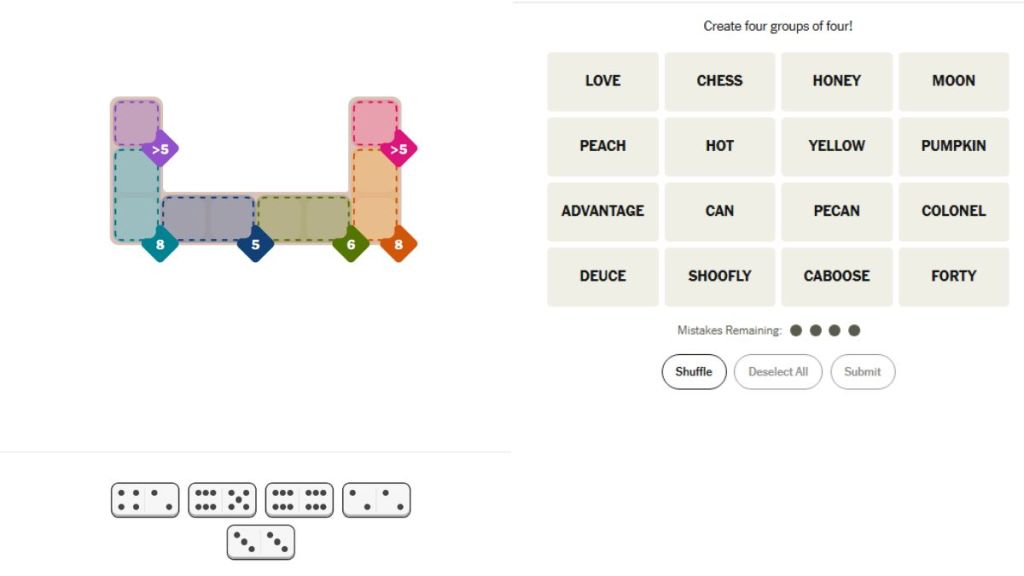
In contrast, Connections presents you with a 4×4 grid consisting of 16 words. The goal here is to group all sixteen words into four sets of four that share a common connection. As you begin forming the right groups, the difficulty color of each group gets revealed. Additionally, finding the remaining groups becomes easier as the word pool gets smaller.
Game Mechanics
| Feature | Pips | Connections |
|---|---|---|
| Feedback Type | Symbols and conditions are color-coded | Difficulty of the category is color-coded |
| Visual Cues | Red dots indicate unsatisfied conditions | ‘One Away’ message appears when three out of four selected words are correct |
| Grid Structure | Jumbled grid layout | Fixed 4×4 grid of 16 words |
| Input Method | Drag the dominoes to empty spaces | Select four words and submit |
| Clue Focus | Numerical conditions on the grid | Word-level thematic grouping |
No hints are provided when you begin a game of Pips. Instead, once you have placed all the dominoes in the empty spaces on the board, you can see red dots indicating the conditions that haven’t been satisfied. In this way, you can identify which parts of the puzzle still need attention and rearrange the dominoes accordingly. If you’re a beginner and want more strategies to solve this puzzle, check out our Pips beginner’s guide.
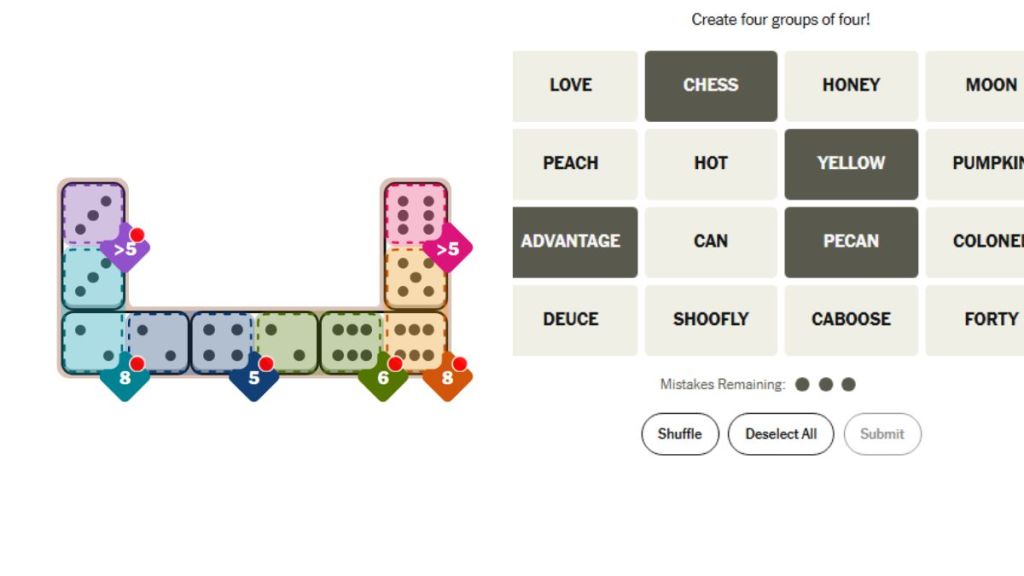
Similar to Pips, Connections doesn’t offer any hints at the beginning. However, it displays the ‘One Away’ message when you have successfully selected three words that share a common theme. Other than that, the difficulty of the category is revealed once you have formed the respective group. The purple category is the hardest category to crack in Connections.
Error Tolerance
| Feature | Pips | Connections |
|---|---|---|
| Max Attempts | Unlimited | Four mistakes allowed |
| Penalty for Wrong Guess | None | Lose one of four chances |
| Game Over Condition | None | Four incorrect submissions |
| Pressure Level | Low, as you have unlimited guesses | High, as every submission counts |
You can freely attempt to solve Pips as there is no limit on the number of guesses. There is no game-over condition either, so you can try to crack today’s Pips answer at your own pace. However, since there are no hints, you may feel a bit of pressure at the start. Nonetheless, you can take your time to solve the puzzle.
It is essential to avoid any common mistakes in NYT Connections, as you have to group the words within four attempts, or it’s game over. The only feedback you get while playing Connections is the ‘One Away’ message, which appears when you manage to select three words that share a connection.
Difficulty
| Feature | Pips | Connections |
|---|---|---|
| Daily Variation | Moderate, with three difficulty levels available | Moderate to high, depending on the category themes |
| Learning Curve | Medium, as you need to learn the rules and symbols to satisfy the conditions in each game | Easy to understand |
| Hardest Element | Empty spaces and less-than conditions | Indirect connections and wordplay |
| Skill Tested | Deduction, pattern recognition, and logical intuition | Word association and pattern recognition |
Despite its simplistic appearance, Pips is a moderately difficult NYT game. There are three different difficulty modes you can select from. Since there are no hints and it takes time to learn the rules and conditions, it can offer a challenging experience for beginners. If you are struggling to learn Pips, check out our guide on how to play Pips.
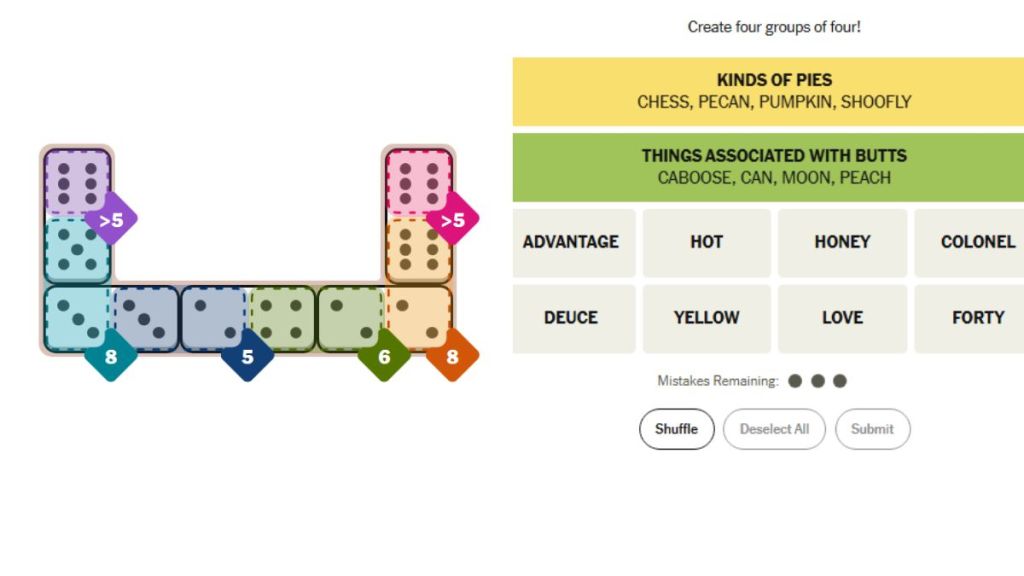
Similarly, Connections tests your pattern recognition and word association skills. There are no difficulty modes in Connections. Instead, each category has a specific difficulty level, with purple being the hardest. You can also check out our guide on how to learn Connections to understand its core mechanics.
Time Investment
| Feature | Wordle | Connections |
|---|---|---|
| Avg. Solve Time | Depends on the difficulty mode | Depends on the difficulty of the given words |
| Natural Time Cap | None | Four mistakes end the game |
Both NYT Pips and Connections take an average of at least 5 minutes to solve. Since neither of these games comes with a timer, it’s up to the player to solve the puzzles quickly or take their time. However, there’s one important difference: you only have four attempts to solve Connections, while Pips lets you keep trying until you find the correct arrangement.
Since both these games can be solved in minutes, you can add any of them to your daily routine. And if you are getting quick at solving one, you can pick up the other game as well as part of your mental workout.
NYT Pips vs Connections: Which Game Should You Play?
NYT Pips and Connections are polar opposites in terms of game design, but both are worthy games that can earn a place in your daily routine. Since solving either doesn’t take up much time, you can even play both of these games daily.
However, if you want to add only one game to your daily schedule, you should pick the one that suits your taste. If you want to hone your logical intuition and deduction skills, then go with the NYT Pips.
On the other hand, if you want to expand your vocabulary and improve your pattern recognition skills, then NYT Connections must be your pick. But always remember that Connections offers only four attempts for a daily puzzle. If you like playing Connections, then you need to check out Sports Connections. You can also learn the difference between Connections and Sports Connections here.
Yes, you can play NYT Pips and Connections for free on the NYT games platform. However, you need a subscription to access their puzzle archive.
While Connections only allows four max attempts, there is no limit on the number of attempts in NYT Pips.
It depends on your problem-solving skills. Pips requires logical thinking and understanding of numerical conditions. Connections, on the other hand, tests your vocabulary and ability to spot hidden word associations.
When Does NYT Pips Puzzle Reset?
 Daksha Gupta

NYT Pips Archive: How to Play Old Games?
 Arnamoy Das

NYT Pips Strategies for Every Difficulty Level
 Pranav Maytray

 Bipradeep Biswas
4 Common Mistakes to Avoid in NYT Pips
 Sanmay Chakrabarti
Top 7 NYT Mini Crossword Tips and Tricks to Keep Your Streak
Bipradeep Biswas
NYT Connections Hints and Answers Today - November 20, 2026 (#1258)
Sanmay Chakrabarti

Wordle Hints and Answer Today - November 20, 2026 (#1980)
 Rishabh Sabarwal
NYT Mini Crossword vs Crossword – Key Differences Explained
Sanmay Chakrabarti
LinkedIn Launches Sumbreak, a New Daily Math Logic Puzzle
Daksha Gupta