
The NYT Pips is a well-known daily logic puzzle from The New York Times and one of the newest additions to the NYT Games lineup. It requires you to drag and place dominoes into a color-coded grid full of mathematical conditions, such as the sum of numbers, greater than/less than a number, and more. It tests your pattern recognition and logical reasoning skills, but not everyone knows how to play the NYT Pips game. So, keep reading to check out the NYT Pips game rules, simple tips and tricks, and common mistakes to avoid.
How to Play NYT Pips on the NYT Website
Pips is a fresh alternative to word games like Wordle, Connections, and Strands. Here are the steps to follow when playing the NY Times Pips game on the official website:
- Visit the Pips website: Open the official Pips page on the NYT Games website.
- Select difficulty: Choose between Easy, Medium, and Hard difficulty on the dashboard.
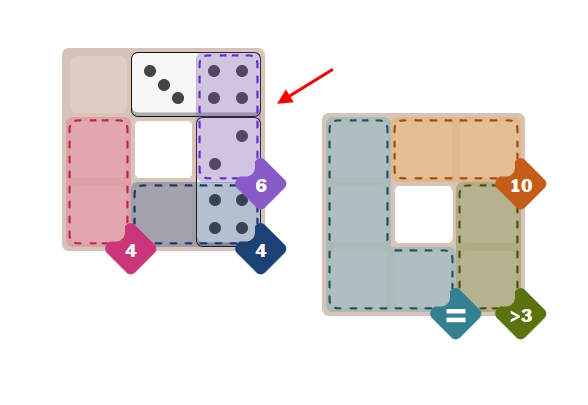
- Read the Pips game grid: You will now see colored regions with mathematical conditions on the puzzle grid. Study the grid before you proceed further. For example, in the image below, the pips in the purple region should add up to 6.
- Go over the dominoes: Next, study all the available dominoes at the bottom of the grid. Each domino carries pips (dots).
- Plan and start placing tiles: After scanning the grid and dominoes, make possible combinations to satisfy the game conditions. Select dominoes carefully and click and drag them to place them on the grid.
- The puzzle is solved when all dominoes are placed correctly in the NYT Pips game grid.
If you want more practice beyond the one daily puzzle, you can also try NYT Pips Unlimited for free to sharpen your skills without waiting for the next reset. And if you’re stuck on today’s grid, check out today’s NYT Pips answers for hints or the full solution.
NYT Pips Game Rules
Understanding the NYT Pips game rules is essential to master the puzzle. These rules make the game logical, mentally challenging, and fair for all players. While learning how to play NYT Pips, you must also know the core rules:
- You can use each Pips domino tile only once.
- You have an unlimited number of moves.
- You are timed, but there is no time limit to complete NYT Pips.
- The game ends when you place all dominoes correctly in the grid.
- NYT Pips has three difficulty levels: Easy, Medium, and Hard. With each increasing level, you need to place more tiles on the board.
- Only one official Pips puzzle per difficulty level is available per day.
- The NYT Pips grid can include the following conditions:
| Condition | Meaning |
|---|---|
| = (Equal) | The pips (dots) on the dominoes in this region should be the same number. |
| ≠ (Not Equal) | The pips on the dominoes in this region are not equal. |
| > (Greater than) | The total of the domino dots in the region should be greater than the number next to this symbol. |
| < (Less Than) | The total of the domino dots in the region should be less than the number next to this symbol. |
| A Number | The domino numbers in the region must add up to the specific number in this condition. |
| Empty/ Blank | The empty or blank region has no conditions and can contain any valid domino. |
For a deeper look at every symbol and what each one means on the grid, check out our dedicated NYT Pips rules and symbols guide.
Beginner Tips to Master the NYT Pips Game
The NYT Pips game is all about logical reasoning and number awareness. Your success depends on recognizing patterns and avoiding common mistakes. If you are new, we also recommend reading our NYT Pips beginner’s guide for a more in-depth walkthrough. Here are the key tips to play NYT Pips more effectively:
- Start with the larger Pip values: Pick the high Pip value tiles first, then arrange the remaining ones to reduce guesswork.
- Split the condition number across tiles: Divide the target number into smaller numbers. For example, a sum of 12 can be solved as 6 + 6, or 5 + 5 + 2, or 4 + 4 + 4.
- Plan two moves ahead: Avoid focusing only on the current move. Consider how your selection affects the remaining conditions on the grid.
- Breaks are good: If you are stuck, step away from the puzzle for a bit. A fresh mind can help you spot better combinations.
Common Mistakes to Avoid in the NYT Pips Game
Here are the most common mistakes players make in NYT Pips that you should actively avoid:
- Clicking dominoes too quickly without studying the grid first
- Ignoring high-value tiles early in the solve
- Not tracking the regional conditions actively as you place tiles
- Overthinking simple combinations when the answer is straightforward
We hope this guide helped you understand how to play NYT Pips, along with the game’s rules, tips and tricks, and other tactics to solve the puzzle. You can also compare it to other NYT puzzles in our NYT Pips vs Wordle breakdown to see how it stacks up.
Pips are tiny dots on a domino. These dots carry a numerical value. One dot is equal to 1 value.
Yes, the Pips game from The New York Times is generally free to play for everyone. You can use the NYT Games website, NYT Games app, and the Games tab in the News app to play the game without a subscription.
You can only access some basic features of the NYT Pips game without paying. To access its full features, you need the New York Times Games subscription.
To solve the Pips puzzle faster, start by studying the grid. Note the color and symbol rules, then begin with dominoes that have high Pip values. Use overlaps to link rules and anchor dominoes. Follow the mathematical signs (<, >, =, and ≠) and use the elimination method. Practice daily to build pattern recognition and a stronger understanding of the game.
Yes, NYT Pips involves number calculations, so it builds memory and logic. It is a spatial and reasoning puzzle, and players can strengthen their cognitive skills by playing this game daily.
Yes, NYT Pips is generally considered harder than Wordle. Wordle is a straightforward word-guessing game with simple color-coded feedback, while Pips requires you to solve mathematical and spatial logic puzzles across a dynamic grid. The learning curve for Pips is steeper, but it becomes more intuitive with daily practice.

When Does NYT Pips Puzzle Reset?
 Daksha Gupta

NYT Pips Archive: How to Play Old Games?
 Arnamoy Das

NYT Pips Strategies for Every Difficulty Level
 Pranav Maytray

 Bipradeep Biswas

4 Common Mistakes to Avoid in NYT Pips
 Sanmay Chakrabarti

NYT Midi Crossword vs Crossword: Key Similarities and Differences
Daksha Gupta

Wordle Hint Today - October 22, 2026 (Puzzle #1951)
 Rishabh Sabarwal
Connections Hints Today & Answers for October 22
Sanmay Chakrabarti
 Rishabh Sabarwal

What Is NYT Connections Bot, How It Works, and How to Read Its Analysis
Daksha Gupta