Blossom
Blossom is a fun and challenging word game from Merriam-Webster. In this game, players use seven letters in a flower grid to create only 12 words. Longer words and Pangrams earn more points.

If you treat daily word puzzles as a non-negotiable part of your morning routine, the Blossom word game is well worth adding to that list. While popular games like Wordle and NYT Connections tend to dominate the daily puzzle conversation, this Merriam-Webster creation has sneakily built a loyal fanbase who want something more strategically demanding than the everyday brain teaser.
The reason Blossom stands out among all the word games out there is because of this single rule: you only get 12 guesses. That constraint transforms what might otherwise be a basic anagram hunt into a genuine word-building puzzle where every word submission counts towards your final score. So, want to know more about the Blossom word game? We’ve got you covered.
What is Blossom Word Game?
Blossom is a free daily word-building game from popular dictionary platform Merriam-Webster. In the puzzle, players are given seven letters, all arranged in a flower-shaped grid. You must form valid words using these letters. The goal is to maximize your score using a fixed number of guesses.
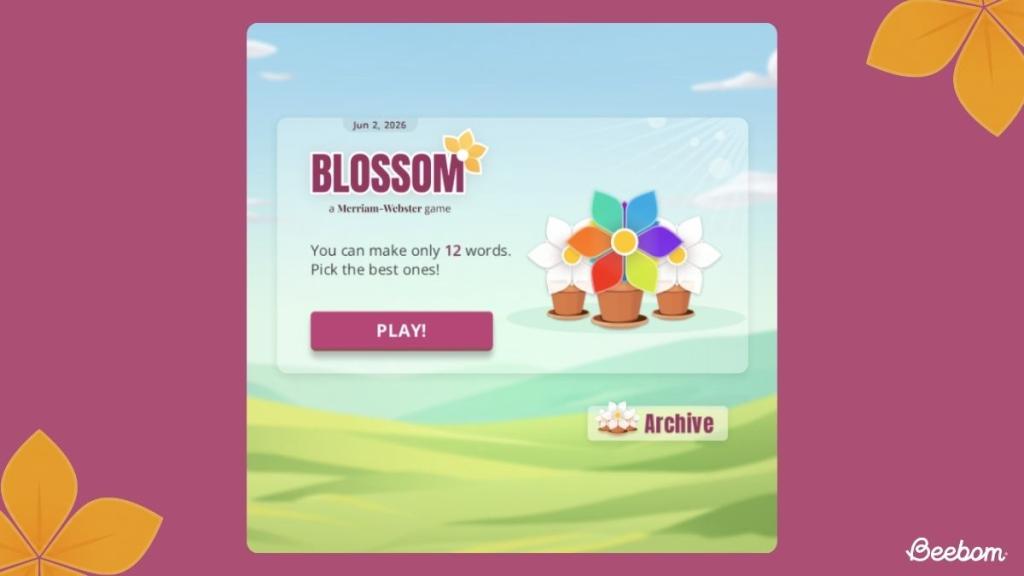
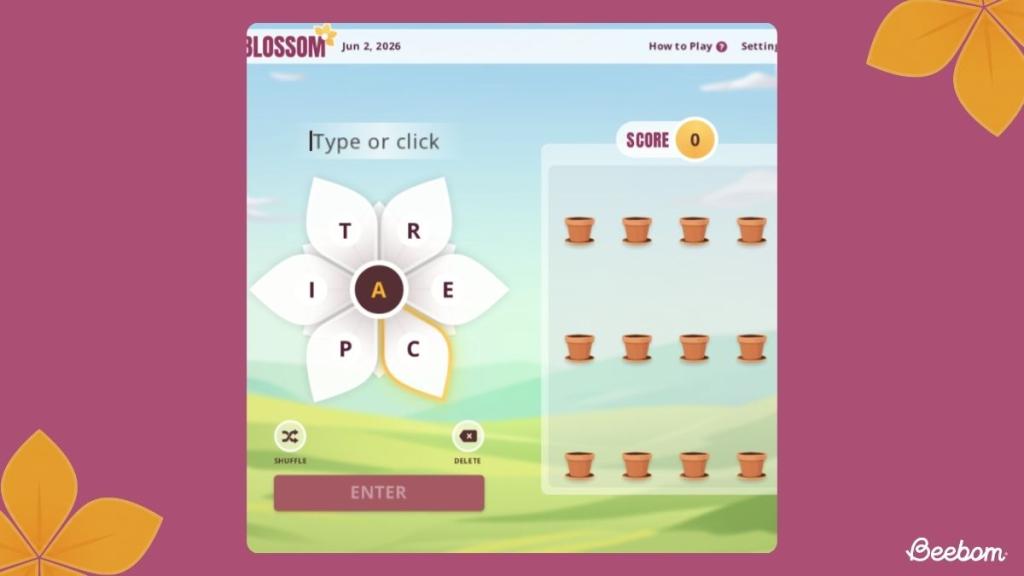
When you look at it first, it bears a strong resemblance to NYT Spelling Bee with its similar seven-letter setup and visual layout. However, these two puzzles operate on entirely different mechanics. Spelling Bee rewards endurance and volume, where the objective is to find as many valid words as possible, and there’s no cap on how many words you can submit.
Blossom, on the other hand, is built around precision. With only 12 word guesses available to you, the main focus is on quality rather than quantity. Short words that are reasonable plays in Spelling Bee become liabilities in Blossom due to its scoring system. Check out our Blossom hints and answers page to find short and long words, along with all the possible Pangrams.
Where to Play the Blossom Word Game?
Blossom is available to play on the Merriam-Webster website under their Games & Quizzes section. The puzzle is free-to-play as there’s no subscription or account required, which gives it a strong advantage over its NYT counterpart. The NYT Spelling Bee limits free users to a small number of words before hitting a paywall.
The website also maintains an archive of past puzzles, so you can access previous Blossoms as well for additional practice or to simply catch up on missed days.
Blossom Rules and Game Mechanics Explained
The structure of Blossom is quite straightforward, but certain rules in the game create a surprisingly layered challenge – something Spelling Bee often misses.
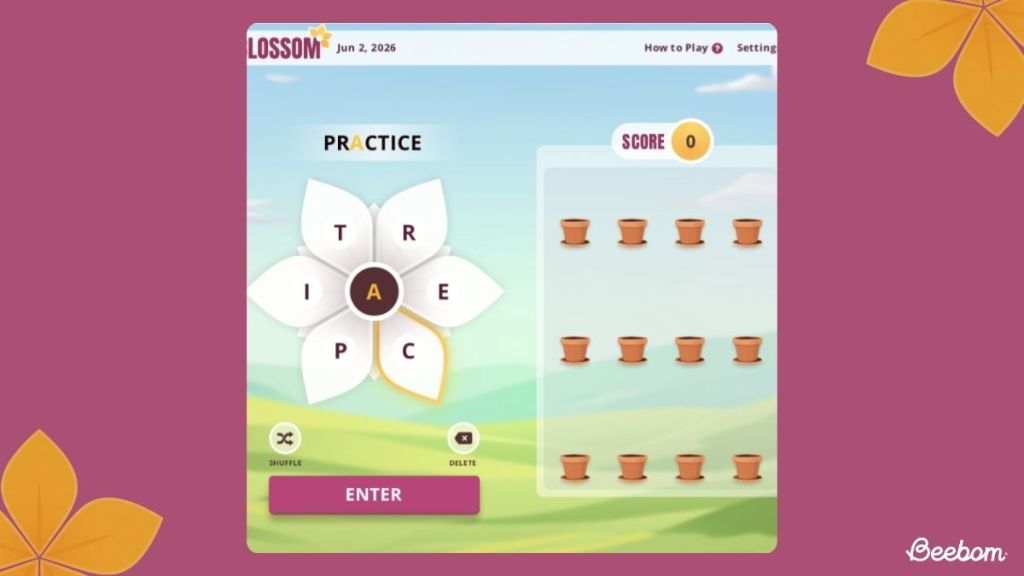
Though we have explained how to play Blossom in a detailed guide, here are the primary mechanics you must know about:
- The Flower Grid: Each puzzle features seven letters in a flower-shaped grid where one letter is placed in the center and six letters are arranged as petals around it.
- Center Letter Rule: Every word guess submitted must contain the center letter at least once. The letters may be used more than once within a single word, but the center letter is required in your guesses at all times.
- Minimum Word Length: All words must be at least four letters long.
- 12-Guess Limit: Players receive exactly 12 guesses per game. This is the game’s defining constraint and the rule that shapes how Blossom should be played.
In our Spelling Bee tips and tricks guide, we note that submitting a series of short four-letter words early in a session is a reasonable way to build momentum. However, in Blossom, the same approach would consume a significant portion of your available guesses for minimal return.
Four quick four-letter words will consume four out of your 12 flower pots. Furthermore, the scoring gap between a four-letter word and a seven-letter word is large enough that those early guesses can effectively cost you the game.
What is a Pangram in Blossom?
A pangram is a word that uses all seven letters in a Blossom puzzle at least once. Since letters can be repeated, a pangram doesn’t need to be exactly seven letters long. It simply needs to include every letter from the available set somewhere within the word. This concept is exactly similar to the Pangram in Spelling Bee, which a lot of you might be familiar with.
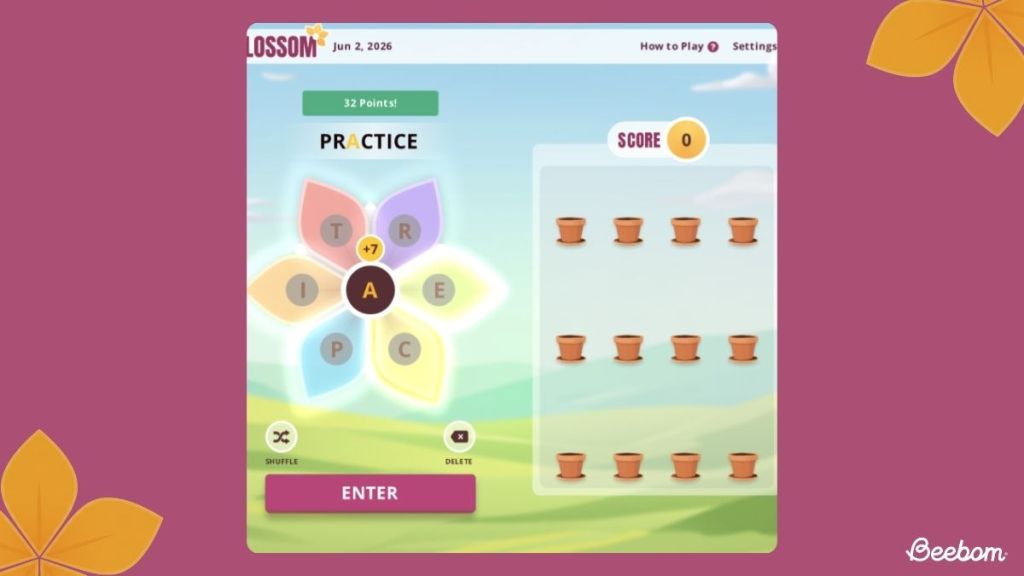
Furthermore, identifying and playing the pangram is one of the most important objectives in any Blossom puzzle, as it triggers a significant bonus on top of the word’s standard score.
Importantly, not all pangrams are equal. For instance, in a puzzle with the center letter O and petals C, M, F, R, T, E, the word COMFORT qualifies as a pangram, as it has seven letters and uses almost all required letters. But the word COMFORTER is a stronger play. At nine letters, it still satisfies the pangram requirement, while also earning a higher score for its additional length.
The pangram bonus is the same in both cases, but the longer word pulls ahead on overall score. So, in cases where a pangram presents itself, it’s well worth asking yourself whether a longer variation of that word exists before committing to the guess.
How Does Scoring Work in Blossom
The scoring system in Blossom is determined by three factors, each of which can be combined to get the maximum score in your final guesses. Here are the factors:
Word Length
Word length forms the base of every score. Longer words earn more points than shorter ones, but the difference isn’t marginal. A seven-letter word will outscore a four-letter word by a large margin, which is why preserving those guesses for longer submissions is absolutely crucial to the game’s overall strategy.
Bonus Letter Petals
This is a feature unique to Blossom’s scoring system and adds a point bonus to the puzzle. One of the six outer petals glows in yellow as the “bonus” letter during the game as you progress.
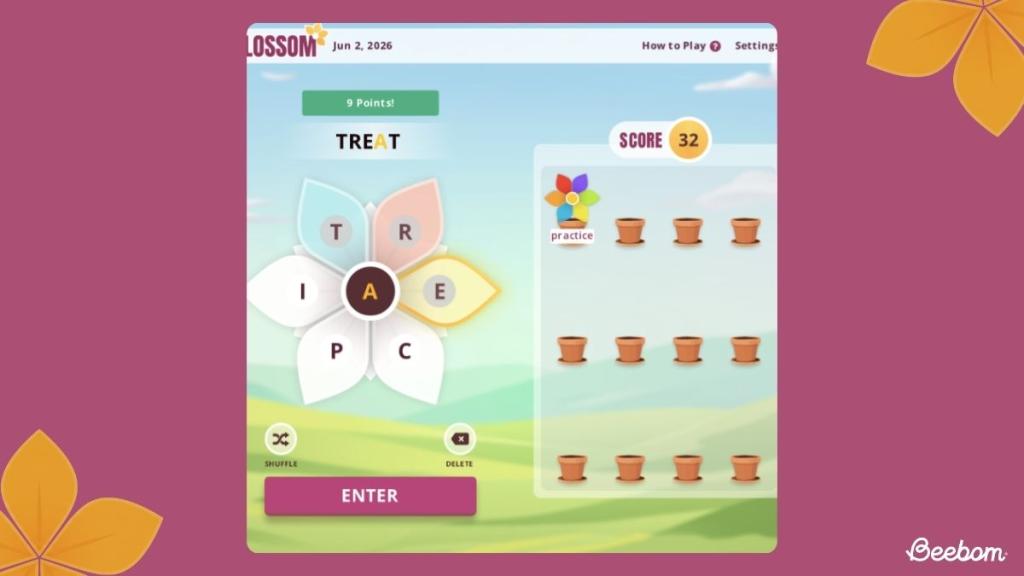
A word that includes this letter receives a significant point boost on top of the base score. Consistently building words around the featured petal is one of the clearest ways to separate a high competitive score from an average one.
Pangram Bonus
This bonus is awarded whenever a submitted word uses all seven letters in the Blossom word game. Pangram bonus stacks with both the word length and the featured petal multiplier. A long pangram that also incorporates the featured letter represents the highest value play available in the game.
Blossom Tips and Tricks
Want to maximize your daily score and earn the highest ranking in the leaderboard? Here are some Blossom tips and tricks to help you:
- Never waste a pot on a 4-letter word: Unless all other options have been exhausted, short words in a Blossom guess do not generate enough points to justify the guess. Reserving every submission for longer words is the most impactful habit a Blossom player can develop.
- Look for suffixes and prefixes: Before you start guessing, look at the letters and see if you can build common words ending with -ING, -ED, -ER, or -ION. If the puzzle has an ‘E’ and ‘R’, find a base word and add ‘ER’ to boost its point value instantly.
- Spam the featured petal letter: If the letter ‘S’ is the featured petal, use it as much as you can. Since repeated letters are allowed, using plural words or finding words with double consonants is a massive point hack in Blossom.
- Take time before committing: Unlike Spelling Bee, where rapid submissions are part of the flow, Blossom rewards patience. With only 12 guesses, each requires careful consideration before it’s submitted. In Blossom, there’s no rush. Just write the letters down or shuffle them around naturally before committing a word to the grid.
Games Like Blossom
If the Blossom word game leaves you craving more vocabulary puzzles, here are a few other similar games you should add to your daily rotation:
- NYT Spelling Bee remains the benchmark of word-building puzzle games. With no guess limit and a large valid word set, it suits players who prefer a longer, more explanatory session over the tactical constraints of Blossom.
- Wordle is a free daily puzzle that has set the current standard for daily word games. With six guesses to identify a five-letter word in a color-coded feedback grid, it is concise, well-designed, and still a reliable daily challenge.
- Quordle/ Octordle: Also hosted by Merriam-Webster, these games take the Wordle format and multiply it, asking you to solve four or eight hidden words simultaneously.
- NYT Strands: A highly intuitive daily puzzle that gives a modern twist to classic word search. Strands requires you to find themed words that stretch and bend across a grid.
Yes, Blossom is a free-to-play daily word-building game by Merriam-Webster.
Similar to NYT Games, Blossom resets at midnight local time, which is when a new puzzle for the day is released.
Blossom has a free-to-access Archive, which lets you play past puzzles free of cost without any subscription.
Blossom is a browser-based online word game, but it is optimized for mobile devices so you can easily play it on any browser app.
Yes, you can reuse letters in your Blossom guesses to make longer words and score more points.
Recommended for You
What Time Does Blossom Word Game Reset?

Today's Blossom Hints and Answers for October 16, 2026


How to Play Blossom Word Game: A Simple Guide for Beginners

More in Puzzle

7 Best Globle Tips and Tricks to Find the Mystery Country Easily
Connections Hints Today & Answers for October 16
Wordle Hint Today - October 16, 2026 (Puzzle #1945)


When Does Globle Reset? Find the Reset Time Here

How Many Countries Are in Globle? A Full Globle Country List