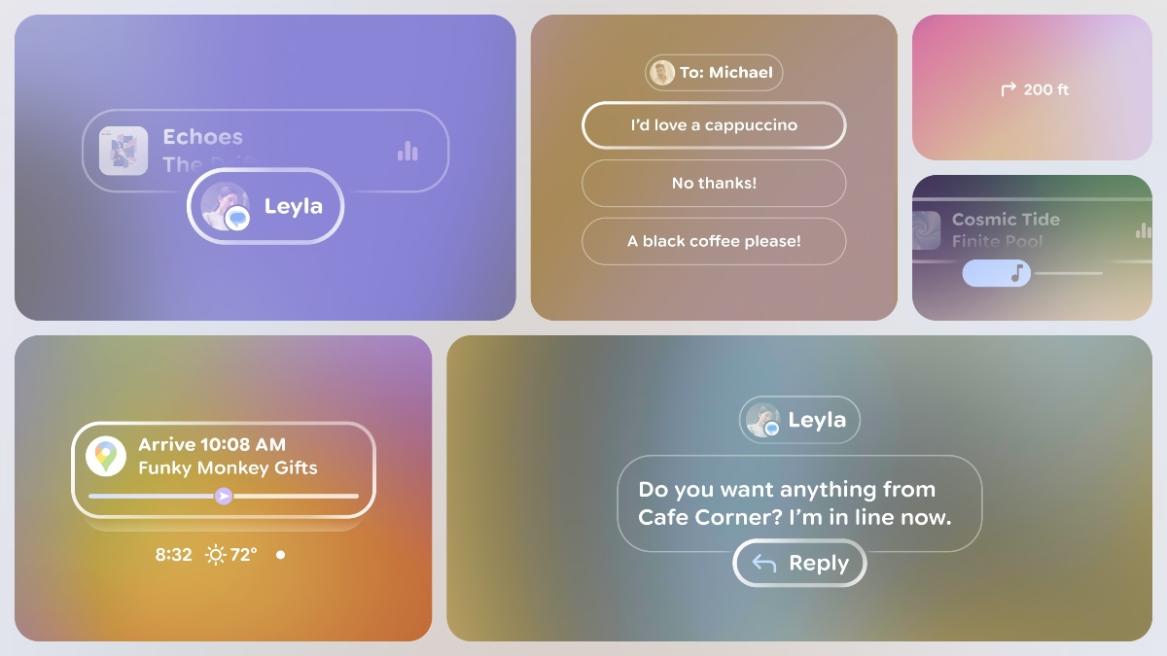
- Google has unveiled Glimmer, a new UI design language for AI glasses under Android XR. It's built for transparent displays.
- Instead of displaying on the screen, it projects the UI at one-meter focal length. Google is going for perception and physics-aware UI.
- The industry is racing up to build the next generation of UI for AI glasses that blends into the real world.
Google has introduced Glimmer, a new design language built for AI-powered display glasses. It’s part of the Android XR initiative, and it prioritizes voice, gesture and eye-tracking with transparent UI elements. The new Glimmer design system focuses on “glanceable, transient elements that appear only when needed”.
Glimmer UI Is Designed for a World Without a Screen
Glimmer’s UI appears on optical see-through AI glasses at one meter away, instead on the lens itself. It’s optimized for transparent displays, so UI is legible, low-distraction and works with voice, gesture and eye input. Google has published a Jetpack Compose Glimmer that features components, theme, and behaviors and a Figma kit. Android developers can build Glimmer-styled UIs for AI glasses.


UI elements have rounded corners and floating tiles for multitasking. And to read in real-world backgrounds, Google has gone with dark surfaces and bright content for contrast. Throughout the UI, sharp corners are discouraged because they are displeasing to the eye. Google says the Glimmer UI must “harmonize” with reality instead of taking the attention away from the user.
In a way, it’s an ambient UI by Google for the upcoming AI glasses revolution, under the Android XR initiative. Google further notes that the UI must earn attention of the user without being dominating. Next, on these AI glasses, the display is additive, meaning it can only add light. So, true black won’t exist and black appears as 100% transparent in a container. Highly saturated colors also disappear in real-world backgrounds.
So, Google is going for neutral and desaturated color palette with dark surfaces and bright content. It’s a break from Google’s Material Design principles and moving towards physics-aware UI philosophy where perception is more important than the screen.