

One of the first steps toward ensuring your data is protected when browsing the internet is using a good VPN. Now, there’s no shortage of free VPNs on Windows, and you’d be surprised to know ChromeOS also has a comprehensive catalogue of VPNs, all thanks to Android support and Chrome extensions. Here are some of the best Chromebook VPNs you can try in 2026.
Overview of Chromebook VPNs
Proton VPN is the best Chromebook VPN for free users. It offers decent performance and doesn’t log user data. If you are looking for a premium Chromebook VPN, just install NordVPN for reliability and strong performance. You can check out all the free and paid VPN services for Chromebooks right below.
Chromebook VPNs Best Suited For Limitations Pricing Proton VPN Chromebook users who want a free VPN without compromising on security or privacy Regional limitation up to 10 countries Free, $3.99 per month on 1-year plan Surfshark Install on unlimited Chromebooks, Android app and extension available, 4,500 servers Streaming issues Paid plan starts at $2.49 per month on 1-year plan Windscribe Another free VPN for Chromebook with 10GB monthly quota Not the best streaming experience Free, Paid plan starts at $5.75 per month on 1-year plan TunnelBear Decent free Chromebook VPN, easy to use, optimized app for Chromebook Only 2GB under the free plan Free, Paid plan starts at $4.99 per month on 1-year plan Browsec VPN Completely free, offers 3 locations, no ads Logs data Free, Paid plan starts at $2.49 per month on 1-year plan Tor Browser Browser with built-in proxy to unlock geo-blocked sites, completely free and open-source Not for general users Free NordVPN Premium VPN with great performance and coverage, 8,900 servers, reliable service 10 device limit Paid plan starts at $4.89 per month on 1-year plan ExpressVPN Easy to use premium VPN for Chromebook, optimized app and extension, great uptime A bit expensive Paid plan starts at $8.99 per month on 1-year plan
How We Tested the Best Chromebook VPNs?
Chromebooks don’t have native support for apps, so you can either run apps through the Google Play Store (Android version), Chrome extension, or via the Linux container. In that scenario, my number one priority before choosing a Chromebook VPN was to see how well the app is optimised for the ChromeOS platform. And whether the VPN provider offers both the Android app and Chrome extension.
And based on this criteria, I picked Chromebook VPNs which are optimized for the larger screen. Secondly, I checked whether these VPN apps have features and security parity with their Windows or macOS versions. Having support for WireGuard protocol, kill-switch, and DNS leak protection is essential for maintaining privacy and security.
Finally, I installed all these VPN apps via the Google Play Store on my Chromebook and tested their performance and coverage. As a result, I picked five free VPNs for Chromebooks and three premium VPNs.
Best Free VPNs for Chromebook
Proton VPN is arguably the best free VPN for Chromebooks. It doesn’t log data and offers decent performance with some regional restrictions. You can also consider Windscribe and TunnelBear, but they have bandwidth limitations.
Proton VPN
Proton VPN is, hands down, the best VPN service you can use on your Chromebook. One of the best things about Proton VPN is that, although it has some limitations, it doesn’t have a data cap like other VPNs and is completely unlimited and free to use. Besides, it’s open-source and, like other Proton services, promises to never log or sell your data. Proton VPN can be downloaded as an Android app and will work outside Chrome and in other apps, including the Linux container.

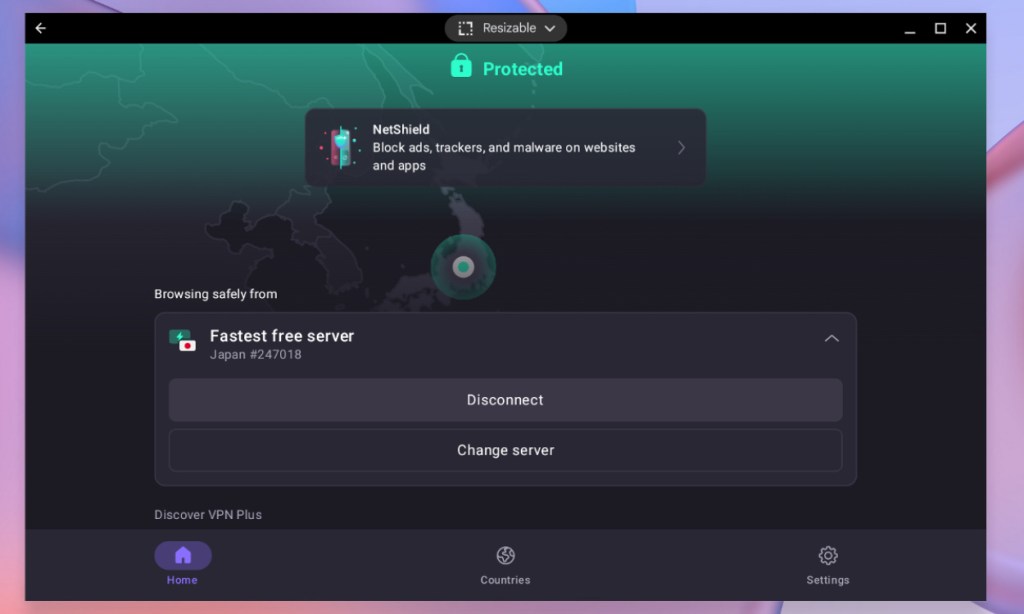
While there are a ton of countries (120) and servers (15,000) to choose from, one of the limitations that Proton recently introduced in the free version is that you cannot seamlessly switch between servers as you could before.
The United States, Japan, and the Netherlands were free before but after this limitation rolled out, Proton randomly selects a region and adds a timer before you could click switch server, and it assigns a random server again. All in all, it’s still a great VPN service that you can use on your Chromebook without paying a dime.
Pros Cons Completely free with no data caps Server selection limitations after new update Great speeds for a free VPN Not invincible to VPN blocks Strict no-log policy Excellent user interface Built-in Ad and tracker blocking
Pricing: Free, Paid plan starts at $3.99 per month with a 1-year plan
Surfshark
Surfshark is one of the more reliable premium VPN options available out there, and the most affordable one too. You can install the Surfshark VPN on your Chromebook via the Google Play Store or through the Chrome extension. It brings access to over 4,500 servers in more than 100 countries. And the VPN maintains that it doesn’t log any user data.
To test real-world performance, I installed Surfshark on my Acer Chromebook, and the VPN managed 29.6 Mbps in download speed and 1.82 Mbps in upload speed. Its performance turned out to be better than ExpressVPN.

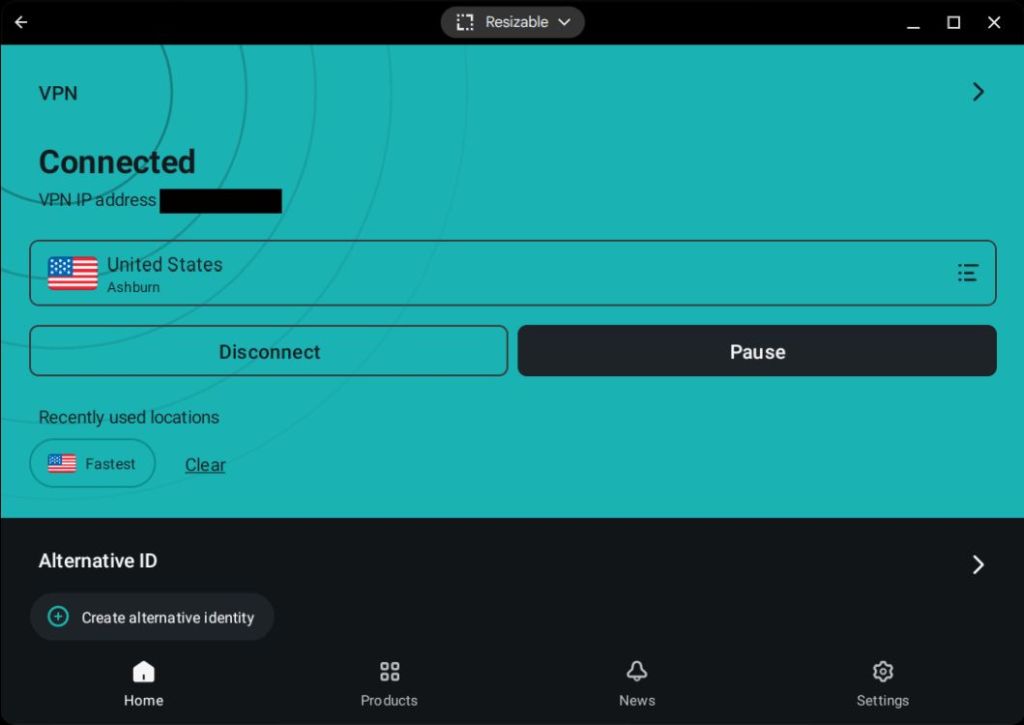
In addition, Surfshark brings support for WireGuard, OpenVPN, and IKEv2 protocols for secure communications. While you don’t get a free plan, it offers a 7-day free trial, which you can try before getting the paid subscription. It is so good that we even suggest it as our top VPN choice for gaming. You should pick this VPN if you want an affordable alternative to ExpressVPN with better performance and unlimited device support.
Pros Cons Affordable VPN, Connect unlimited devices No free tier 4,500 servers in 100 countries Android app and Chrome extension available Supports WireGuard protocol
Pricing: Paid plan starts at $2.49/month with a 1-year plan
Windscribe
Windscribe is a great free VPN service, but has a few limitations. For starters, it has a data cap of 10GB per month, which is just not enough even if you intend to use it for regular day-to-day usage. However, it’s great for someone who uses a VPN to access geo-blocked information (mostly consisting of text), and we could see this come in handy for students who may need more information for their thesis and watching a couple of videos here and there.

That said, Windscribe has a bunch of free servers like the United States, Canada, France, Germany, Netherlands, Norway, Romania, Switzerland, the UK, and Hong Kong. Besides, Windscribe uses IKEv2, WireGuard, WStunnel, and Stealth protocols all available for free to better protect you. With over 190 locations and many servers, Windscribe is a nice free VPN for your Chromebook, but the 10 GB limit could be extremely limiting for some. Windscribe is available as both a Chrome extension and an Android app.
Pros Cons Free for casual usage 10 GB per month limitation Decent speeds Questionable privacy after data breach in 2021 Lots of free servers Excellent user interface IKEv2, WuireGuard, and Stealth protocols
Pricing: Free 10GB per month, Paid plan starts at $5.75 /month for 1-year plan
TunnelBear
TunnelBear can be used as a ChromeOS app using both the Android app and Chrome Extensions. The extension will particularly come in handy on school Chromebooks since most of them do not come with Google Play Store support.

In terms of servers and locations, Tunnelbear lets you access all of them without any premium subscription, while it caps the data to 2GB per month which is extremely low. On the positive side, TunnerBear is one of the cheapest VPN subscriptions you can purchase at just above $3 a month.
TunnelBear lets you choose between OpenVPN and WireGuard, both pretty great and secure protocols. Besides, while the speeds won’t impress, they’re more than enough for streaming or any general tasks. Moreover, the app comes with features such as VigilantBear which blocks all traffic until the VPN connects again, and SplitBear. Overall, TunnelBear is easily one of the best VPN services you can use on a Chromebook in 2026.
| Pros | Cons |
|---|---|
| Great for casual usage | 2 GB per month limitation |
| Decent speeds | Questionable security |
| Locations are not locked | Login required |
| Handy features in the app | |
| Supports WireGuard and OpenVPN |
Pricing: Free 2 GB/month, Paid plan starts at $5.95 per month with the 1-year plan
Browsec VPN
Browsec is yet another free VPN you can use on your Chromebook. It’s available as both an Android app and a browser extension and works pretty well. We’d recommend using the Android app if you have a capable Chromebook. You could stick to the browser extension if you need it only when browsing.

Browsec is free and gives you 3 free locations to choose from – the Netherlands, Singapore, and the United States. While it doesn’t support the WireGuard protocol, it does have IKEv2, OpenVPN, and XRay protocols. Besides, you can choose to exclude apps from using the network with ease. Overall, Browsec is a pretty neat VPN app for Chromebooks.
Pros Cons Completely free Logs data Three free servers with no ADs No WireGuard support No login required Slow speeds 7-day free premium trial
Pricing: Free, Paid plan starts at $2.49 per month on 1-year plan
Tor Browser
Tor Browser is not exactly a VPN per se, but it mostly does what a VPN is capable of, i.e., unlock geo-blocked stuff on the internet. It is a browser, so the network won’t apply outside the app. However, since most of us use VPNs to access content outside inaccessible in our countries via a browser, it makes sense to use Tor instead of a free VPN that may log your personal data. In fact, Tor does the contrary and reroutes connection via different nodes so that no one can find out your real identity on the internet.

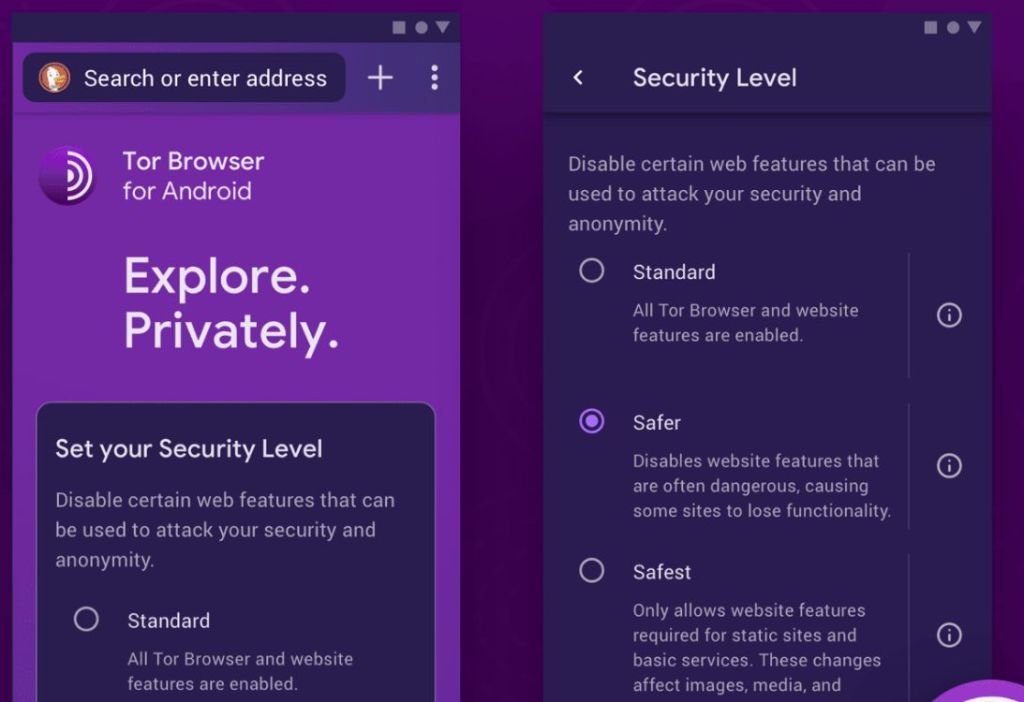
To use the Onion network, you can install the Tor Browser on Chromebook via Linux or from the Google Play Store. Besides, browsers such as Brave come with Tor built-in and offer other features such as ad blocking. Overall, if you need a VPN service mostly to browse blocked content on your Chromebook, you can use Tor instead.
Pros Cons Completely free Slow browsing speeds as your requests go through multiple servers Open-source and extremely secure The network only applies to the browser Available on almost all platforms
Pricing: Free
Best Premium VPNs for Chromebook
NordVPN is one of the best premium VPNs for Chromebook as it offers wider coverage and great performance. You can also check out ExpressVPN which is pretty reliable on Chromebooks.
NordVPN
For those who want a premium VPN for Chromebook, I would highly recommend NordVPN. It offers an optimized Android app for ChromeOS via the Google Play Store and also a Chrome extension if you want to use the VPN in your browser. While I generally use Proton VPN as it’s free, NordVPN offers more than 8,900 servers across 178 countries around the world.
It means that you will get unparalleled performance and coverage. I did test NordVPN on my Chromebook and it managed to reach a whopping 67 Mbps in download speed and 2.7 Mbps in upload speed while connected to a US server, which is pretty amazing.

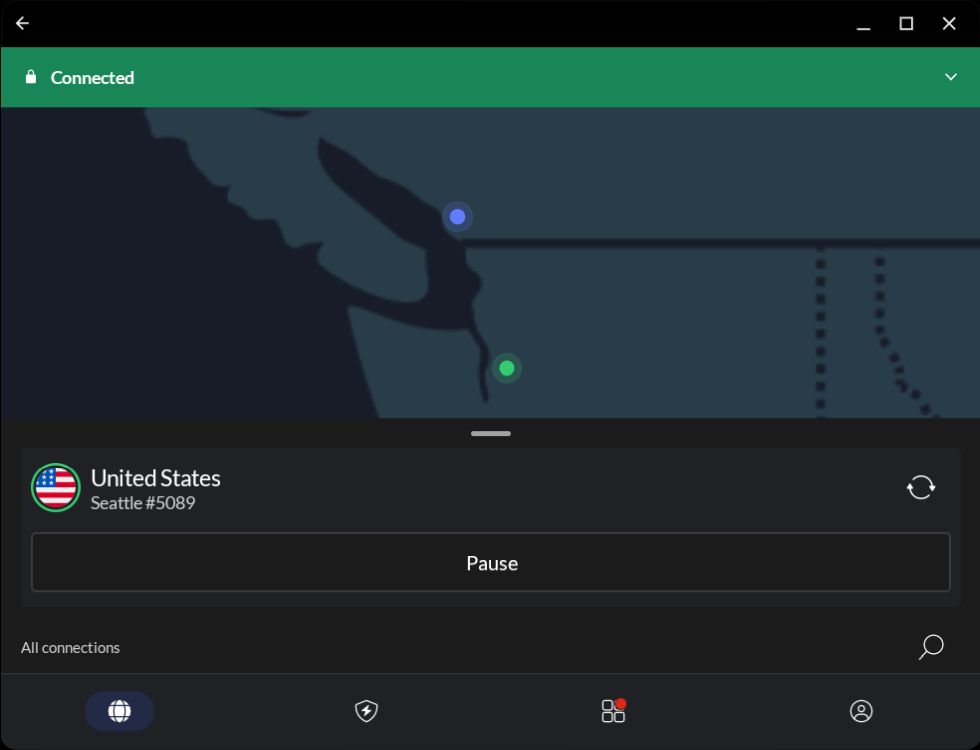
I would say for streaming geo-blocked content on Chromebook, NordVPN is an excellent choice. Apart from that, in terms of security too, NordVPN offers the latest WireGuard protocol and has a no-logs policy. If you want an all-around Chromebook VPN that is reliable and works without any fuss, NordVPN is the best choice out there.
Pros Cons 8,900 servers in 178 countries No free tier Optimized app and extension for Chromebook Supports WireGuard protocol Strong performance and coverage
Pricing: Paid plan starts at $4.89/month with the 1-year plan
ExpressVPN
ExpressVPN is another excellent VPN for Chromebooks as it offers servers from over 170 locations. As it’s a paid VPN, you get top-notch performance, security, and coverage. On top of that, you can install an Android app for Chromebook or simply download the Chrome extension — both are available. That said, keep in mind that ExpressVPN is a bit more expensive than other paid VPNs out there.
To evaluate ExpressVPN, I installed it on my Chromebook and connected to a US server. It achieved 4 Mbps in download speed and 10 Mbps in upload speed, which is decent at best.

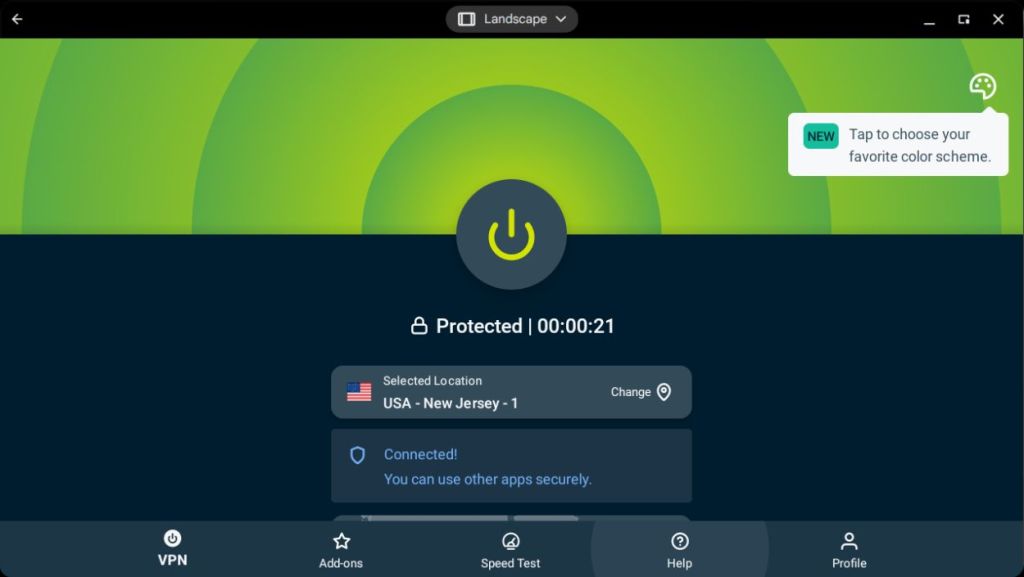
Coming to privacy protections, ExpressVPN is based in the British Virgin Islands which doesn’t have any data retention law. So, your data is not logged and the company maintains transparency by verifying its source code with independent security researchers. Finally, you can connect up to eight devices with a single plan.
| Pros | Cons |
|---|---|
| Android app and Chrome extension available | Can only connect up to 8 devices |
| Fast and reliable VPN performance | A bit more expensive |
| Strong privacy protection | |
| No-logs policy |
Pricing: Paid plan starts at $8.99/month with the 1-year plan
If you’re looking for a VPN that strikes a good balance between privacy and speed, we cannot recommend Proton VPN enough. Windscribe and TunnelBear are also great free VPNs for ChromeOS. And if you want a paid VPN for Chromebooks, you can check out NordVPN and ExpressVPN.
Chromebooks don’t come with built-in VPN, but it does support third-party VPN services. You can easily install apps like Proton VPN or NordVPN on ChromeOS.
For free users, Proton VPN is the best for Chromebooks and for paid users, you can consider NordVPN and ExpressVPN.
Yes, ExpressVPN is available on Chromebooks via the Google Play Store. You can install the Android app or use the Chrome extension as well.

