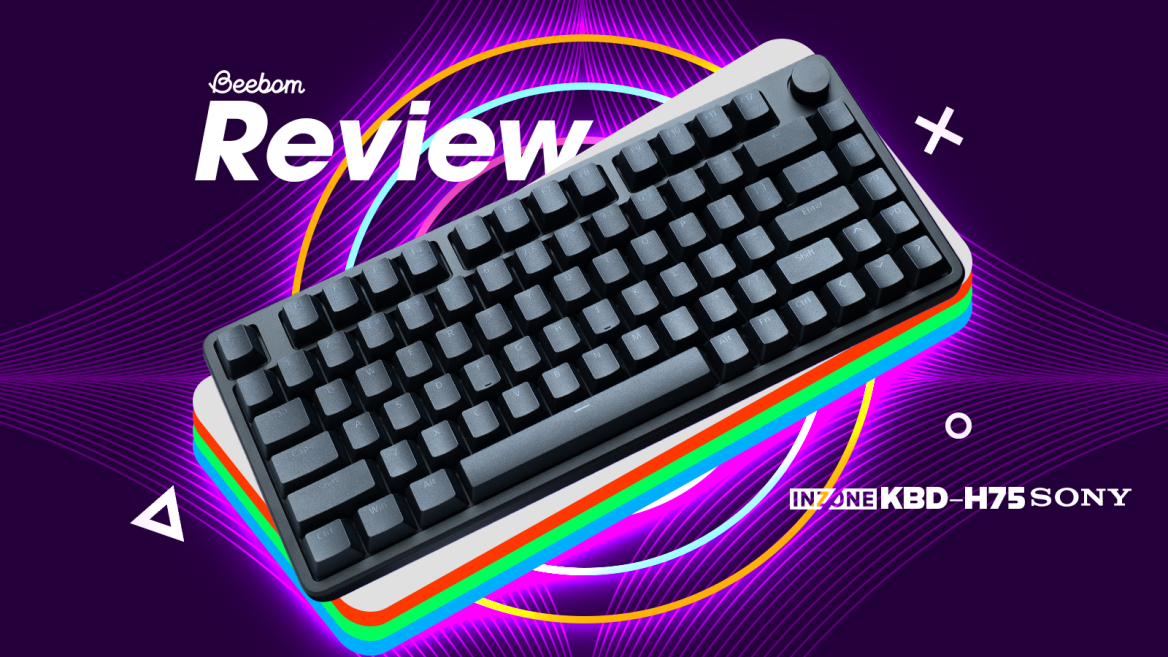
Beebom Score
Okay, let me begin this by being honest. I did not expect Sony to walk into the gaming keyboard space and start swinging like this. The company everybody associates with PlayStation, noise-cancelling headphones, Bravia TVs, and even mirrorless cameras, entered the gaming keyboard market like it had something to prove. And honestly? It did prove something with the Sony Inzone KBD H75.
The keyboard isn’t just “good for a first attempt.” I mean, it’s genuinely good. Like, “why does this one feel better than the keyboards I’ve been stuck with for the past 10 years?” good. This is a 75% wired gaming keyboard built in collaboration with Fnatic esports athletes, who clearly seem to be the minds behind a spec sheet that reads like a competitive gamer’s wishlist.
The compact layout, the spacebar height, tactile response, and Hall Effect magnetic switches, even the impressive 8000 Hz polling rate, with a tank-like aluminum body. It’s clean, minimal, and serious about its performance for some serious play time.
But here’s where the illusion shatters for most gamers – it costs around $300 ($298 to be exact). So yeah, the keystrokes are smooth like butter, but the wallet takes a crunch out of this bite. Read on my Sony Inzone KBD H75 review and how this keyboard fared against my wall of mechanical gaming boards over the years.
Design, Build, and Features – Magnetic Magic But My Wallet’s Tragic
The build quality of the keyboard is solid, as if it’s built like a tank. The CNC-machined aluminum top plate feels sturdy with zero deck flex, and the matte black finish handles fingerprints well, even if they’re oily after you’ve just popped a Cheeto. The bottom half, though, is plastic, which is a minor bummer at this price, but it doesn’t affect its rigidity when put to work.
At 810 g, the keyboard feels planted on the desk without being annoyingly heavy. It’s also compact enough to free up mouse space; the sweet spot of a 75% form factor clearly shows as a deliberate design choice made with FPS players in mind, like Fnatic athletes. The gasket mount build adds a subtle bounce to each keypress, and internal foam dampening keeps the sound profile clean. It’s so clean that I kept using Typing Test for the first few minutes after hooking up the keyboard to my PC to get that sweet music in.
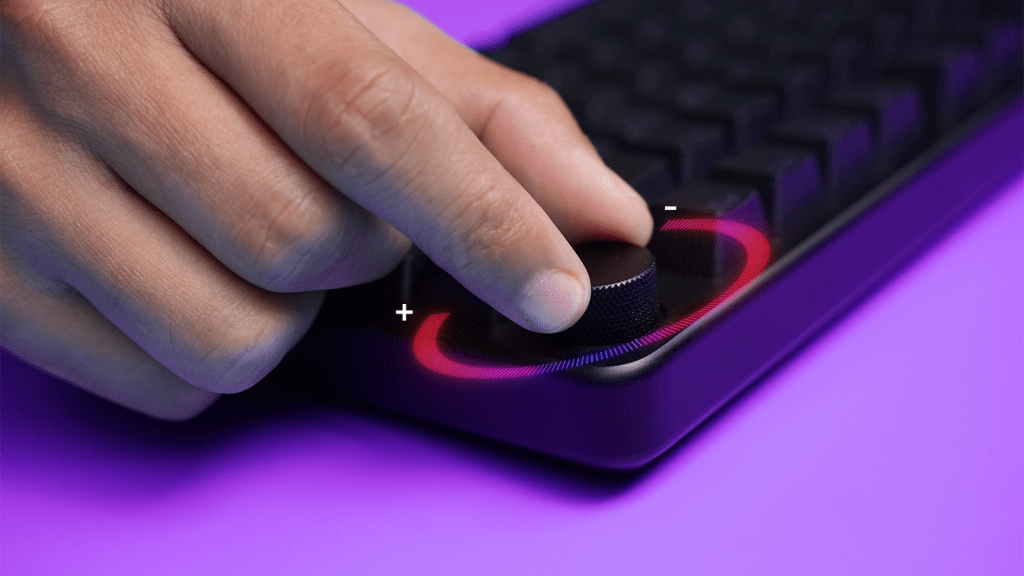
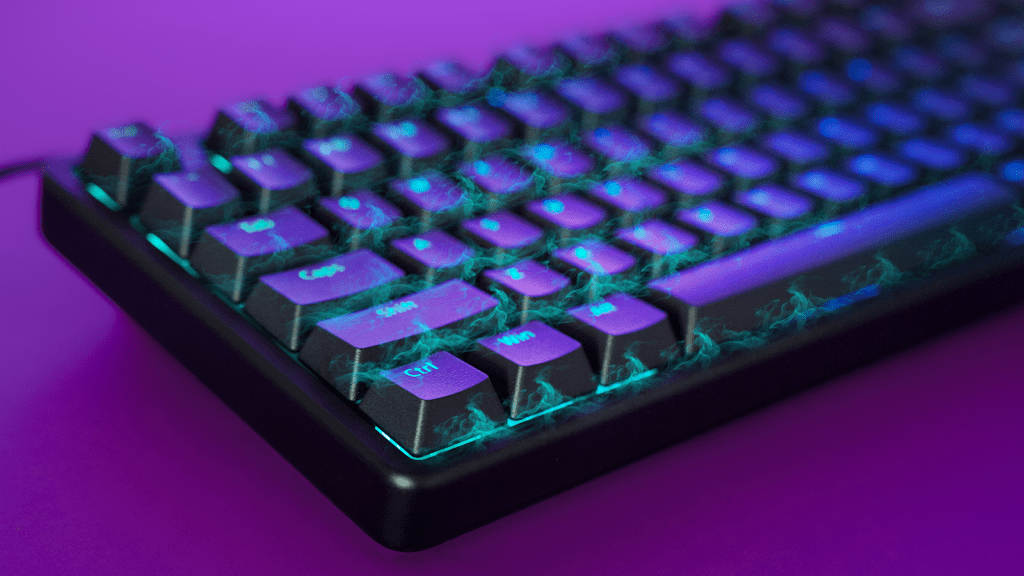
The double-shot PBT keycaps are textured and premium with translucent legends for RGB shine-through. There’s also a metal volume knob in the top-right corner with click-to-mute, which works well but can’t be remapped to another function, which is such a missed opportunity.
Even I wouldn’t have imagined using a keyboard that comes with Hall Effect magnetic switches. But this is 2026, fellas, the year of GTA 6, where everyone’s bringing their A game. Sony here has used Gateron KS20 HE switches, which detect actuation through magnetic sensors rather than physical contact. You can customize the actuation point from 0.1 mm to 3.4 mm in 0.1 mm increments on a per-key basis. Want WASD to activate with the lightest touch? Done. Want typing keys set deeper to avoid misfires like sending a “K” to your boss? Also done.
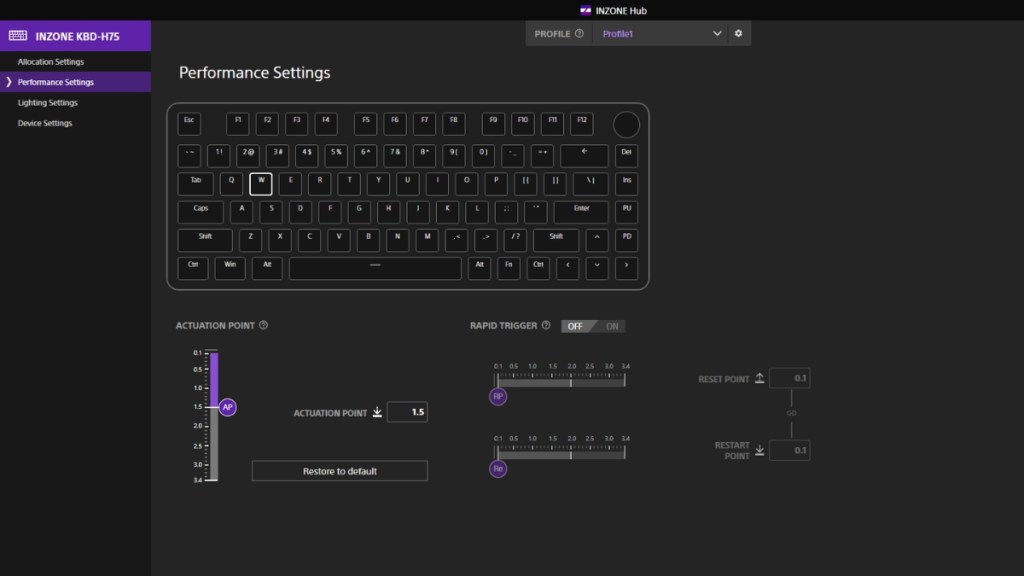
Each key also gets independent Rapid Trigger control (0.1 mm to 3.4 mm), which lets the key reset the instant you start lifting your finger. It’s so smooth that it makes movement feel noticeably more responsive, especially for strafing and counter-strafing in shooters. Now, something that’s worth noting with KBD H75 is that the software customization isn’t as deep as its competitors.
There’s no SOCD support, no mod-tap functionality, and the Inzone Hub software, while clean and available as both a desktop app and a web tool, feels too basic in 2026 compared to what keyboards from brands like SteelSeries offer. You get per-key actuation, Rapid Trigger, RGB customization, macros, and key remapping – the essentials are covered, but tinkerers like me want more when we’re paying $300 for a peripheral like this one. You can also store up to five profiles onboard, which is a nice touch for anyone who switches between different setups for different games.
The RGB customization, too, is quite limited. The keyboard does not give you a native key to switch between different RGB profiles. Instead, you’ll need to choose from one of the five saved profiles on the board to switch the RGB mode of your preference that has been preset using the Inzone Hub.
When it comes to limitations, the keyboard is wired-only via USB-C, which might disappoint fans of the wireless peripheral range, and it’s Windows-only, so no macOS support. The 8000Hz polling rate is impressive on paper and ensures inputs register fast, though in everyday use, the difference between 4k and 8k is hard to perceive unless you’re at a genuinely competitive level.
At a $300 price point, you’re in the same territory as the Wooting 60HE+, SteelSeries Apex Pro Mini Gen 3, and Asus ROG Falchion Ace HFX, as they offer deeper software features and customization. But the KBD H75 arguably sounds better out of the box and has a more refined build. Even though it’s a trade-off, it’s not a clear win yet.
Gaming Performance – Now I Can’t Blame My Keyboard For Losing Matches
This is where I put the KBD H75 to the test and made me feel it’s actually worth its hefty price tag. I tested it across Fortnite and Marvel Rivals, two live-service games I play almost every day, and that too, with a competitive edge. And I must say, the experience in both games was mighty smooth.
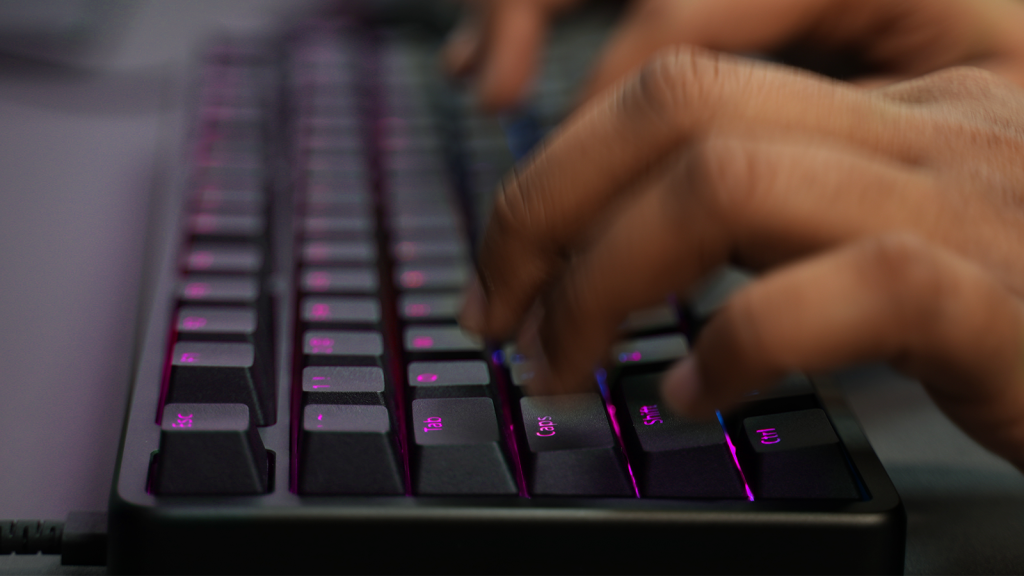
In Fortnite, the Rapid Trigger made the largest difference. Thanks to low actuation on movement keys, strafing felt instant, and build edits registered neatly. Wall retakes were tighter, cranking 90s in build fights felt more deliberate than the keyboards I’ve used in the past, and that 8000 Hz polling rate kicked into action and captured every tiny input as soon as it happened. I won’t pretend it turned me into a pro like Clix overnight, but the keyboard genuinely removed any sense of input delay from the equation. This hardware just stays out of your way and lets you play.
In Marvel Rivals, the linear switches struck a decent balance for ability-heavy gameplay. Enough resistance to prevent accidental presses during intense 6v6 fights, but light enough that chaining abilities with Deadpool didn’t feel tiring. I set ability keys slightly deeper than movement keys, which helped reduce misfires during clutch moments. The keyboard tracked every keystroke with precision, and across long sessions, the gasket mount kept things comfortable without finger fatigue. It’s the kind of keyboard that you stop noticing because it just works, which is honestly the highest compliment I’ve ever given to a peripheral like this one. It’s a smoooooth operator!
Verdict: That 0.1mm Changed Me
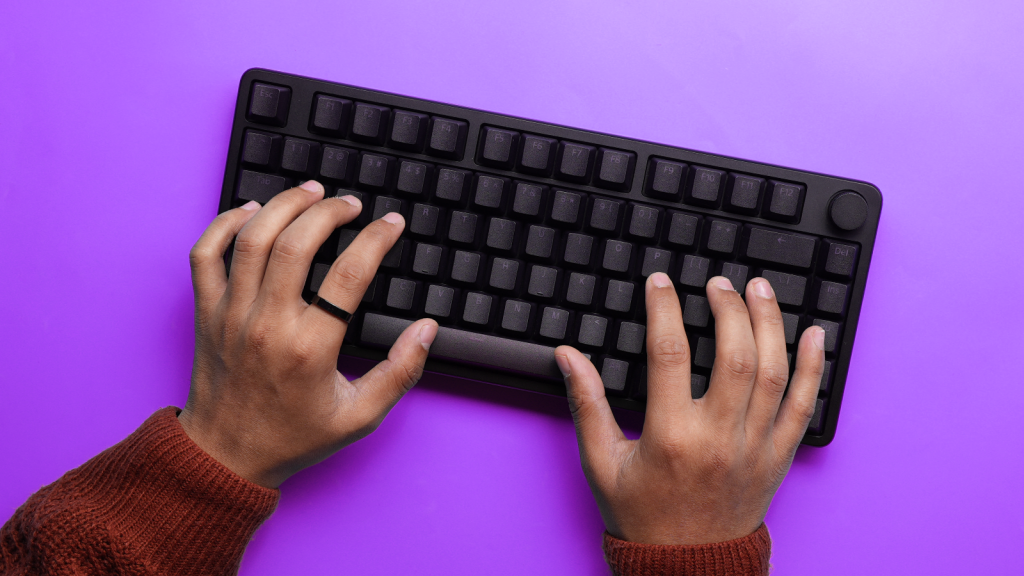
The Sony Inzone KBD H75 is one hell of an impressive keyboard from a brand like Sony. The Fnatic collab shows in the thoughtful layout, the tuned switch response, and the overall focus on competitive performance. The HE switches with rapid trigger work as expected, and the build is sturdy and well-finished. The typing feel and keystroke sound are among the best I’ve experienced in the category. Even though it’s not perfect, as the software could be deeper, wireless would’ve been nice, and $298 is a high ask when competitors pack more features at the same price, it still holds its weight.
As an all-round package that nails the fundamentals of feel, sound, and performance, it’s hard to go wrong with this one. If you’re a pro gamer looking for a premium board that works exceptionally well right out of the box, the KBD H75 delivers. The actuation points that go as low as that perfect 0.1 mm, the gasket mounts, everything is in there that I would’ve wanted from a keyboard this pricey.













 Sanmay Chakrabarti