With rapid improvements in AI, things are quickly moving away from AI chatbots to action-driven AI agents. AI agents are ready to change our everyday lives and how we interact with services. They don’t just generate text or images, but make decisions and act on them. So, to demonstrate agentic applications, we have compiled powerful examples of AI agents in 2026. From computer-using AI agents to autonomous vehicles, we have mentioned all of them here.
1. ChatGPT AI Agent
The first real-world example of AI agents that we have on the consumer side is Computer-Using AI agents. Leading AI companies are developing Computer-Using AI agents to automate and achieve tasks on the web and local computers. OpenAI’s ChatGPT AI agent (earlier called Operator) is the most noteworthy one as it can autonomously perform tasks on behalf of the user on the web.
The ChatGPT AI agent can navigate websites, click buttons, fill out forms, type text, and scroll pages to complete any task you throw at it. It basically analyzes the active screen and decides where to click next or perform a suitable action. You can use it to book flights, hotels, order groceries, fill out forms, and more.
That said, for sensitive tasks like making payments or entering CAPTCHAs, you still need manual intervention. It’s available to ChatGPT Plus and Pro users, which starts at $20 per month. You can also try OpenAI’s new AI browser called ChatGPT Atlas which has built-in support for ChatGPT Agent.
2. Manus AI Agent
China’s Manus is one of the prime examples of AI agents that has become quite successful among general consumers. It was hailed as China’s second DeepSeek moment as this general-purpose AI agent claimed to execute any task you could think of. Now, the Manus AI agent has been acquired by Meta for $2 billion. It’s one of the few AI startups that is generating more than $100 million in annual recurring revenue from subscriptions.
As for the AI agent itself, it can plan, execute, and finish complex tasks for users. It can run multi-step workflows including market research, data analysis, travel planning, report generation, and more. It runs Python in a sandbox environment to perform real actions and produces files, dashboards, and visual reports.
Users can always inspect how tasks are being executed and review the steps too. Basically, Manus is very good at orchestrating the model, writing executable code, and enabling long-running tasks. This AI agent is not a project, but an actual product and you can start using it right away from here.
3. Claude in Chrome
Similar to ChatGPT Agent, Anthropic has developed a Claude extension for Chrome, which uses Claude to perform operations inside the Chrome browser. Claude in Chrome can browse the web and perform various tasks. The AI agent is now available to all paid Claude users across Pro, Team, and Enterprise plans.
It can click, type, navigate pages, fill forms, and run multi-step workflows on your behalf. You can use it to clean up your inbox, manage calendar, data extraction, and much more. You can observe the AI agent working in real-time and also take control at any point.
4. Gemini AI Agent
The Gemini Agent is another example of AI Agent which does the planning and integrates web browsing, deep research, and your Google apps to execute tasks for you. It’s currently available to Google AI Ultra subscribers (costs $200 per month) in the US. It can perform complex, multi-steps tasks inside the browser. Before taking sensitive actions like purchasing or sending an email, it asks for your permission.
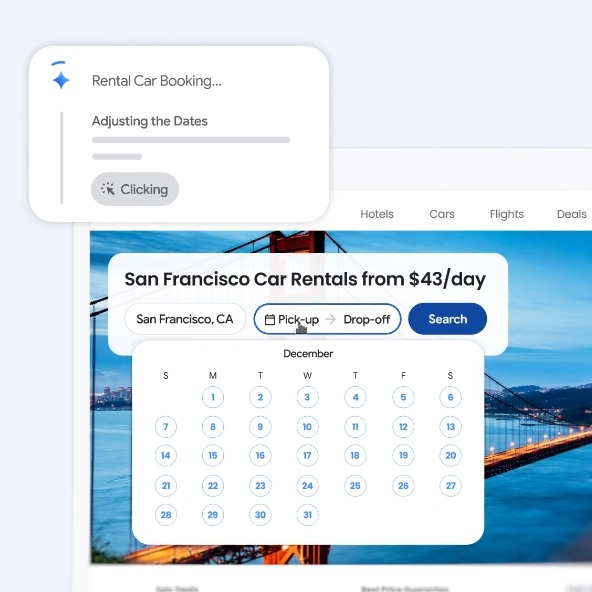
You can use the Gemini AI Agent to manage your inbox, archive emails, draft a response and more. It can also visit multiple websites to gather information and help you with booking and purchasing. It can connect with your Gmail, Google Calendar, Google Drive, Keep, Tasks, Google Maps, and YouTube. The Gemini AI agent is powered by the powerful Gemini 3 Pro AI model.
5. Claude Code
If I have to pick one example of AI agent to illustrate the agentic capability of AI systems, it would be Claude Code. Unlike consumer AI agents, Claude Code is meant for developers and programmers. However, general users can also use Claude Code to perform actions on their local computers. That said, Claude Code remains one of the best AI tools for coding.
It has been developed by Anthropic and it operates within a terminal. Claude Code integrates your local development environments, reads your codebases, understands project structure, and run commands to execute actions. It can debug your code, write tests, refactor files across multiple directories.
You can interact with Claude Code using natural language instructions for planning and executing multi-step tasks. You should use the Claude Opus 4.5 AI model for the best experience with Claude Code. Put simply, it’s one of the best examples of AI Agents in 2026.
6. Perplexity Comet
A new example of AI agent is emerging in the form of AI Browsers. Perplexity’s Comet is an agentic AI browser that can perform tasks on the web. It’s a new kind of web browser, built on the Chromium base, but with a built-in AI agent. You can ask the Comet Assistant to fill forms, order grocery, navigate webpages, and more.
It can also summarize webpages, find information across multiple tabs, draft emails, plan trips, and even automate multi-step tasks like calendar scheduling and shopping. Basically, it provides a unified experience as the whole browser is built for agentic tasks. Comet is now available to all users and it no longer requires a subscription.
7. ChatGPT Atlas
Just like Perplexity Comet, OpenAI launched its own agentic AI browser called ChatGPT Atlas in October, 2025. This browser is another great example of AI agent in action as it tightly integrates the ChatGPT Agent into the Atlas browser. Besides summarizing and extracting pages and comparing products, ChatGPT Atlas can also take multi-step actions across different websites.
It’s still available for macOS, and there is no confirmation as to when this agentic browser will arrive on Windows. That said, you can delegate tasks to this browser and the AI agent goes to the web to achieve the tasks for you. You can ask it to book tickets, reserve tables at a restaurant, buy grocery, and much more. While the browser is free to use, if you have ChatGPT Plus subscription, you will have more credits to use the AI agent. You can download ChatGPT Atlas from here.
8. Kimi OK Computer
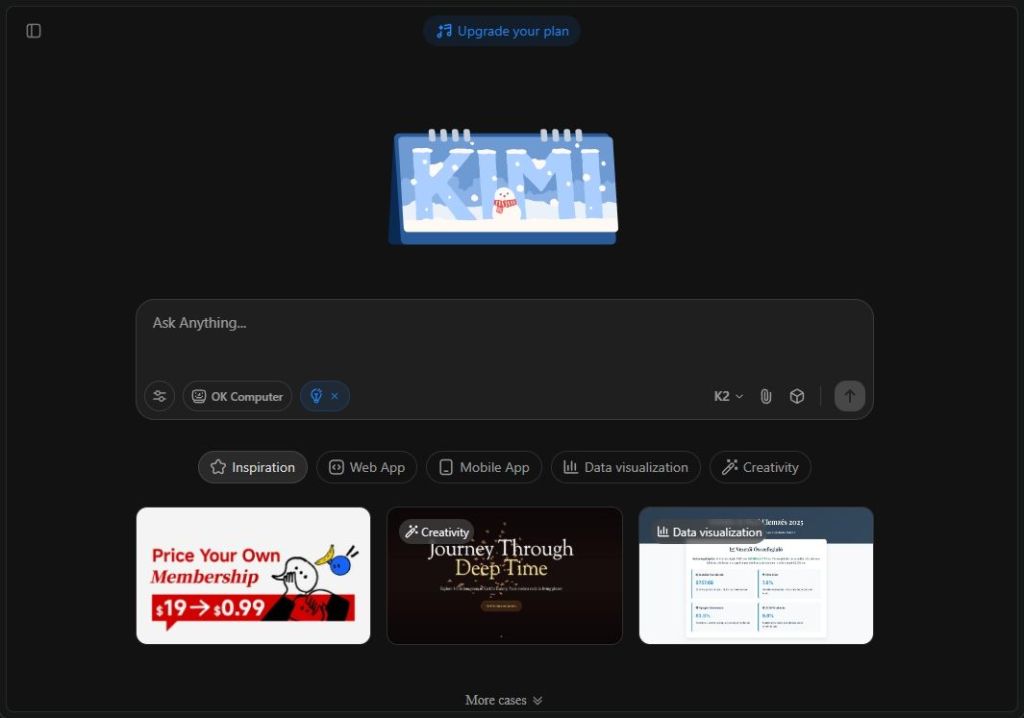
China’s Moonshot AI has released one of the best AI models called Kimi K2 Thinking for agentic browsing. And it powers the ‘OK Computer’ AI agent that executes the task for you. The AI agent can create slides, perform multi-step search, and synthesize information across various sources. Basically, you can use this AI agent to produce slides or reports. The best part is that you can delegate up to 3 tasks for free.
9. Copilot Actions on Windows 11
Beyond web browsers, Microsoft is launching a native AI agent on Windows 11 called Copilot Actions. It goes beyond your web browser, and performs actions on your local computer. While Microsoft has not released the AI agent yet, it’s coming to Windows Insiders in the coming months. You can use Copilot Actions to rename local files, extract data from PDFs or images, create PowerPoint slides and more.
Microsoft says Copilot Actions will perform actions in a virtual environment on your PC and you can monitor the task or take control anytime you want. If Microsoft can pull this off, it would be a huge step forward in making Windows an agentic OS.
10. Knowledge-Based AI Agents
Next, Knowledge-based AI agents are another real-world example of AI agents in 2026. OpenAI’s Deep Research AI agent is available to consumers on ChatGPT, and it can perform complex, multi-step research for you, like a professional analyst.
The Deep Research AI agent plans what information it requires, goes to the web to curate high-quality information, and does a deep analysis to generate a comprehensive report on any subject.

As it uses the powerful OpenAI’s powerful reasoning model with lots of tools, the generated reports are more fleshed out. The Deep Research AI agent can analyze images, diagrams, tables, PDF files, and even user-uploaded files to gather more insights. Best of all, the generated reports have in-line citations so you can quickly verify the information on ChatGPT.
Other than that, Google’s Deep Research AI agent in Gemini does the same thing, and it’s available for free. Anthropic has also released the Research tool in Claude that can research on the web and extract information from your personal Google Workspace documents.
11. Coding AI Agents
In the programming world, Coding AI agents are making big waves and stand out as great examples of AI agents. OpenAI’s latest Codex CLI tool is agentic in nature and operates from the terminal, just like Claude Code. Codex CLI has three modes — Suggest, Auto Edit, and Full Auto. The Full Auto mode can autonomously read, write, and execute commands without human approval.
Next, Cursor is an AI-powered code editor, and its agent can complete coding tasks while keeping programmers in the loop. It can automatically detect errors, apply fixes, and run commands. Devin is another agentic AI tool for developers who want to complete software development end-to-end. It can plan, generate context-aware code, debug, and solve complex coding errors. Devin also has support for multi-agent operations.
12. Conversational AI Agents
For consumers, voice-based conversational AI agents are the best real-world examples of AI agents. The upgraded Gemini voice assistant on Android, which is powered by an AI model, is much more agentic than traditional voice assistants. For example, the Gemini voice assistant can reason, maintain context across multi-turn conversations, and use function calling to execute the action.

Recently, the Gemini voice assistant on Android received support for multiple actions at once. You can ask Gemini to find when a particular train arrives and set a reminder using the Calendar app, in one go. There are many multi-step actions you can perform on your Android phone.
Apart from that, the Perplexity voice assistant on Android is again action-driven as it can find information using its LLM, and send emails or set contextual reminders. It can also book Uber and restaurants through voice input which demonstrates its agentic capability.
The new Alexa Plus voice assistant by Amazon is again an action-driven AI agent. It can execute tasks like booking an appointment, finding a service provider, managing your calendar, ordering groceries, and more. While Apple has also teased an AI-powered Siri that can perform actions, it’s delayed and may be released by the end of 2026.
13. Security AI Agents
Now, let’s talk about AI agents in the cybersecurity field. In this field, AI agents are being leveraged for threat detection and analysis, automatically responding to security incidents, behavioral analysis of systems, automated triaging of alerts, and more. Microsoft recently released Security Copilot with AI agents which can assist companies in areas such as phishing, data security, identity management, and more.

Microsoft Security Copilot can automatically detect phishing alerts and cyberattack signals. There are six different agents designed to process high-volume security tasks. Apart from that, Google also unveiled semi-autonomous Gemini security AI agents on Google Cloud to manage end-to-end security operations. It can help enterprise customers analyze malware, and investigate alerts.
14. Healthcare AI Agents
AI agents are revolutionizing the healthcare space, showcasing a great real-world example of AI agents in action. Healthcare AI agents can automate a lot of administrative workflows like scheduling appointments with doctors, managing patient records, billing, processing insurance claims, and handling patient inquiries. So besides medical-related diagnostic support, AI agents can be highly effective on the administrative side too.
On the diagnostic side, Healthcare AI agents can analyze X-rays, MRIs, and CT scans with speed and accuracy. Just recently, we learnt that a German-based company called Vara has developed an AI-powered software to detect breast cancer early on. Other than that, AI agents can analyze patient data and help in clinical decisions, reducing the burden on doctors.
Next, AI agents can engage with patients and deliver personalized health advice. Google has developed Articulate Medical Intelligence Explorer (AMIE) which offers a conversational diagnostic research AI system. Other than that, medical institutions can create specialized AI agents on Vertex AI for automating administrative and medical workflows.
15. Customer Support AI Agents
Customer support AI agents offer the most practical real-world example of AI agents. In fact, AI agents are already serving customers and answering queries around the world. AI chatbots, with access to customers’ history and order details, can handle customer queries 24×7. With support for AI agents that can check order status, company policies, etc., businesses can effectively leverage AI agents to resolve customer queries.
In this area, nearly all major cloud providers offer AI agents to handle customer interaction. Google has Customer Engagement Suite that includes AI agents, Microsoft provides Microsoft Copilot for Service, Amazon provides Amazon Connect, and Salesforce has Einstein Bots and Salesforce agents. Basically, these AI chatbots with agentic capabilities can transform custom support and can easily handle routine tasks at scale.
16. Finance AI Agents
From fraud detection to analyzing financial data, Finance AI agents can automate a lot of tasks. As we all know, AI systems are trained on a large amount of financial data, news, and economic data from the past. This allows Finance AI agents to perform a thorough analysis of companies and manage customers’ portfolios.

For instance, Finance AI agents can identify trading opportunities based on the risk tolerance of the user. Financial companies can use AI agents to monitor transactions and detect fraudulent activities. Not only that, but AI agents can be used to accurately measure the creditworthiness of individuals by analyzing multiple credit reports.
Besides that, Finance AI agents can automate repetitive back-office tasks like data entry and invoice processing which would reduce operational costs for the company. Big financial institutions such as JPMorgan Chase, Bank of America, Goldman Sachs, etc., are already utilizing AI across the board for fraud detection, risk management, client servicing, and more.
17. Supply Chain AI Agents
To give you another real-world example of AI agents, take a look at supply chain management. Supply Chain AI agents are designed to track shipments, monitor inventory, analyze customer demands, and forecast future trends. AI agents are best suited for demand forecasting as they analyze historical sales data, market trends, and the larger economic indicators to accurately predict demand.

In addition, Supply Chain AI agents can perform route optimization by analyzing real-time traffic data, weather conditions, etc., and re-route vehicles to reduce operational cost. It can also help in procurement, automating warehouse management, and risk management of suppliers. Amazon uses AI agents in its supply chain to manage its network of warehouses. Walmart is also using AI agents for optimizing routes and logistics operations.
18. Autonomous Vehicles AI Agents
Finally, we come to our final example of AI agents which is Autonomous vehicles. Autonomous vehicles operate without human intervention and make decisions solely based on sensor data. They are intelligent AI-powered systems that operate in a dynamic world. Autonomous vehicles use multiple cameras, radar, and LiDAR to gather real-time data and create an internal world model based on their surroundings.
These vehicles analyze the data using AI to make an informed decision as to where to stop, change lanes, accelerate, or slow down. Google’s Waymo autonomous cars are considered Level 4 (fully autonomous) and uses LiDAR along with cameras and radar to navigate traffic and offer a driverless experience. It’s already available in San Francisco, LA, and Phoenix.
Tesla cars are also examples of AI-powered agentic vehicles, but they are not fully autonomous (Level 2). It still requires driver supervision as it mostly uses a vision-based approach to detect obstacles.
So these are the 18 best real-world examples of AI agents in 2026. Action-driven AI agents are going to change the world as they become better and reliable in the future. Google has already stated that we are entering the agentic era, and things are only going to improve going forward. So what do you think about AI agents? Let us know in the comments below.