
Wordle is the most-played NYT game in the world, with millions guessing the five-letter word every day. Long before Wordle was created, Crossword has been part of everyone’s daily routine since the 40s. Both of these NYT games are played widely around the world, but they differ significantly from one another. If you are deciding between Wordle vs Crossword, here are the major differences and similarities between the popular NYT games.
Wordle vs Crossword in a Nutshell
On the surface, both Wordle and Crossword are word-finding puzzle games. However, their game mechanics differ drastically. Wordle is a quick puzzle that can be solved within a minute or so. On the other hand, solving the Crossword takes time, even with all the given clues.
That said, here is a brief overview of both Wordle and Crossword puzzles:
| Feature | Wordle | Crossword |
|---|---|---|
| Founder | Josh Wardle | Various freelance constructors |
| Release Date | October 2021 | February 15, 1942 |
| Objective | Guess a secret 5-letter word | Discover all words in a grid based on clues |
| Word Length | 5 Letters | Varies per word |
| Attempts | Six guesses allowed | Unlimited |
| Game Modes | Daily (Hard Mode available) | Daily (No Hard Mode) |
| Feedback System | Letters are color-coded for visual cues | Grid-based color coding |
| Paid or Free | Free | Paid |
| Avg. Solving Time | 1-2 minutes | 5-10 minutes |
| Puzzle Archive | Yes, requires an NYT subscription | Yes, requires an NYT subscription |
| Languages | English (Wordle Unlimited sites in other languages) | English |
Wordle vs Crossword Compared
With the basics out of the way, we have compared the long-running Crossword with the modern word-guessing game, Wordle, on common parameters like game mechanics, time taken to solve, error tolerance, and more.
Objective
| Feature | Wordle | Crossword |
|---|---|---|
| Goal | Guess a single secret word | Find all words based on clues |
| Starting Info | No hints (Enter your first word to start getting clues) | Clues for each word available from the start |
| Core Skill | Vocabulary, deduction, and quick thinking | Vocabulary and general knowledge |
Compared to other NYT puzzles, you need to start from scratch when it comes to Wordle. You have to guess and input a five-letter word to receive color-coded clues, which will point you towards the correct five-letter word of the day.
You must choose the starting word wisely, as you only have six attempts to guess today’s Wordle answer. If you are facing trouble, check our list of the best starting words for Wordle if you want some help getting off the ground.
In contrast, Crossword presents either a 15 x 15 (Monday-Saturday) or a 21 x 21 grid (Sundays) that you need to fill with at least 70-100 words based on the given set of clues.
This is the grid size of the standard Crossword puzzle, but two more versions are available to play, namely The Mini and The Midi Crossword. Both of these crosswords have a smaller grid size and can be finished much more quickly.
However, the goal is the same for all three: find the words (across and down) that perfectly fit the grid based on the hints.
Game Mechanics
| Feature | Wordle | Crossword |
|---|---|---|
| Feedback Type | Color-coded feedback offers visual cues on letter position | Grid-based color coding on check |
| Visual Cues | Color of the letter tiles (Green, Yellow, and Gray) | Color of the grids (Yellow, Red, and Blue) |
| Grid Structure | Fixed five-letter grid | 15 x 15 (Mon–Sat) 21 x 21 (Sun) |
| Input Method | Type full words as guesses | Type full words (Across and Down) |
| Clue Focus | Letter-level (position, adjacency, sequence) | Word-level |
As mentioned earlier, Wordle’s color-coded visual feedback system is a vital mechanic for players in solving the puzzle. As you enter your first guess, three colors indicate the position and status of the submitted letters.
Green highlights the correct letter in the correct position, yellow indicates the correct letter in the wrong position, and gray denotes an incorrect letter that isn’t present in today’s answer. With the color-coded feedback, you can avoid common Wordle mistakes and easily find the secret word.
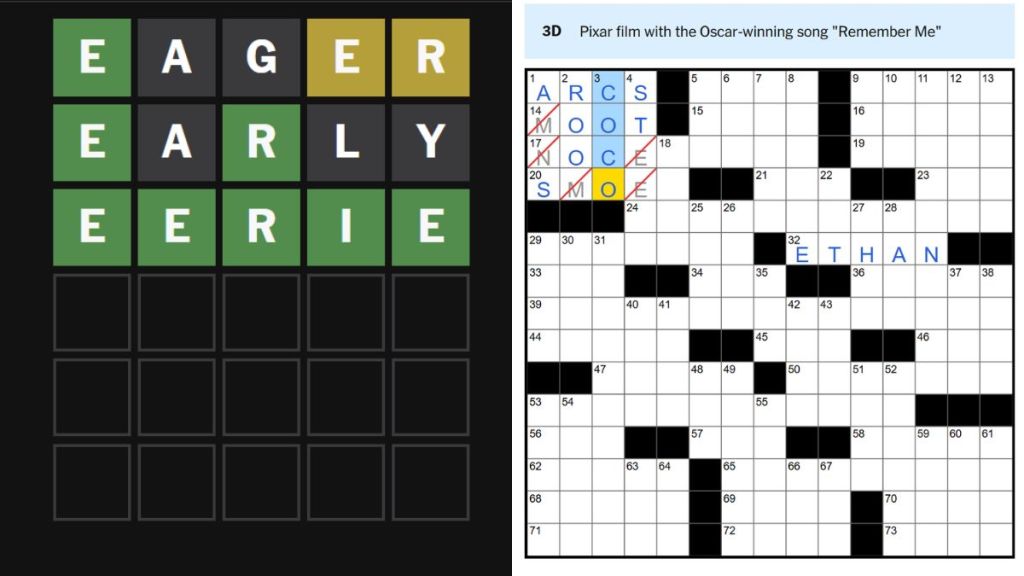
In comparison, the Crossword doesn’t highlight the letters in a specific set of colors right away. It, instead, lets you check if the letters are in the right cell or not by enabling Crossword’s Autocheck feature, which strikes out incorrect letters.
If it’s a correct word, each letter cell is highlighted in blue. This way, you can learn if the word you are going for is right or wrong. In addition, you can use the Pen and Pencil feature to write and distinguish the correct words you know, and the words you are still guessing.
So, unlike Wordle, you are given both clues and visual hints in Crossword to complete the puzzle.
Error Tolerance
| Feature | Wordle | Crossword |
|---|---|---|
| Max Attempts | Six guesses | Unlimited |
| Penalty for Wrong Guess | Lose one of six guesses | None |
| Game Over Condition | Not finding the secret word on the sixth guess | None |
| Pressure Level | Medium, as you have limited guesses, but each guess can give you enough confirmed letters | None, as you can freely input words |
When it comes to error tolerance, Wordle and Crossword are opposites. In Wordle, you only have six guesses to find the secret word. If you fail, then it’s game over. This is where the visual feedback comes in handy and lets you turn the game around.
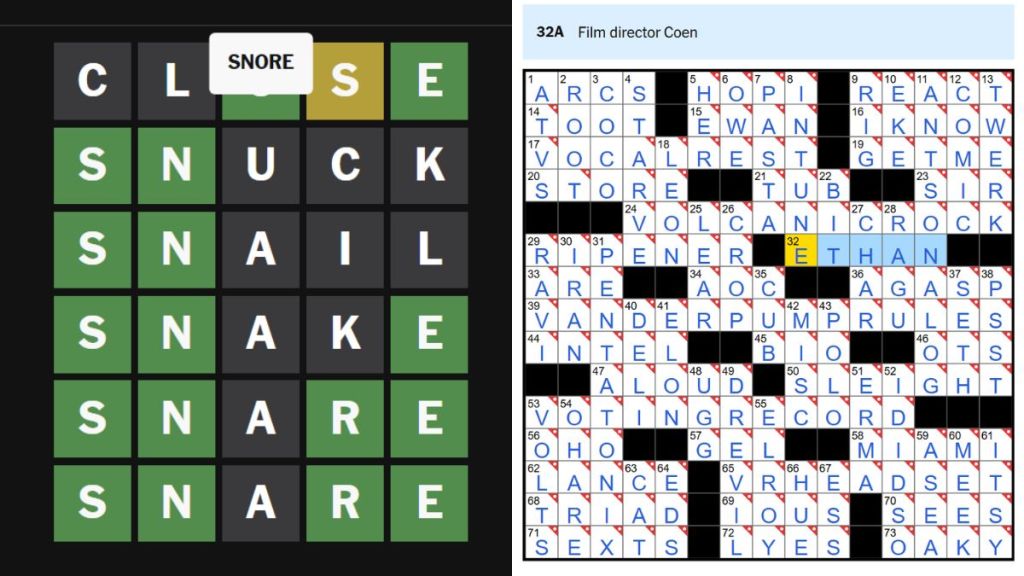
On the other hand, there are no limits in all three Crossword games under the NYT banner. You can enter an unlimited number of words as you guess answers based on clues. The game won’t penalize you or end. So, you can keep adjusting your guesses until you end with the right words.
Is Wordle Harder Than Crossword?
| Feature | Wordle | Crossword |
|---|---|---|
| Daily Variation | Moderate, as you only have a 5-letter word every day | Easy to hard, as it depends on the puzzle every day |
| Learning Curve | Low, as color feedback is easy to understand | Easy to understand, but the learning curve gradually increases with puzzle complexity |
| Hardest Element | Lesser-known words | Wordplay and cryptic words |
| Skill Tested | Vocabulary and deductive reasoning | Vocabulary and General Knowledge |
Even though you’re given a blank slate at the start, Wordle is still one of the easiest puzzles to solve in the NYT Games portfolio. There is a dedicated Wordle Hard mode for puzzle enthusiasts, where you always need to use green and yellow letters revealed in previous guesses. Otherwise, the basic Wordle game’s difficulty ranges from easy to moderate.
It takes only a few minutes to solve with the help of all the visual feedback we receive after entering a starting word. However, if you are struggling to figure out Wordle daily, learn how to play Wordle properly by going through our guide, where we have covered the basics.
In contrast, the Crossword requires a significant amount of your time and vocabulary skills as its difficulty can often range from easy to hard. But with the checking feature and clues, it is always possible to solve a Crossword game without facing defeat.
Time Investment
| Feature | Wordle | Crossword |
|---|---|---|
| Avg. Solve Time | 1-2 minutes | 10+ minutes |
| Short Word Days | Fixed five-letter words | Fixed grid format |
| Long/ Hard Word Days | Fixed five letter words | Can appear |
| Natural Time Cap | Yes, as six guesses end the game | None |
| Daily Commitment | Low | High |
Solving a Wordle only takes a few minutes, as we mentioned before. All you have to do is find the secret five-letter word of the day, and you are done. Even though there is a guess limit, the visual clues are more than enough to help you figure out the correct word. Therefore, both the difficulty and time investment for a Wordle game are minimal.
However, unlike Wordle, you cannot finish a Crossword game in minutes. The NYT Crossword needs you to commit at least 10 minutes or more every day. The difficulty of the game varies, but there are alternative versions of the game that you can go with if you are already running low on time daily.
Wordle vs Crossword: Which Game Should You Play?
NYT Crossword is a classic word game that has stood the test of time and continues to pull in the most dedicated puzzle players. On the other hand, Wordle was only released recently but has been exploding in popularity ever since its debut in 2021. So, both Wordle and Crossword are must-play NYT puzzle games, and it comes down to your personal preference at the end.
If you want a mini puzzle to entertain you and enrich your vocabulary and deduction skills, then go with NYT Wordle. It is a perfect puzzle game that requires only a little time to complete. So, you can easily begin playing Wordle as part of your daily routine. You can also check out the best games like Wordle if this game has become part of your everyday routine.
But if you are ready to commit a portion of your daily time to solving a much larger puzzle, which tests your vocabulary and general knowledge, then opt for the Crossword. In addition to expanding your vocabulary skills, Crossword also improves your world knowledge. If you are stuck between Strands vs Wordle, you can go through our comparison to understand the differences. We have also compared Wordle vs Connections if you want to explore more NYT game matchups.
As always, make sure to play both puzzles for at least a week to see which one suits you the best and becomes your daily mental workout companion.
While Wordle is a free-to-play NYT game, you need an NYT subscription to play any version of Crossword, be it the standard, Mini, or Midi.
In Wordle, you are limited to six guesses, whereas Crossword has no guess limit.
Yes, Crossword is generally harder than Wordle. It requires you to find 70–100 words using vocabulary and general knowledge, and its difficulty increases from Monday to Saturday. Wordle only requires finding one five-letter word per day using deductive reasoning.
The main difference is scope and structure. Wordle gives you one secret five-letter word to find in six attempts using color-coded feedback. Crossword gives you a full grid of 70–100 words to fill in using across and down clues, with no attempt limit and no fail condition.
Wordle typically takes 1–2 minutes to complete. The NYT Crossword takes 10 minutes or more depending on the day, with Monday puzzles being the quickest and Saturday puzzles the most time-consuming. If you are short on time, the Mini or Midi Crossword are faster alternatives.
Wordle Hint Today - October 16, 2026 (Puzzle #1945)
 Rishabh Sabarwal
Wordle Bot: What It Is, How It Works, and How to Use the Tool to Get Better at Wordle
 Daksha Gupta
NYT Games Reset Time Guide: When Do Wordle, Strands, Connections and Other Games Reset?
Daksha Gupta
An X User Claims to Have 'Cracked Wordle,' So We Put His Three Opening Word Trick to the Test
Daksha Gupta
How Does Wordle Work? Explained
 Sanmay Chakrabarti

7 Best Globle Tips and Tricks to Find the Mystery Country Easily
Daksha Gupta
Connections Hints Today & Answers for October 16
Sanmay Chakrabarti

When Does Globle Reset? Find the Reset Time Here
Daksha Gupta
How Many Countries Are in Globle? A Full Globle Country List
Daksha Gupta

Globle Answer Today for October 16, 2026 - Hints and Full Solution
Daksha Gupta