- AI systems learn patterns from data rather than following explicit instructions. Neural networks process information through connected layers to detect complex patterns.
- Modern AI chatbots like ChatGPT predicts the next word based on statistical probability.
- Unlike humans, AI systems don't know what they are saying and lacks true understanding of the world.
Artificial Intelligence is no longer science fiction so understanding this technology is crucial if you want to understand the future. So, in this article we have explained how does AI work, what actually happens behind the scenes, and answer whether machines truly think like humans. On that note, let’s go ahead and learn how AI really works.
What is Artificial Intelligence (Beyond the Chatbots)?
Artificial Intelligence (AI) is often reduced to just AI chatbots and voice assistants, but it’s much bigger than that. Fundamentally, AI is a discipline of computer science that focuses on building intelligent systems that can perform tasks that normally requires human intelligence. For example, recognizing images, translating languages, making decisions in a tricky environment, or predicting outcomes.
Beyond that, AI is also used in various embedded systems that we use every day. These include algorithms that recommend the next Reel or Netflix show, the fraud detection system behind credit cards, and more. Even navigation apps like Google Maps use AI to reroute and find the optimal direction. Basically, AI has many examples and it’s a broad system with various use cases, but the common goal is to make machines that are smart like humans and adaptive to different environments.
Defining AI vs. Traditional Computing
AI is quite different from traditional computing software. Traditional software is deterministic. This means, for the same input, AI always returns the same output as it’s pre-programmed. AI systems, on the other hand, are probabilistic in nature. They use statistical patterns to make an educated guess and it may get better over time. Here is the core difference between AI and traditional computing.
| Traditional Computing | Artificial Intelligence | |
|---|---|---|
| How to handle logic | Follows explicit and pre-programmed rules | Learns pattern from data on which it’s trained |
| Adaptability | Only does what it’s programmed to do | Improves with new experiences |
| How to handle ambiguity | No | Yes |
| Failure mode | Breaks or shows error if rules are not defined | Can make wrong predictions |
The Core Mechanics: How AI Learns
As I described above, AI systems don’t follow a fixed script and developers don’t write rules for every situation, instead they learn through training. AI systems are trained on large amounts of data and they figure out the rules by themselves. During the training process, millions of parameters are adjusted to tune the system until its output is correct.
Machine Learning: The Foundation of Modern AI
Machine Learning or ML is one of the most common ways to train an AI system. This kind of AI system is trained on historical data to identify patterns and make predictions on new data. To give you an example, if you are building an AI system to identify spammy emails, instead of writing explicit rules, you simply feed the model thousands of spam and non-spam emails. It automatically figures out the pattern and learns on its own.
Here are the key steps for ML training.
- Input data: Expose the model to large amounts of labeled or unlabeled examples
- Training: During this process, the model adjusts its internal parameters to minimize errors
- Prediction: Apply the learning to new and unseen data
Deep Learning and Neural Networks: Mimicking the Brain
Deep Learning is a specialized subset of machine learning and it uses an approach inspired by the human brain, and it’s called neural networks. In this training process, layers of interconnected nodes (called neurons) process information in sequence and each layer extracts increasingly abstract features and meaning from the data.
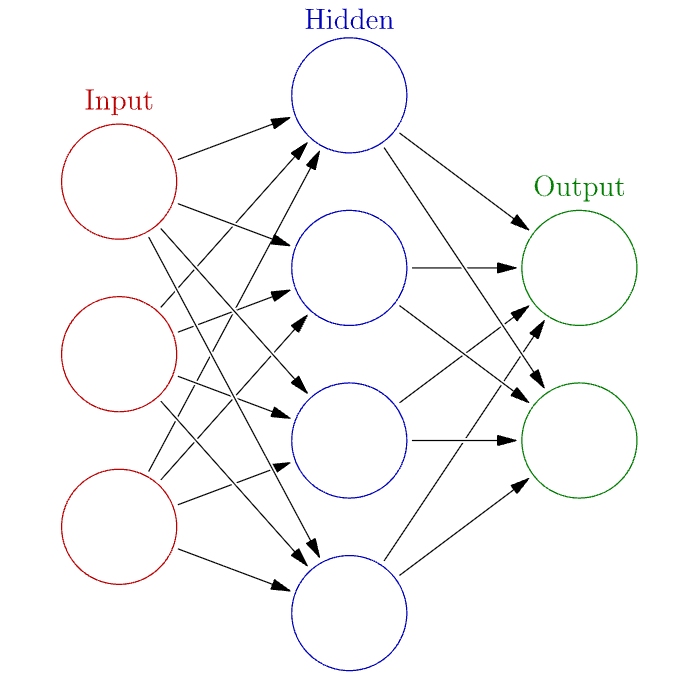
For example, if you ask an AI system to recognize a cat photo, Layer 1 will detect the edges and shapes, Layer 2 will use those features to make something like ears, and Layer 3 will combine all those features to recognize the cat.
Basically, the “deep” in deep learning comes from the number of interconnected layers. Modern AI models have millions of such layers and this allows the AI to do complex tasks like speech recognition, and image generation with high accuracy. And that’s the key difference between deep learning and machine learning.
The 3 Main Methods of AI Training
Now, coming to the three popular methods of AI training. Let’s start with Supervised learning and see how AI systems learn from the data.
Supervised Learning (Learning with Labels)
First off, Supervised learning is the most common way to train an AI system. It learns from a dataset where the data is labeled and has examples with the correct answer.
How it works: You start feeding the model thousands of examples with labels. For example, images are tagged with “cat” or “not cat” for an image recognition system for cats. It learns from the labeled data and applies the learning to new data.
Best for: This kind of model is best for classification, be it email spam filters, facial recognition, image recognition, etc.
The catch: That said, labeling millions of data is expensive and time-consuming. Manually tagging all data is nearly impossible.
Unsupervised Learning (Finding Hidden Patterns)
Now, as the name suggests, Unsupervised learning is not trained on labeled data. In this training process, the AI system must find meaning, structure, and relationship on its own. It automatically learns to group similar items, detect exceptions, and reduce complexity.

How it works: The model starts to recognize relationships between complex data without being told what to look for.
Best for: This kind of model is best for discovery and segmentation tasks such as fraud detection in security, grouping customers based on their similarities, creating topic clusters from large documents, and so on.
The advantage: The advantage of Unsupervised learning is that it doesn’t require labeling, which makes it scalable for massive datasets.
Reinforcement Learning (Trial and Error)
Now, we come to the third and the most popular training method in recent years, Reinforcement Learning (RL). Here, the model takes a different approach and interacts with an environment to receive rewards or penalties based on its actions. For example, when you do something right or good, you get a treat, and bad behavior gets penalty.
How it works: An AI system takes actions, and receives feedback. It could be positive or negative reward. Gradually, the system learns the optimal strategy which maximizes long-term rewards.
Best for: RL is used in game-playing AI systems like AlphaGo, robotic movement, and autonomous vehicles.
The advantage: RL is computationally very intensive, but results in capable systems for complex environments.
Inside the Tech: How Generative AI & LLMs Work
Generative AI is the new wave of AI systems which don’t classify images or predict the weather, it creates from the data it’s trained on. It can create text, images, code, audio, video, music, etc. The most prominent example are Large Language Models (LLMs) which are designed for generating text. Here is the simplified process of how LLMs work.
- Pre-training: The model is trained on vast amounts of text from the internet, including books. It learns language patterns by constantly predicting the next word in a sequence. It also learns grammar, syntax, and abstract features of language.
- Fine-tuning: Now, this pre-trained model is trained on high-quality and curated datasets to improve accuracy and safety. This process makes the raw model a bit more useful.
- RLHF (Reinforcement Learning from Human Feedback): Next, during the RLHF process, human reviewers evaluate outputs from the model and gives feedback. This feedback cycle shapes the model behavior to be more helpful and less harmful.
- Inference: Finally, the model can be used by end users. When you ask a question, the model generates a response based on what it learned during the training process. It tries to generate the most statistically correct answer.
Key Components of an AI System (Data, Algorithms, and Compute)
Every modern AI system is built on three important components, which include data, algorithms, and compute. Here, data is the raw training material like text, images, videos, audio, etc. If you have better quality data in large quantity, you will see better results. Similarly, algorithms are mathematical breakthroughs that define how the model learns and makes decisions.
An efficient algorithm can train a capable model that is highly accurate even with less data. Also, algorithms are different based on modalities. If you are training an LLM, the algorithm will be Transformer-based, and if you are training an image generation model, it might be based on the Diffusion architecture.
Finally, the compute power like GPUs, TPUs, and cloud infrastructure play a key role in training massive AI systems. Currently, AI models are trained on more than a trillion tokens and they require a cluster of gigawatt data centers to complete the training run.
All these three factors are linked together. If one of the areas see improvements, it unlocks much powerful capabilities in AI systems. Currently, we are seeing all three areas are improving at a breakneck pace.
Challenges and Ethical Considerations in AI
While AI is rapidly advancing, there are some serious challenges and ethical considerations around its development. AI companies, researchers, and governments must come together to answer these questions.
- Bias and fairness: As described above, if an AI system is trained on biased or under-represented data, it amplifies those biases in its response. An AI-powered hiring tool may discriminate based on race, or facial recognition systems may underperform on darker skin tones.
- Hallucinations: AI hallucinations is one of the most troubling issues of today’s AI systems. When unsure, AI models tend to hallucinate and generate confident, but entirely false information. This makes it harder to trust AI models.
- Unemployment: While automation has always displaced work, many fear that AI as a technology is going to completely fuel the economic disruption. It’s particularly more important because AI is gaining capabilities at an astounding pace, and it may result in mass unemployment.
- Transparency: Despite all the advances, AI systems are largely a black box. Researchers say that they are still trying to understand how and why a model comes to a decision. In fields like healthcare or criminal justice, it may prove to be fatal if we don’t understand the system itself. Companies are now putting resources on AI interpretability to find out how AI systems think.
- Existential risk: A number of AI researchers argue that advanced AI systems may pose long-terms risks to humanity if they are misaligned. That’s why companies are being asked to train AI models with human values to mitigate those existential risks.
No, AI systems tend to “hallucinate” and generate entirely false information when they are unsure about a topic. So, you can’t fully trust an AI response.
ChatGPT is a Generative AI chatbot, and it’s powered by a large language model (LLM).
GPT stands for Generative Pre-training Transformer, which means it’s pre-trained on the Transformer architecture to generate text, images, videos, and more. Currently, GPT is hugely popular for generating different kinds of media so it has become synonymous with AI.