
While Gmail is the default choice for several users out there, there comes a point where you simply want to try something new. Or, you probably just want to stop relying on the Google ecosystem too much and take a more privacy-focused route. If you can relate and are on the lookout, here are some of the best Gmail alternatives in 2026.
Overview of Best Gmail Alternative Options in 2026
While ProtonMail is a great Gmail alternative for privacy-focused users, if you are looking for a fresh new way to check emails, I would recommend the HEY email client by Basecamp. You can find all such cool email apps right below.
| Gmail Alternative | Best Suited For | Limitations | Pricing |
|---|---|---|---|
| ProtonMail | Privacy-focused users, journalists, businesses who need end-to-end encryption | Only 150 messages per day under free plan | Free, Paid plan starts at $9.99 per month |
| Tuta | Users who want strong encryption for emails, great for businesses | Only 1GB storage under free plan | Free, Paid plan starts at $3.60 per month |
| StartMail | Best for users who want unlimited email aliases, privacy-focused and anti-tracking professionals | No mobile apps | Paid plan starts at $4.99 per month |
| Outlook | Users who are in Microsoft 365 ecosystem, Enterprise users, organizations with extensive integrations | Free version has ads | Free, Paid plan starts at $9.99 per month, bundles Microsoft 365 apps |
| HEY | Cool new Gmail alternative, workflow-based approach, best for individuals and business users | Free version only for 30 days | Free, $99 per year |
| Zoho Mail | Best for small and medium businesses, startups, Zoho ecosystem users | Slow search in mailboxes | Free for 5 users, $1 per user per month |
| Fastmail | Best for privacy-focused power users, Supports IMAP/SMTP, custom domains | No end-to-end encryption by default | Paid plan starts at $6 per month |
| Shortwave | AI-powered features, automate your email, organize and schedule with AI agent | Dependent on Gmail | Free, Paid plan starts at $18 per month |
| Yahoo Mail | Free email service with decent storage, legacy users, improved service | Ads on free tier | Free, Paid plan starts at $5 per month |
| iCloud Mail | Best for Apple ecosystem users, seamless device syncing, 5GB free storage | 20MB attachment limit | Free. Paid plan starts at $0.99 per month |
How We Tested the Best Gmail Alternatives?
To find the best Gmail alternatives, I started by email services that take privacy seriously. So, I looked for email clients that offer end-to-end encryption by default. On top of that, I checked whether the email services intelligently block phishing attempts or not. Next, I installed a dozen of email apps and sent various messages to see how fast they are synced and delivered.
Gmail is very good at it, so it was important to find capable alternatives that deliver on performance, privacy, and features as well. Beyond that, I also included some email services that have taken a fresh approach to email messaging. Many services now offer AI agents to automatically schedule and organize your inbox, while some offer a workflow-style inbox. Considering all these points, I have finalized the 10 best alternatives to Gmail.
Best Gmail Alternative Apps for Privacy
ProtonMail is one of the best Gmail alternatives if you want additional privacy protections. Following that, Tuta is another encrypted email service you can consider in place of Gmail. You can find more such privacy-focused email clients right below.
ProtonMail
ProtonMail is a Swiss-made and privacy-friendly alternative to Gmail and also one of the best Email clients. It offers end-to-end encryption and does not require any personal information while creating an email account. Yes, you can choose to not share your phone number. For security, ProtonMail uses open-source encryption libraries. The company says it uses secure implementations of AES-256 (better known as military-grade encryption), RSA, and OpenPGP.
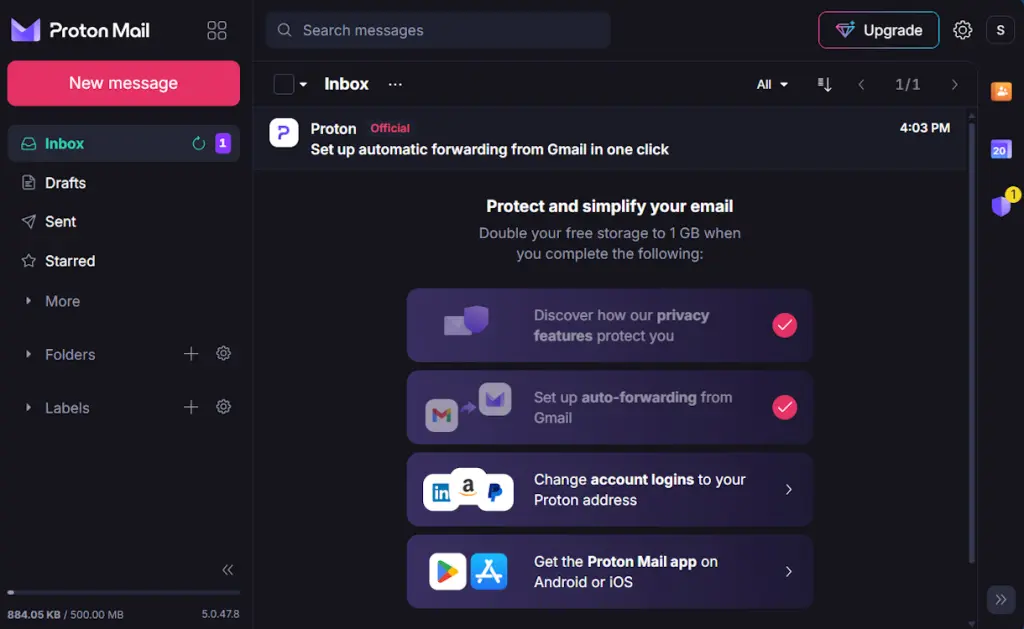
While you have to opt for the paid version to use all the features, the free tier offers 500MB of mail storage and a limit of 150 messages per day. For other features, including custom filters, using your domain, and priority customer support, you can choose the Plus plan which costs $9.99 per month.
| Pros | Cons |
|---|---|
| Solid End-to-End and Zero-access Encryption | 150 messages per day under free version |
| User-friendly interface | |
| Paid version is economical |
Price: Free, $9.99/month
Tuta
Tutanota is yet another popular open-source and privacy-focused email service that offers encrypted email service with E2E encryption. The German company stores your encrypted emails in secure data centers in the country and is compliant with GDPR. Like Zoho Mail, Tutanota offers an ad-free experience for free.

With Tutanota’s free tier, you get 1GB of storage, a single calendar, and limited search options. The paid plans offer up to 20GB of storage, and you can get additional storage with separate storage subscriptions. To make the process a bit more secure, Tuta also makes you go through a 48-hour verification process, post which you will be able to make the most use of its services.
| Pros | Cons |
|---|---|
| Free version has no message limits | Only 1GB storage under free plan |
| Super secure and doesn’t profile accounts for advertising purposes | The 48-hour verification process may be off-putting for some |
| Very easy to use |
Price: Free, $3.60/month
StartMail
While StartMail is more of an email client than a fully-fledged alternative to the Gmail service, it gets a lot of things right. For starters, it’s a Dutch-based privacy-focused client that offers disposable aliases to keep your main email address hidden. Besides, the client doesn’t have ads, encrypts emails, and the base plan offers 20 GB storage which is plenty for emails.

StartMail doesn’t have a free tier which could be a bummer for those who want to try it first to see if it’s any good. For an asking price of $36 a year, you get an email address with StartMail and one custom domain alongside unlimited email aliases and 20 GB storage. Combined with the privacy and security features it has to offer, StartMail is easily one of the best Gmail alternatives.
| Pros | Cons |
|---|---|
| Great privacy | No free tier |
| Unlimited aliases | No mobile apps |
| Base 20 GB is sufficient for most |
Price: Free, $4.99 per month
Best Gmail Alternative for Productivity and Business
Outlook is, without a doubt, a capable alternative to Gmail for business users. HEY is another fantastic service that brings a workflow-style approach to emails. You can find more such productive email apps in this section.
Outlook
If you use Microsoft’s services, you have probably heard of Outlook. In case you haven’t, Outlook is Microsoft’s email offering. Just like Gmail, Outlook has integrations with Microsoft’s productivity apps such as Word, Excel, PowerPoint, and OneNote. In addition, Outlook features many AI-powered Copilot features. However, it is worth mentioning that the free tier of Outlook has ads.

Getting rid of ads will cost you $9.99 per month or $99.99 per year with the Microsoft 365 Personal plan. You also get access to 50GB of mailbox storage (15GB on the free version), custom domain names, and 1TB of OneDrive storage with the subscription. Outlook is a popular Gmail alternative for businesses.
| Pros | Cons |
|---|---|
| Integration with Microsoft Office Suite | Not as integrated with non-Microsoft services |
| Neat and well-organized interface | |
| Free version offers 15GB of mailbox storage |
Price: Free, $9.99/month
HEY
You might not be aware but HEY is the cool new Gmail alternative that you must try. It has been developed by the team behind Basecamp and it brings unique features like Bubble Up for automatic follow-ups. HEY also features something called The Screener that seeks your consent before allowing someone to email you.
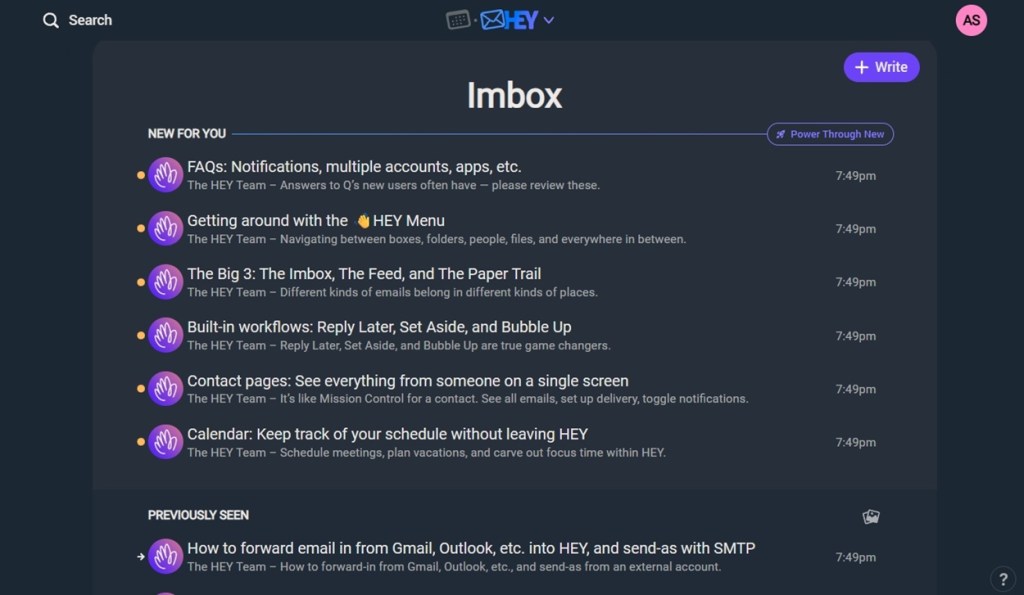
And instead of traditional folders, HEY organizes your emails into the “Imbox” (yes, it’s not a typo), which shows your important messages. There is also The Feed for newsletters and Paper Trail for receipts. You get all of this for $99 per year and you get a new @hey.com email address. To sum up, HEY brings a completely new workflow-approach to email and you should consider it in place of Gmail.
| Pros | Cons |
|---|---|
| Premium email service from Basecamp | No free tier |
| Workflow-based approach to email | |
| Get @hey.com email address |
Price: Free for 30 days, $99/year
Zoho Mail
Zoho Mail is another option you can consider if you’re looking for a Gmail alternative. What makes Zoho Mail an attractive choice is that it offers an ad-free experience, even for free users. You also get 5GB of storage in the free tier, along with access to Zoho’s diverse workplace apps.

Furthermore, Zoho even offers a free plan for small businesses with up to five users. That is enticing if you are just getting started with your startup and want email hosting for a single domain. You can also opt for Zoho’s Mail Lite, Mail Premium, or Workplace plans for more users and additional features.
| Pros | Cons |
|---|---|
| Integrates very well with the entire Zoho Suite | Not the most user-friendly interface |
| Free version is ad-free | |
| Uses TLS and S/MIME security protocols |
Price: Free, $1 per user per month
Fastmail
Just like Tuta and Edison Mail, Fastmail doesn’t go through your emails for advertising purposes. On top of that, you get to enjoy top-tier TLS, SSL, and PFS encryption protocols, alongside working with YubiKey Nano and YubiKey Standard. It’s also 100% ad-free, and you have complete ownership of your data, unlike on Gmail, where work emails are practically owned by your employer.

Additionally, your emails are masked to hide the IP addresses and offer secure logins. You can access Fastmail not just via the web, but there are dedicated Android and iOS apps in place for it, all of which are said to have phenomenal user interfaces. You also get at least 60GB of storage, which you can further expand as per your usage. Users can also create custom domain names as well as multiple aliases with Fastmail.
Now, if you’re willing to take the paid route as well and get one of the best Gmail alternatives, Fastmail is your way to go. However, plans are not too expensive either, starting at just $4.67 per month, costing you $168 billed every 36 months. If you want to take the monthly route, it will set you back $6. In addition, you also get a free trial of 30 days, so there’s that.
| Pros | Cons |
|---|---|
| Quite affordable | No free version |
| Top-tier security and privacy features | |
| Custom domain and multiple alias creation |
Price: Free, $6/month
Shortwave
AI is everywhere, so why should your email management be left out? Shortwave is the best possible example of integrating AI into your workspace, thanks to what the makers call Ghostwriter. This AI assistant lets you summarize emails and conduct smart searches to save a lot of time. In addition, it now uses AI agents to organize and schedule your calendar within Shortwave.

Moreover, since Shortwave is made by ex-Google folks, you see it retains some of those useful features like snoozing and pinning emails, undoing send, customizing notifications, email categories, and more. All of that easily makes it one of the smartest and best Gmail alternatives.
However, Shortwave only works with Google accounts, so there’s that. Besides, since it leverages Google accounts, the storage limit depends on how much storage you have on your Gmail account. Paid plans start at $14 per month, billed annually. Or, if you want to take a monthly approach solely, you can get it for $18.
| Pros | Cons |
|---|---|
| Packed with AI-powered features and AI agents | Only integrates with Google |
| Free version is adequate | The learning curve can be steep |
| Attractive interface |
Price: Free, $18/month
Best Gmail Alternative Apps for Free
Finally, you can consider familiar names like Yahoo Mail if you are looking for a free Gmail alternative. Apple’s iCloud Mail is also a great service worth checking out.
Yahoo Mail
Yahoo Mail might not be as popular as it used to be before, but Yahoo is still a free email provider and a neat alternative to Gmail. One attractive aspect of Yahoo Mail is that it offers a whopping 1TB of storage to free users. However, the catch is – the maximum file size for an attachment is 25MB.

Apart from that, you can customize the look and feel of Yahoo Mail with themes. Also, Yahoo Mail lets you manage all your email addresses in one place, use filters, group conversations, view emails by topic, and more. Most importantly, Yahoo mails use TLS encryption in transit. With all that said, do keep in mind that you will see ads on the free version.
| Pros | Cons |
|---|---|
| Staggering amount of free storage | 25MB maximum file attachment size |
| Secure and reliable | Too many ads |
| Custom domain and alias creation |
Price: Free, Paid plan starts at $5 per month
iCloud Mail
If you’re an iPhone user, Apple Mail could be a great alternative to Gmail. While it does offer an iCloud mail email address, it’s better at being an email client. It’s simple and quite easy to use, especially if you’re into the Apple ecosystem. If you’re not into the ecosystem, though, iCloud email can be accessed on the web via your Apple account. One of the clear advantages Apple Mail has over Gmail is the ease of adding multiple email addresses from different providers, which is not that easy on Gmail.

Therefore, if you juggle multiple email addresses, Apple Mail does a better job at helping you manage them. Not only that, the service recently got Apple Intelligence, so just like Gemini, it can sum up your emails or help you write new ones effortlessly. Storage-wise, sure, you only get 5 GB on the free version but upgrading to iCloud+ could give you lots of storage. Overall, Apple Mail is one of the best Gmail alternatives.
| Pros | Cons |
|---|---|
| Completely free | Only 5 GB off storage on offer for free versions |
| Great security | |
| Integrated Apple Intelligence | |
| Excellent for Apple users | |
| iCloud+ is incredibly inexpensive |
Price: Free, Pricing starts from $0.99 per month
So, those are the best Gmail alternatives in 2026 with more storage space, privacy features, and sign-up options that don’t require you to enter a phone number or address. Do you use any other email service that’s not mentioned in the list here? Let us know if that’s the case, along with the reason why you chose it in the comments section below.
I would highly recommend ProtonMail if you are looking for a privacy-focused Gmail alternative.
For personal users, I recommend the HEY email client. You get a new @hey.com email address and fantastic features that turn email messages into a workflow.
You can check out Outlook and Zoho Mail if you run a business. Apart from that, HEY is also a great email client for business users.
