
The New York Times Games features classic puzzles like Crossword and Spelling Bee, which puzzle enthusiasts have tackled every morning for decades. Now, they are challenging the classics with new games like Letter Boxed, Wordle, and more. If you are wondering which one of the puzzles, modern Letter Boxed vs classic Spelling Bee, is worth your time, check out our in-depth comparison to find the key similarities and differences.
Letter Boxed vs Spelling Bee in a Nutshell
The NYT Letter Boxed game features a geometric design with letters inscribed on each side of the box (or a square). The goal is to link all letters in as few words as possible. With a word limit set in stone, Letter Boxed poses a great challenge for puzzle lovers to solve
The Spelling Bee puzzle has evolved from the NYT magazine into a modernized game in the digital space. However, Spelling Bee is a classic word-hunting game at its core, with the puzzle featuring the iconic honeycomb design. So, keep finding as many words as you can from the given letters is Spelling Bee’s main objective.
That said, here is a brief comparison of the NYT Letter Boxed and Spelling Bee games:
| Feature | Letter Boxed | Spelling Bee |
| Founder | Sam Ezersky | Frank Longo |
| Release Date | February 1, 2019 | February 22, 2015 (print) May 9, 2018 (browser) |
| Objective | Use all the given letters to solve the puzzle | Discover as many words as possible from a given set of letters |
| Game Rules | Using all letters in as few words as possible Each word must be at least three letters long Cannot use two consecutive letters from the same side | All formed words must include the center letter Reusable Letters Each word must be at least four letters long |
| Game Modes | Daily | Daily |
| Paid or Free | Free (until a certain rank) | Paid |
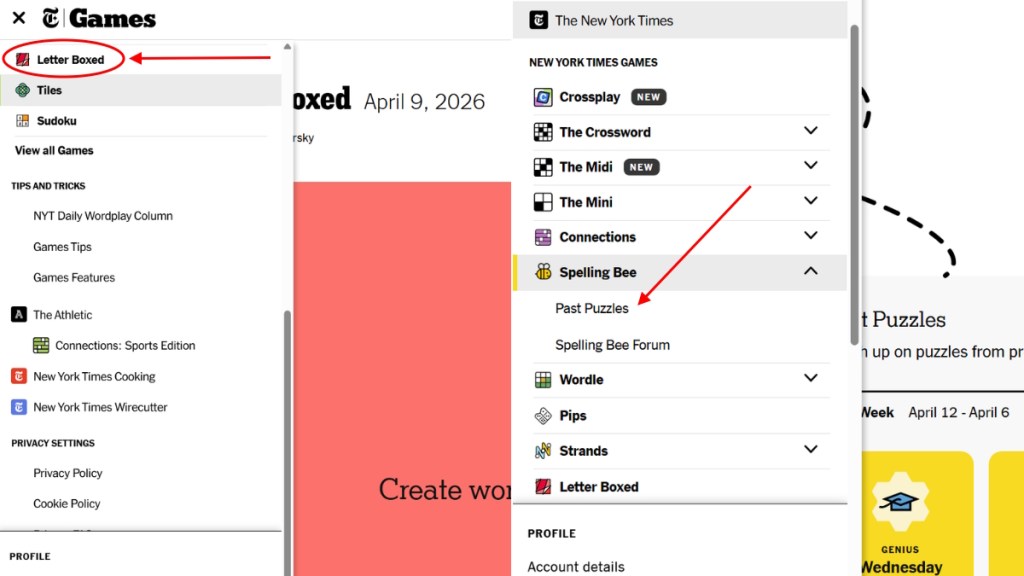
| Puzzle Archive | Yes, requires NYT Subscription | Yes, requires a NYT Subscription |
| Languages | English | English |
Letter Boxed vs Spelling Bee Compared
Objective
| Metric | Letter Boxed | Spelling Bee |
| Goal | Use all letters within a set limit of words | Use all letters to find numerous words + Pangram |
| Word Length | At least 3 letters long | At least 4 letters long |
| Daily Puzzle | One per day | One per day |
The Letter Boxed puzzles test your strategic thinking in addition to vocabulary skills. You need to stay two steps ahead, as you must remain efficient when it comes to forming words with the given set of letters. You get unlimited tries to connect letters, but the strict rules of Letter Boxed raise the difficulty bar.
If you’re struggling a bit with the Letter Boxed rules, learn how to play Letter Boxed to understand the core mechanics and rules to start playing the game better. The key to success here is to form proper, lengthy words so you can quickly use all the given letters.
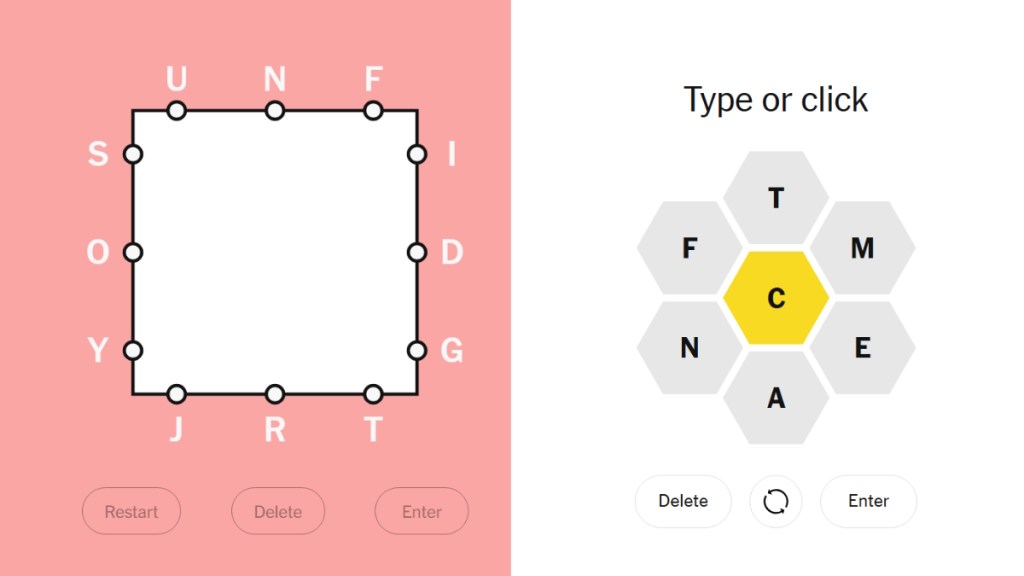
On the other hand, Spelling Bee is much simpler, where you can keep forming words with the given set of letters, but the middle letter needs to be present in all words. You can keep finding new words to increase your score and reach the Genius or Queen Bee ranks.
While finding words remains the common objective between these two games, the concept of chaining letters varies greatly, as both Letter Boxed and Spelling Bee come with a different set of rules.
Game Mechanics
| Feature | Letter Boxed | Spelling Bee |
| Color Feedback | Apricot Blush Pink (lines and stripes) | Highlighted in Bold (Pangram) Yellow (middle letter) Black (other letters) Grey (wrong letters) |
| Visual Cues | Formed words are marked on the box with lines | Letters are highlighted in different colors while typing |
| Structure | Box-shaped (12 letters) | Honeycomb-shaped (7 letters) |
| Clue Type | None | None |
Letter Boxed features a simple color feedback system to indicate the letters that are being connected with stripes, and letters already used to form a word with lines. There aren’t any particular visual cues for hints like the three-color system in Wordle. Keep an eye on the letters on the four sides of the box, so you can find the pending letters that need to be linked up.
As for Spelling Bee, you don’t need to connect letters with your mouse or by touch. Instead, you can simply type in the words, and the letters are highlighted in different colors to help you discover if you are on the right track. The usable letters are shown in black, yellow for the middle letter, and letters that weren’t presented, if used, will be greyed out.
Moreover, you can find a Pangram (one or more, depending on the puzzle) in the Spelling Bee puzzle. It is basically the word containing all seven given letters. Finding a Pangram will result in bonus points, so check out how the Spelling Bee scoring system works in case you don’t know.
Error Tolerance
| Metric | Letter Boxed | Spelling Bee |
| Guess Limit | Unlimited | Unlimited |
| Penalty | No penalty | No penalty |
| Fail Condition | Letters remaining disconnected | None |
| Performance Metric | Fewest words formed | Form as many words as you can |
Well, the good news is that both Letter Boxed and Spelling Bee don’t have any guess limits. While Letter Boxed encourages you to link all the letters in as few words as you can come up with, you can spend your sweet time and create as many words as you wish to solve the puzzle.
The end goal is that all letters should be connected. While it sounds easy, Letter Boxed does test your patience and planning skills at times, but you can check out Letter Boxed hints every day to solve the puzzle on your own.
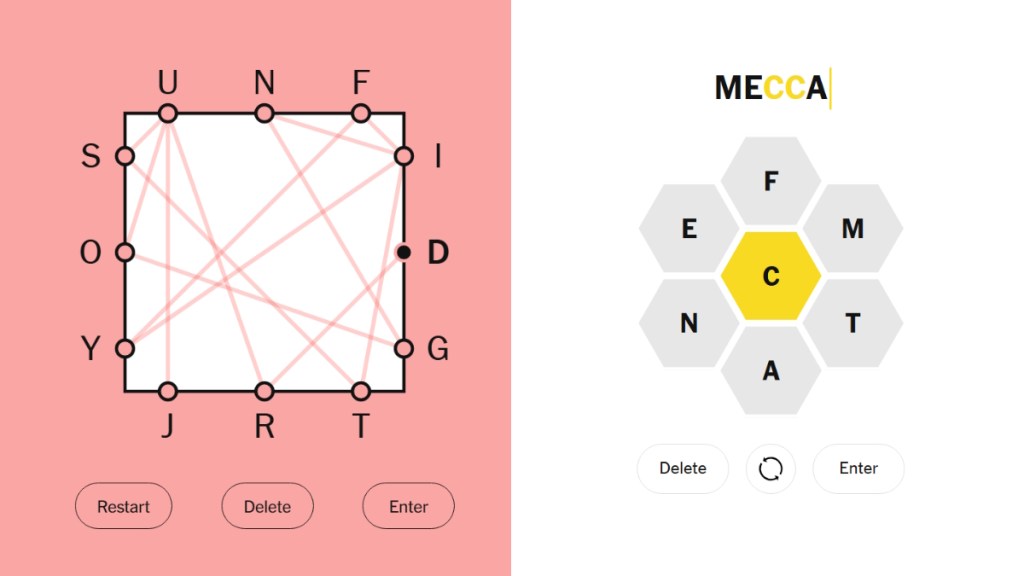
In contrast, you can take your time, brainstorm the words, and enter them to keep scoring in Spelling Bee. There is no time or word limit, so you can do this puzzle in a breeze. There are times the Spelling Bee gets hard to test your vocabulary skills. But most of the time, you will have a fun time forming words without any hassle.
Difficulty
| Aspect | Letter Boxed | Spelling Bee |
| Difficulty Curve | Medium | Easy to Medium |
| Learning Curve | Low | Very Low (simple logic) |
| Strategy | Finding long words, thinking in pairs, etc | Learning word families, adverbs, and NYT special words |
| Vocabulary Demand | High | Medium |
Fortunately, both Letter Boxed and Spelling Bee aren’t mentally taxing puzzle games. Letter Boxed doesn’t have a guess limit, so you can keep trying to connect letters and restart if you need to. It seems a bit difficult at first, but as you keep playing daily, you will be able to figure out the Letter Boxed puzzles in no time.
The same goes for Spelling Bee. All you need to do is keep developing words until you reach your desired rank. Eight different ranks are available, from Beginner to all the way up to the Queen Bee rank. So, you can make your stop once you feel like this is enough. However, Spelling Bee’s ranking system keeps motivating you to do your best every day.
Time Investment
| Factor | Letter Boxed | Spelling Bee |
| Session Length | 2–5 Minutes | 5–15 Minutes |
| Daily Commitment | Minimal | Moderate |
| Replayability | Very Low | High (can find more words) |
| Frustration Factor | High (often get stuck in the middle) | Low-Moderate |
The amount of time you spend on Letter Boxed and Spelling Bee directly depends on your vocabulary. If you have a strong vocabulary, you can easily complete both of them in your leisure time. Whether you are traveling to work or waiting for your coffee, you can quickly play a game of Letter Boxed and begin your day with a win.
Unlike Letter Boxed, which ends soon once you connect all the letters, Spelling Bee goes on a bit longer if you are set on achieving the genius or queen bee ranks. You can always stop at any point in solid or amazing ranks. However, if you have a great command of the English language, you can keep pushing and achieve the highest ranks in minutes.
Nevertheless, there is always a possibility for these NYT games to become frustrating during the initial phase if you start missing the easiest and most obvious words.
Letter Boxed vs Spelling Bee: Which Game Should You Be Playing?
There is always a constant dilemma of which puzzle game you should add to your daily routine, and it ultimately comes down to your personal choice at the end of the day.
Both Letter Boxed and Spelling Bee offer a stimulating experience and enrich your vocabulary. However, the time taken to play each game and the central appeal of the puzzles vary greatly and come down to personal preference.
If you only have a short free time in the mornings, Letter Boxed will be a suitable choice as the game can be wrapped up quickly once you are done linking the letters. Or you can consider Spelling Bee if you are okay with settling down for the beginner ranks.
In comparison, Spelling Bee consumes a brief amount of time if you are aiming for the top ranks. So, if you can either spare the time it needs or are comfortable with playing the game during different breaks, Spelling Bee can be the right puzzle game for you.
Finally, there is also the option of playing both these NYT games daily if you are someone who simply loves cracking down puzzles. Therefore, any one of these puzzles is perfect for your daily brain exercise. That said, let us know in the comments below which puzzle game you are going with after learning Letter Boxed and Spelling Bee’s similarities and differences here.
Yes, you can play Spelling Bee for free until you reach the beginner ranks. If you want to keep playing, you need a NYT Games subscription.
No, Letter Boxed is not a free-to-play NYT game. You cannot even play partially like the Spelling Bee, and you need a subscription.
No, you cannot lose in a Letter Boxed game, as it doesn’t have a guess limit, unlike a Wordle game.
When Does NYT Letter Boxed Reset?
 Daksha Gupta
NYT Letter Boxed vs Wordle - Key Similarities and Differences Explained
 Pranav Maytray
Letter Boxed vs Strands - Key Similarities, Differences, and Detailed Comparison
 Bipradeep Biswas
The 8 Best Letter Boxed Alternatives
 Ishan Adhikary
Letter Boxed Strategies: Best Tips to Win Quickly
Ishan Adhikary
Connections Hints Today & Answers for October 26
 Sanmay Chakrabarti
Wordle Hint Today - October 26, 2026 (Puzzle #1955)
 Rishabh Sabarwal
What Is Quordle Sequence and How Does It Work? Explained
 Ajith Kumar
NYT Midi Crossword vs Crossword: Key Similarities and Differences
Daksha Gupta
 Rishabh Sabarwal