The NYT Games portfolio is home to some of the world’s most addictive daily puzzles. While Wordle is the viral sensation that basically kicked off the trend, Letter Boxed has surged in popularity as its sophisticated cousin rewards players with expansive vocabularies and creative thinking. Both games challenge your word-finding skills. While Wordle is about word deduction, Letter Boxed is all about building complex bridges between letters. Here is how Letter Boxed vs Wordle stack up against each other.
Letter Boxed vs Wordle in a Nutshell
In Wordle, the challenge is an exercise in deduction. You start with a blank 5 x 6 grid and use your guesses, which give colored feedback, to narrow down a single word. It’s a game of reductive logic where you eliminate thousands of possible five-letter words until only one remains. The difficulty lies in your ability to interpret the clues efficiently before you run out of rows.
Letter Boxed, however, shifts the challenge to spatial navigation. You are not guessing a hidden word. Rather, all twelve letters are visible from the start, pinned to the four sides of a square. The difficulty comes from the simple rule that you cannot use two letters from the same side in a row. This forces your brain to jump around the box, tracing paths between the perimeter walls to chain words together.
While Wordle is about finding the one right answer, Letter Boxed is about creating a path, where the last letter of one word becomes the first letter of the next, requiring you to think ahead.
| Feature | Wordle | Letter Boxed |
|---|---|---|
| Creator | Josh Wardle | Sam Ezersky |
| Release Date | October 2021 | February 2019 |
| Objective | Guess a secret 5-letter word | Use all 12 letters in as few words as possible |
| Game Rules | 6 tries; color-coded feedback | Connect letters on a square; no side-sharing |
| Game Modes | Daily (Hard Mode available) | Daily |
| Paid or Free | Free | Requires NYT subscription |
| Puzzle Archive | Yes, requires NYT Subscription | No |
| Languages | English | English |
Letter Boxed vs Wordle Compared
With the basics out of the way, we will now compare both NYT puzzles across common parameters like objective, mechanics, difficulty, and more.
Objective
| Metric | Wordle | Letter Boxed |
|---|---|---|
| Goal | Guess the hidden 5-letter word | Chain letters and clear the board using all letters |
| Word Length | Strictly 5 letters | 3 letters or more |
| Daily Puzzle | One per day | One per day |
In Wordle, your focus is entirely singular as you try to find one secret word that every player in the world is trying to find that day. You get feedback on correct letters and their positions using three colors: green, yellow, and gray.
You are trying to essentially cut through the noise of valid five-letter words part of the Wordle word pool to find that one needle in the haystack. Once you hit that fifth green tile, the puzzle is solved. If you find yourself hitting a roadblock, you can check out how to play Wordle to familiarize yourself with the best strategies.
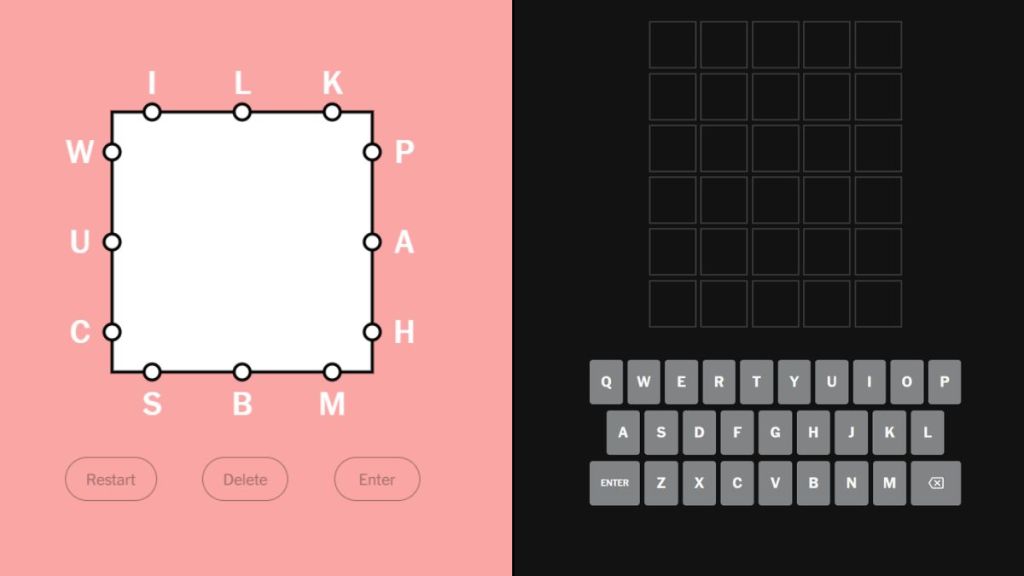
Letter Boxed shifts the goal toward the utilization of all available letters. There is no one correct word to find; instead, you need to connect all 12 letters in as few words as possible.
While Wordle ends when you find the secret word, you have found today’s Letter Boxed answer correctly when the board is empty, and every letter has found its place.
Game Mechanics
| Feature | Wordle | Letter Boxed |
|---|---|---|
| Color Feedback | Green, Yellow, and Gray tiles | Highlighted letters on the box |
| Additional Visuals | On-screen keyboard updates | Letters change colors once used |
| Grid Structure | 5 x 6 (5 letters, 6 attempts) | A square with 3 letters per side |
| Clue Type | Feedback from previous guesses | The letters themselves are the clues |
At its core, Wordle is a modern spin on the classic board game Mastermind, serving as a game of feedback loops. Every word you type is a test to see how the system reacts.
The green and yellow tiles don’t just tell you if you are right, they tell you exactly how far you are from today’s Wordle answer. You are essentially using a process of elimination to find the secret word, making it a purely deductive experience. Picking the best Wordle starting words is one of the most effective ways to narrow down the answer quickly.
On the other hand, Letter Boxed feels more like Scrabble on steroids. You are given a specific set of letters and tasked with using all the letters in the most efficient words possible. The game also has a chaining rule, as the last letter of your current word must be the starting letter of your next one.
If you find a word like WASH, you are then forced to find a word starting with H. We explain this and more about how to play Letter Boxed in our dedicated guide.
Error Tolerance
| Metric | Wordle | Letter Boxed |
|---|---|---|
| Guess Limit | 6 attempts | Unlimited |
| Penalty | Game Over / Broken Streak | Higher word count score |
| Fail Condition | Running out of rows | None (The puzzle stays open) |
| Performance Metric | Guess count (e.g., 3/ 6) | Number of words used (e.g., 2 words) |
The primary difference in the vibe of both Wordle and Letter Boxed comes down to the penalty for being wrong.
In Wordle, you are given exactly six attempts, and each one is a precious resource. Since you cannot delete a guess once you hit “enter,” every move is permanent. But it gives color-coded feedback that pushes you towards the word. This creates a high-stakes environment where the tension builds as you reach the bottom of the grid. If you fail to find the word on that sixth guess, the game is over.
Letter Boxed, by contrast, allows for more experimentation. There is no “Game Over” screen in Letter Boxed. If you find yourself backed into a corner with a word that doesn’t lead you anywhere, you can simply take a step back and delete your last word or clear your entire chain to start from scratch. This forgiving nature turns the puzzle into a more relaxing process.
Difficulty
| Aspect | Wordle | Letter Boxed |
|---|---|---|
| Difficulty Curve | Low to High (Luck-based) | Medium to High (Skill-based) |
| Learning Curve | Instant | Moderate (Side-jumping rule) |
| Strategy | Vowel-stripping starters | Finding words using all letters from all sides |
| Vocabulary Demand | High (Common 5-letter words) | Very High (Longer, obscure words) |
The primary difficulty in Wordle stems from “the trap” or common Wordle mistakes. Because you only have six attempts, you can easily find yourself in a situation where you have identified four out of five letters, only to realize there are more possible answers than you have remaining rows.
These alphabetical traps turn NYT Wordle into a high-stakes game, as, if you don’t use a throwaway word to eliminate multiple consonants at once, you can lose your entire streak simply by guessing the wrong, similarly sounding word. It is also worth noting that Wordle Hard Mode removes this safety net entirely, forcing you to use every confirmed letter in each subsequent guess.
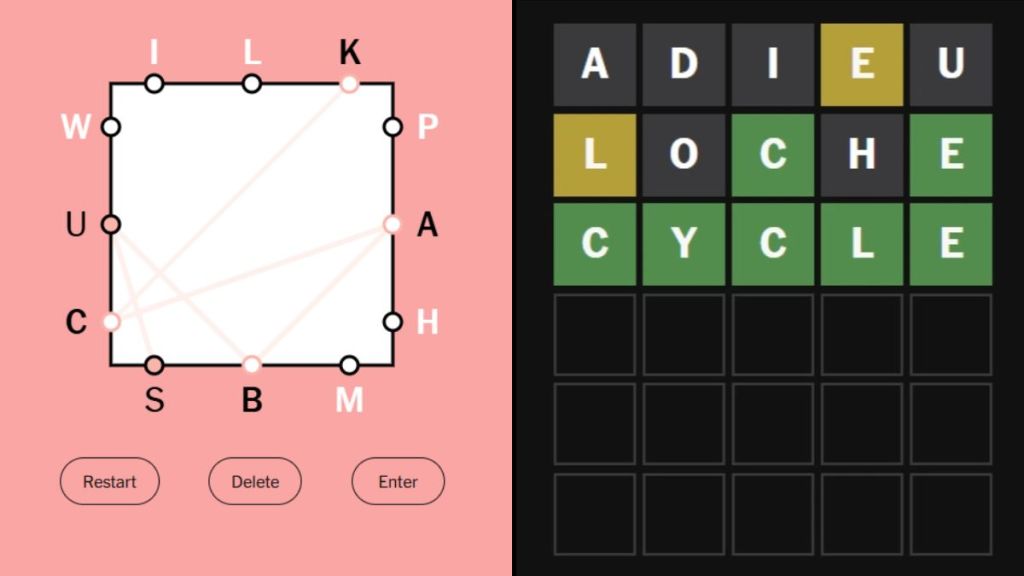
Letter Boxed replaces this guessing game with a spatial puzzle. The difficulty is not about what the word could be, but whether the letters’ physical positions allow you to build it. The side-jumping rule, which forbids you from using two letters from the same side consecutively, creates a mental hurdle.
You might see a word like DOGMA clearly, but if the D and O are both on the same side of the box, the word is illegal. This forces you to zig-zag your focus across the square. Learning a few Letter Boxed strategies and tips can dramatically reduce the number of words you need to clear the board.
Time Investment
| Factor | Wordle | Letter Boxed |
|---|---|---|
| Session Length | 1–3 Minutes | 5–15 Minutes |
| Daily Commitment | Minimal | Moderate |
| Replayability | Low | Low |
| Frustration Factor | High (Fear of failure) | Low (No fail state, just tricky) |
Wordle is designed for efficiency and speed. Since the grid is small and the goal is a single, five-letter word, most players can complete the puzzle in under three minutes. It’s the ultimate “waiting for the bus” game, as you can open it, run through your six guesses, and be done before your coffee cools. The pressure comes from the limited rows, which forces you to make quick, decisive moves.
On the other hand, Letter Boxed is a slow burn that demands your full attention. Because you have to utilize twelve specific letters and chain your words together, you can’t just jump in with random guesses.
A single mistake in the first word can make the rest of the game impossible to clear. So, the game rewards patience and foresight. You might find yourself stuck on a single puzzle for 10 minutes or more, experimenting with different word combinations and clearing the board to start over.
Letter Boxed vs Wordle: Which Game Should You Play?
Choosing between Letter Boxed and Wordle is not about which one is smarter. Rather, it’s about which one fits the current tempo of your day. Because the mechanics are so different, they scratch two distinct types of mental itches.
If your morning is a race against the clock, Wordle is your perfect choice, as it features a punchy, logical flow. You don’t need a deep strategy to start; you just need a solid opening word and a bit of deductive reasoning.
If you have 10-15 minutes of quiet and want to flex your vocabulary, Letter Boxed is the superior choice. It moves you away from simple deduction and into the realm of creative construction. The game requires a sit-down focus because you have to hold multiple possible paths in your head at once.
Most puzzle enthusiasts don’t actually choose one over the other. Rather, they use them to bookend their day. You can play NYT Wordle in the morning as a “brain-waker.” It’s a fast-paced game that gets your gears turning without a massive time commitment. In contrast, play NYT Letter Boxed in the evening as a “deep stretch.” After a long day, the unlimited guesses and no-fail environment of Letter Boxed allow you to wind down while still giving your brain a complex workout. If you enjoy both and want to explore further, see how Letter Boxed compares to Strands or how Wordle stacks up against Connections.
Wordle is available to play for free on the NYT Games website, whereas Letter Boxed requires an active NYT Games or All Access subscription to play the game.
No, while Wordle gives you limited guesses and a fail condition, Letter Boxed has unlimited guesses, and you cannot lose and keep trying until you get the answer.
Letter Boxed takes longer to finish than Wordle, usually up to 10 minutes.
Yes, Letter Boxed is generally considered harder than Wordle. While Wordle has a fixed difficulty structure with color-coded feedback to guide you, Letter Boxed requires you to plan multiple words ahead, navigate the side-jumping rule, and use all 12 letters — often demanding a broader vocabulary and more strategic thinking.
Not always. While the NYT designs each daily Letter Boxed puzzle to have at least one two-word solution, that solution can be quite obscure. Most players solve it in three to five words, and the puzzle does not penalize you for using more words — it simply tracks your word count as your score.
When Does NYT Letter Boxed Reset?
 Daksha Gupta
Letter Boxed vs Strands - Key Similarities, Differences, and Detailed Comparison
 Bipradeep Biswas
The 8 Best Letter Boxed Alternatives
 Ishan Adhikary
Letter Boxed Strategies: Best Tips to Win Quickly
Ishan Adhikary
Today's Letter Boxed Answer for October 12
Ishan Adhikary