
Globle looks like a basic daily game testing your geography knowledge and spatial skills. But that couldn’t be further from the truth. If you know how to play Globle, you’d know that just knowing where every country is located isn’t enough to solve it quickly. The real trick is turning each guess into a useful clue instead of just throwing country names at the 3D globe. To help you do this and bring down your guess count, I’ve shared useful Globle tips, tricks, and strategies below.
Start With a Big Country
Your first guess in Globle can technically be any country, but I wouldn’t make a completely random choice. Instead, start with a large country whose location you know well. The goal isn’t to guess the answer right away. The goal is to figure out which part of the world to focus on.
For example, when guessing the Globle answer today, you could start with the USA for North America, Brazil for South America, Germany for Europe, India or China for Asia, or the Democratic Republic of the Congo for Africa.
If one of these gives you a relatively warm result, you’ve immediately got a region worth exploring. If it’s extremely cold, you can move your search somewhere else.
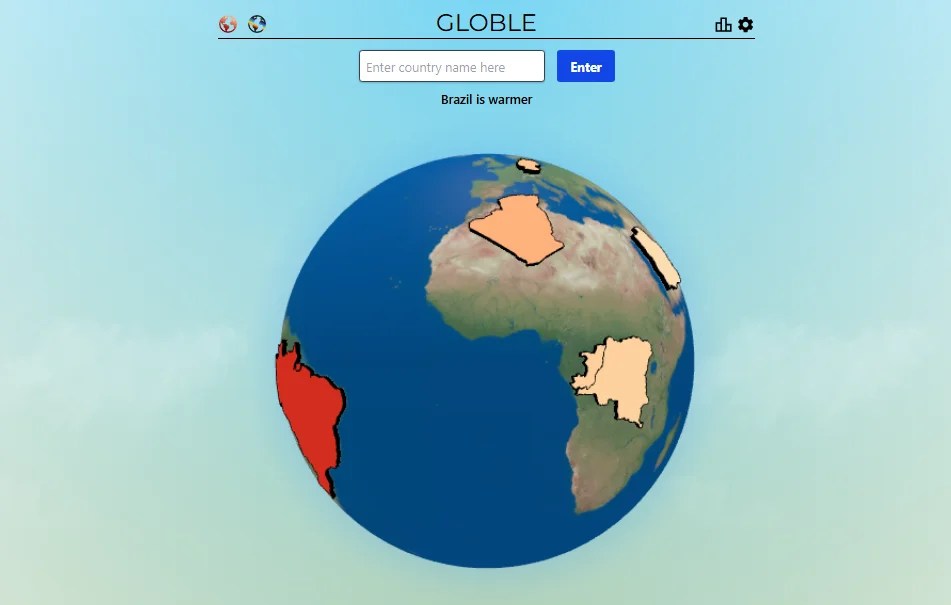
So, think of your first guess as a way to test a region, not as your best shot at the answer. Once you know roughly where to look, your next guesses become much more useful.
Compare Hot and Cold Guesses
Once you’ve guessed some big countries, it’s time to start comparing your guesses. While one warm guess can tell you where to look, comparing warm and cold guesses can tell you where not to look. This is one of the easiest ways to make your guesses more meaningful.
For example, imagine you guess China and get a very light color result. Then, you try Saudi Arabia, and it gets comparatively warmer, yet not very dark. So, you keep moving west and try Germany in Europe and Algeria in Africa.
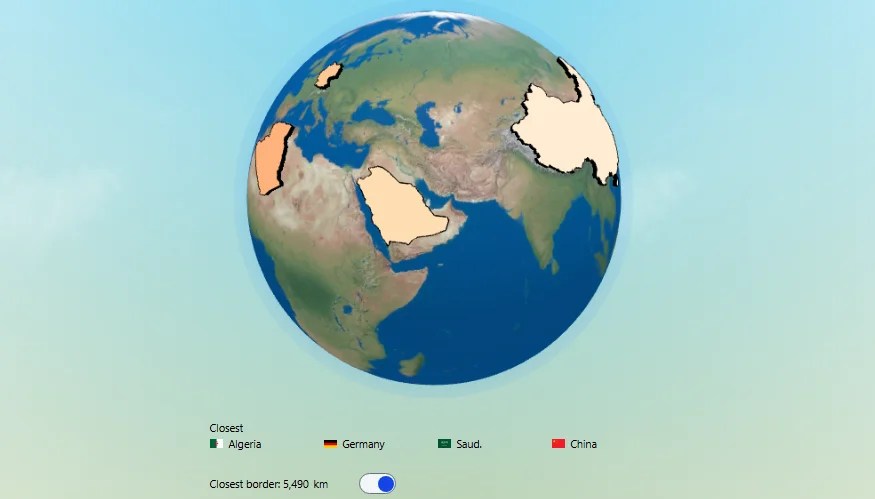
Say, Algeria turns out to be the darkest guess so far. That doesn’t just tell you Algeria is closer to the answer. It also tells you that continuing to explore Asia or Europe probably isn’t the best use of your guesses. Now, you can either move south through Africa or go farther west toward the Americas.
So, don’t look at each guess on its own. Think about how the colors compare with one another, which is an essential mechanic you learn when understanding how to play Globle. When one part of the map keeps getting warmer while another gets cold, you can start eliminating large areas without having to guess every country in them.
Use Your Warmest Guess as Your Anchor
Once you get a darker or warmer result, don’t ignore it and jump to another part of the world. Treat that country as your anchor and start exploring the areas around it.
Let’s say you guess Brazil and get a warm result. You could then try Argentina, Chile, Colombia, Paraguay, or another nearby country to see which direction makes the color warmer. If Colombia is darker than Brazil, you’ve got a pretty good reason to start moving north.
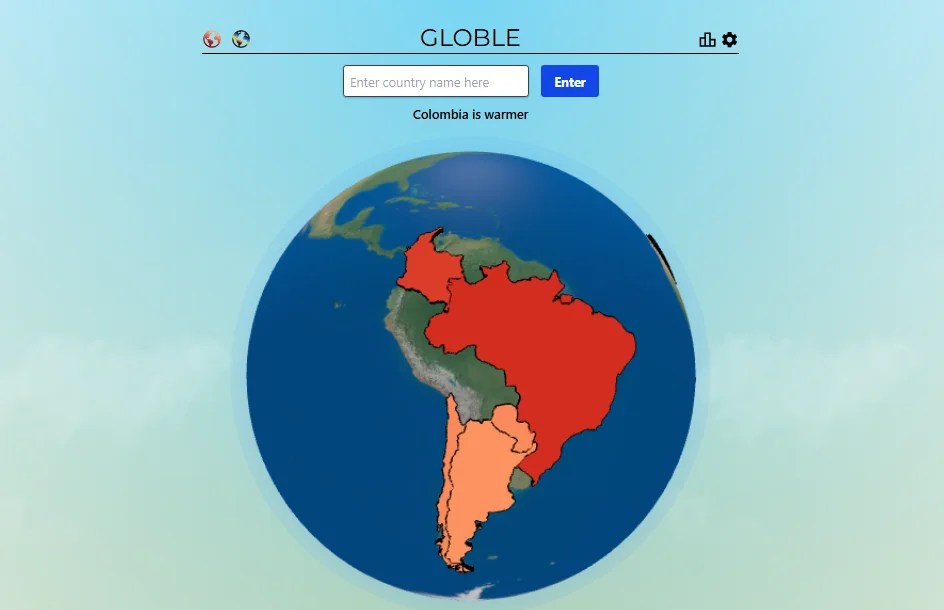
This is especially useful when two or three nearby guesses start getting progressively warmer. So, instead of thinking about the entire world map, you will know that you have to work with a much smaller search area. For that, we have a handy solution for you.
We have compiled a Globle country list that you can follow to reach the mystery country quicker while also learning about all the countries in each continent.
Don’t Keep Moving in the Same Direction
One of the easiest ways to waste your guesses is to keep following a direction even after the colors start getting colder. If your guesses are getting progressively lighter, that’s Globle’s way of telling you that you’re moving away from the answer.
So, let’s say you start with a warm guess in Africa, then try a country farther east and get a colder result. Instead of continuing east, go back to your warmest guess and explore another direction from there.
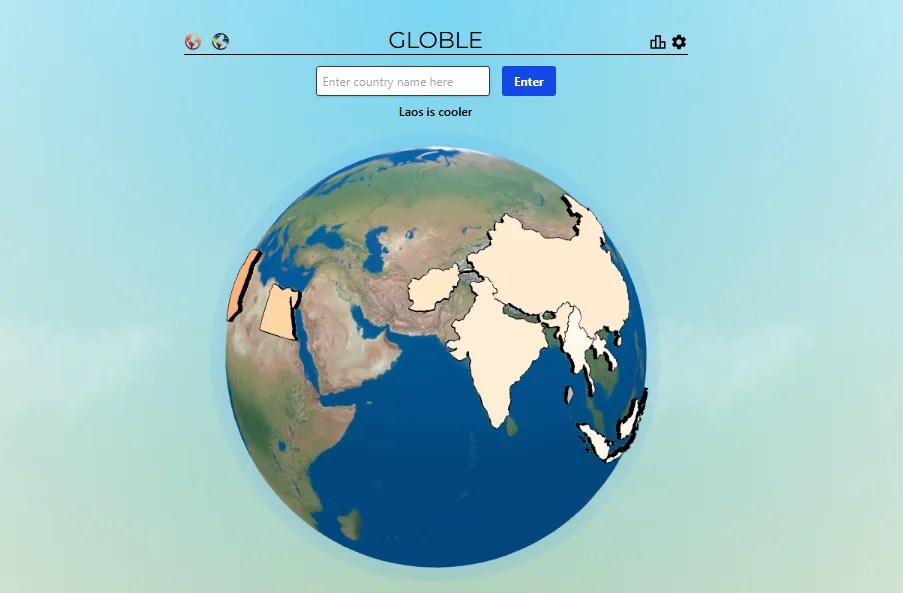
Think of your guesses as a trail rather than a straight line. If one path makes the color colder, backtrack to your last useful clue and try another route. There is no penalty for changing your mind.
Use Multiple Guesses to Pinpoint the Area
Another important Globle tip is not to judge every guess on its own. You get the real advantage from the clues only when you look at several guesses together and figure out what they tell you as a group.
For example, imagine Brazil gives you a warm result, Venezuela gives you an even warmer one, but Colombia gets a little cooler result. You now have more information than you would from simply knowing that Brazil is warm. The pattern suggests that the answer could be somewhere around the Caribbean rather than farther north.
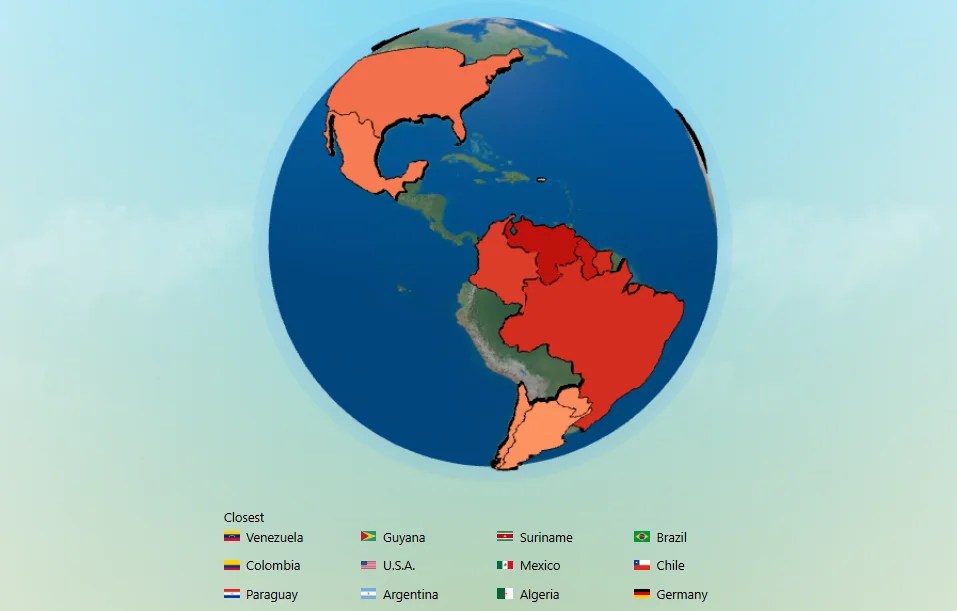
This is also why it’s useful that Globle leaves your previous guesses on the globe. So, instead of starting from scratch after every turn, use the different shades as a rough map of where you’re getting closer and where you’re moving away.
Don’t Ignore Small or Less Familiar Countries
Globle can seriously expose how rusty your geography knowledge is. You might know that a region is warm but then spend several guesses naming the biggest countries you remember, completely forgetting the smaller nations sitting between them.
So, once you have narrowed down a region, slow down and look at the globe carefully. If you’re somewhere around Europe, for example, don’t just guess France, Germany, Italy, and Spain. Countries like Luxembourg, Slovenia, Moldova, or other smaller countries can become important once you’re close to the answer.
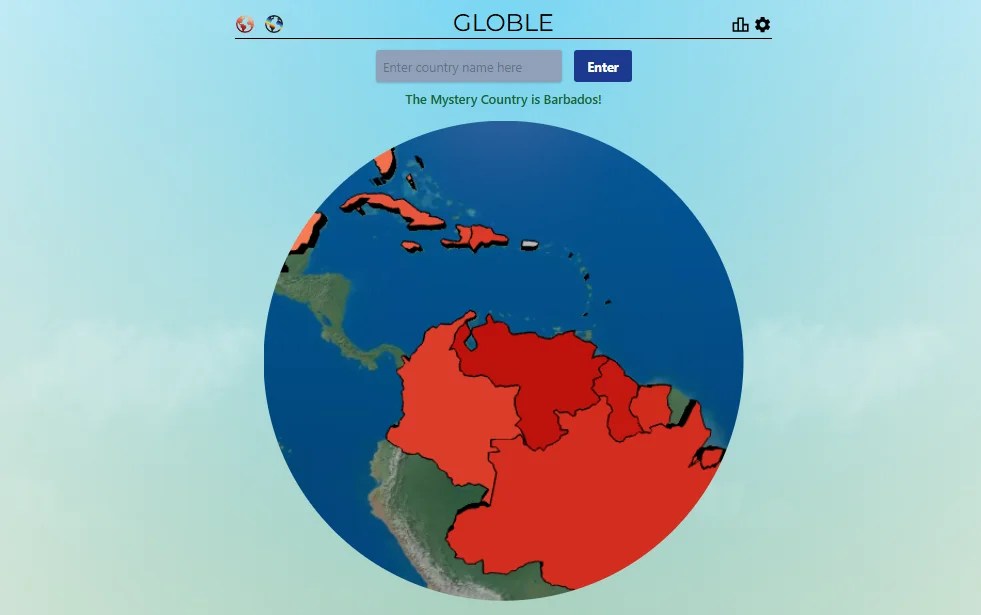
The same goes for island countries. If your guesses on the mainland are staying relatively cold or aren’t giving you a clear direction, look beyond the continents and consider islands in the Caribbean, Pacific, or Mediterranean. They can be easy to overlook simply because there aren’t many neighboring countries around them to help narrow down the answer.
Use Practice Mode to Test Your Strategies
If you keep making the same mistakes in the daily puzzle, you don’t have to wait for the Globle daily reset to try and practice again. Globle has an official Practice Mode that gives you a way to play additional rounds and experiment with different approaches.
You can use these extra games to test things like your opening guess or how quickly you change regions after a cold result. The more you play, the easier it becomes to build a mental map of the world. Eventually, you’ll start recognizing that a warm result in one country should make certain neighboring countries your next guesses, rather than thinking about every possible location.
That was all about the Globle tips and strategies I’ve gathered from playing the puzzle regularly for a long time. It’s really simple: follow the warmest clues, compare your guesses, don’t be afraid to backtrack, and pay equal attention to every country. Once start treating every guess as a clue instead of just another attempt, you may be surprised by how quickly your guess count comes down.
There isn’t one guaranteed best first guess in Globle. Pick a large country whose location you know well and use its color as your starting clue. From there, move toward warmer regions and adjust your guesses accordingly.
The easiest way to get better at Globle is to play regularly and pay attention to how your guesses change color. You can also play in Practice mode once you’re done with the day’s puzzle.
To win Globle in fewer guesses, use every guess as a clue instead of guessing randomly. Apart from that, start with a familiar country, follow your warmest result, compare multiple guesses, and explore nearby smaller countries once you’ve narrowed down the region.
Globle doesn’t have a fixed difficulty setting for its daily puzzle. However, some mystery countries can feel much harder to find than others, especially when they’re small or located near several neighboring countries.
Globle has an official Practice mode that lets you play additional rounds outside the daily puzzle. It is useful for testing different opening guesses, learning the color system, and getting more comfortable with the geography.
When Does Globle Reset? Find the Reset Time Here
 Daksha Gupta
How Many Countries Are in Globle? A Full Globle Country List
Daksha Gupta
Globle Hints and Answer Today for October 15, 2026
Daksha Gupta
How to Play Globle: A Step-by-Step Guide for Beginners
Daksha Gupta
Connections Hints Today & Answers for October 16
 Sanmay Chakrabarti

Wordle Hint Today - October 16, 2026 (Puzzle #1945)
 Rishabh Sabarwal

Wordle Bot: What It Is, How It Works, and How to Use the Tool to Get Better at Wordle
Daksha Gupta
NYT Games Reset Time Guide: When Do Wordle, Strands, Connections and Other Games Reset?
Daksha Gupta
How Do Strands Hints Work? Explained
Daksha Gupta