Startups and enterprise teams are increasingly looking for project management software to assign tasks, automate workflows and deliver faster results. It allows teams to collaborate and provide visibility about the working progress. So to make things easier for you, we have curated the 8 best project management software which are free, feature-rich, and offer several different views. On that note, let’s explore the list.
Overview of Best Project Management Software
ClickUp is the top project management software as it has a complete set of features and offers a generous free plan. For visually managing tasks, Trello is a great choice and for small teams, you can’t go wrong with Asana. Check out the complete list below.
Project Management Software Best Suited For Limitations Pricing ClickUp Teams who want multiple tools in one workplace, usable free offering Steep learning curve Free, Paid plan starts at $7 per month per user Trello Freelancers and small teams who need a simple, visual Kanban board No native Gantt chart or time tracking Free, Paid plan starts at $5 per month per user Asana Best for small to mid-size teams for task ownership Timeline and dashboard views only under paid plan Free, Paid plan starts at $10.99 per month per user Basecamp Best for remote teams, communicate and collaborate Time tracking costs extra Free, Paid plan starts at $15 per month per user Jira Software and engineering teams running Kanban workflows Not for non-dev teams Free, Paid plan starts at $7.91 per month per user monday.com A complete suite for cross-functional teams Automation actions capped Free, Paid plan starts at $12 per month per user Smartsheet Best for Excel-style project management No native chat Paid plan starts at $9 per month per user InVision UI/UX designers who want to prototype and collaborate Not a strict project management tool Free
How We Evaluated the Best Project Management Software?
To evaluate the best project management software, we looked at different factors including feature set, ease of use, pricing, integration with third-party services, and free offering. We also considered special use cases for collaborative design, software development, and more. We checked the user base of each tool, their adoption across the industry, and their customer support.
Next, we looked at 2026 product updates including G2 and Capterra ratings and considered Gartner rankings to come up with the list. Note that we tried to avoid services that charge high add-on fees for extra features or do billing per seat. Also, we selected PM software which can be used by non-technical teams for workflow automation.
Best Project Management Software in 2026
ClickUp is considered the best project management software as it’s packed with features and offers a generous free tier. You can also check out Trello which pioneered visual Kanban boards, and if you are running a small team, Asana is a great project management tool for managing tasks.
ClickUp — Best Free Project Management Software
ClickUp is one of the best free project management software as it offers a generous free plan with unlimited members. You can even do unlimited tasks and collaborate without any limitations. It has more than 8 million users globally and the platform has become an all-in-one workspace that replaces most of the productivity tools.

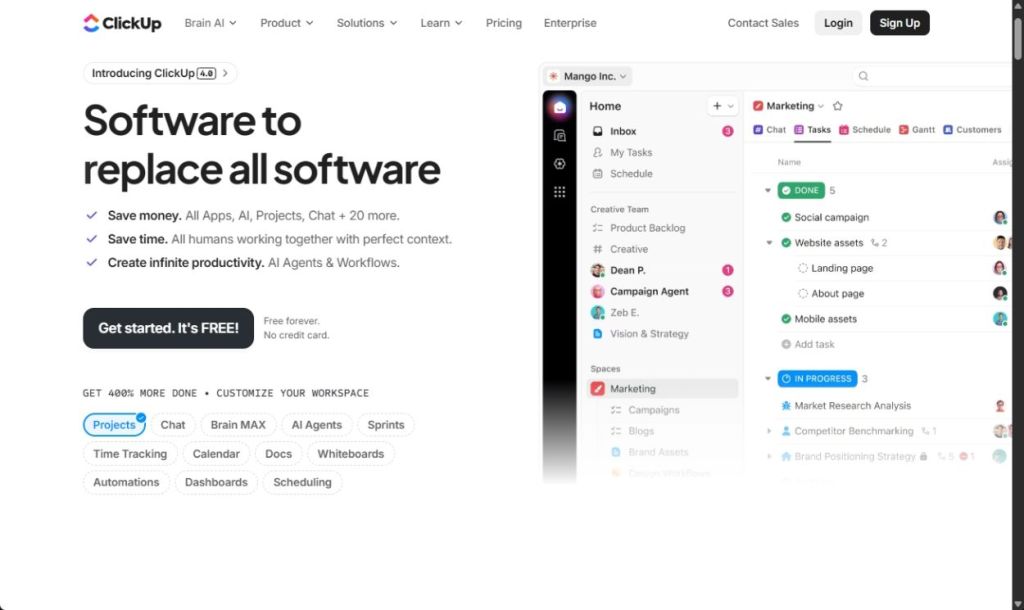
ClickUp offers various project views including Gantt charts, Kanban boards, timelines, calendars, and even a workload view that allows managers to distribute tasks efficiently. You can even build custom automations, access real-time Docs, and a Chat feature that works similarly to Slack. It has also introduced an AI-powered ClickUp Brain feature which is amazing. Overall, if you want to test a free tool for project management, I would highly suggest ClickUp.
Pros Cons Generous free plan, no user limit Steep learning curve for new users AI features via ClickUp Brain Customizable workflows and dashboards
Pricing: Free, Paid plan starts at $7 per month per user
Trello — Best for Visual Kanban Boards
Trello is another great project management software that offers a meaningful free tier. It has been developed by Atlassian and Trello is the company that made Kanban boards mainstream for visual task management. It has boards, lists, and cards and all can be managed by drag-and-drop functionality. You can assign color labels, add checklists, and due dates as well.
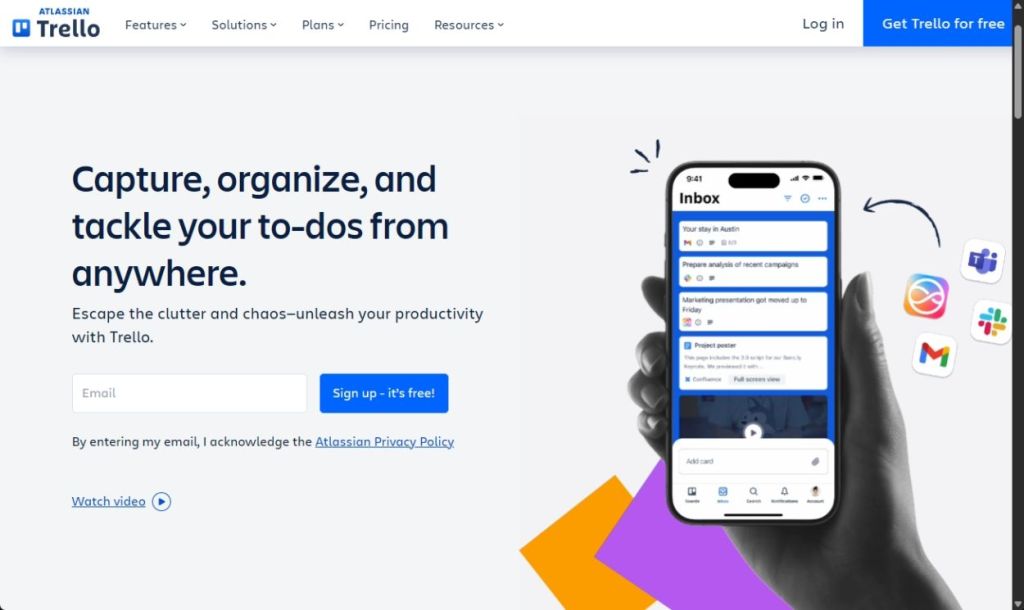
The Butler automation system also covers most of the lightweight workflows. Not to mention, the free plan supports unlimited cards up to 10 boards which is enough for freelancers and content teams. Note that it lacks native Gantt charts, and time tracking. Put simply, if you like visual Kanban boards and want a free project management software, you should take a look at Trello.
| Pros | Cons |
|---|---|
| Easy to use and learn | No native time tracking |
| Clean and great visual Kanban board | |
| Free plan for small teams |
Pricing: Free, Paid plan starts at $5 per month per user
Asana — Best Project Management Tool for Small Teams
Asana is hugely popular among small teams for its clean interface and broad project view support. It supports lists, board, calendar, timeline, and workload — all in one place. You can use its automation engine to handle custom triggers, cascading due dates, and integrate the workflow with Slack, Google Workspace and Salesforce. Note that the free plan covers unlimited projects for up to 10 users.
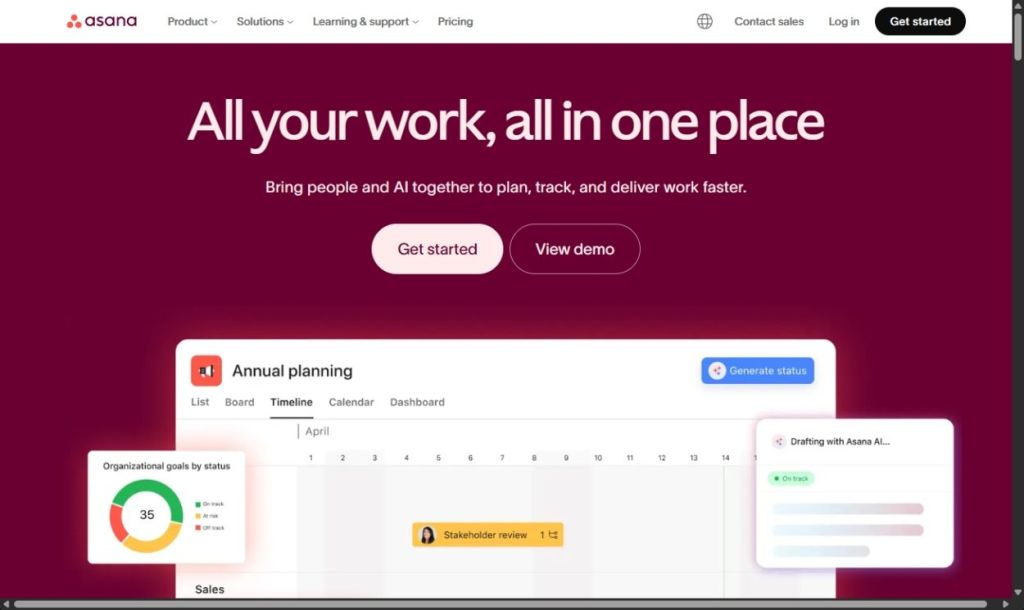
Asana recently made project creation much easier to set up and now automations are straightforward to use even for non-technical users. That said, there is no support for real-time chats so keep that in mind. In addition, timeline and dashboard features are only available to paid tiers. If you are looking for team accountability, Asana is a great tool for small teams.
Pros Cons Intuitive user interface No chat feature Project views including Gantt and Kanban Excellent automation
Pricing: Free, Paid plan starts at $10.99 per month per user
Basecamp — Best Tool for Collaboration
Basecamp by 37signals is one of the oldest PM software for collaboration. Unlike other project management software, Basecamp has a minimal toolkit which includes to-do lists, message boards, Kanban card table, and Campfire chat. You can also enable check-ins and schedule view to get a good grasp of tasks. Basecamp is designed for remote teams and creative agencies.
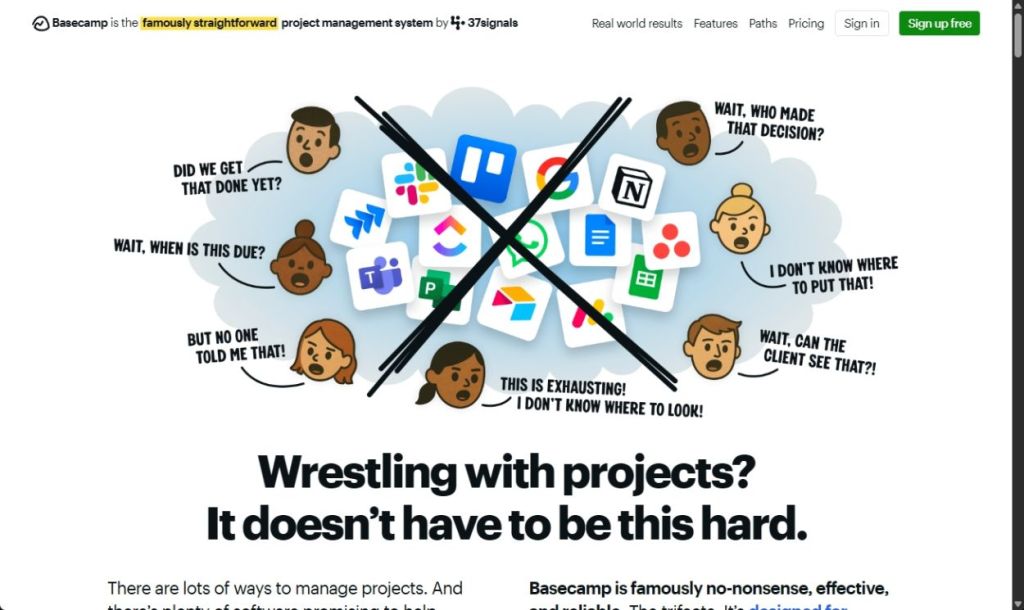
Bear in mind that there is no native support for Gantt charts and task dependencies. And for time tracking, you will have to pay extra for an add-on. While these shortcomings may feel limiting, for collaboration and effective communication, Basecamp is a solid tool for project management.
Pros Cons Easy onboarding with minimal training No native Gantt chart Clean UI Great for small teams
Pricing: Free, Paid plan starts at $15 per month per user
Jira — Best Agile Project Management Software
Jira is another software by Atlassian that has become the de-facto tool for agile software development. In fact, it’s used by companies like Spotify and BlackRock. It features Scrum boards which natively support sprint planning, backlogs, velocity charts, and burndown tracking. You can also set up custom workflow engine to design state-by-state transitions.
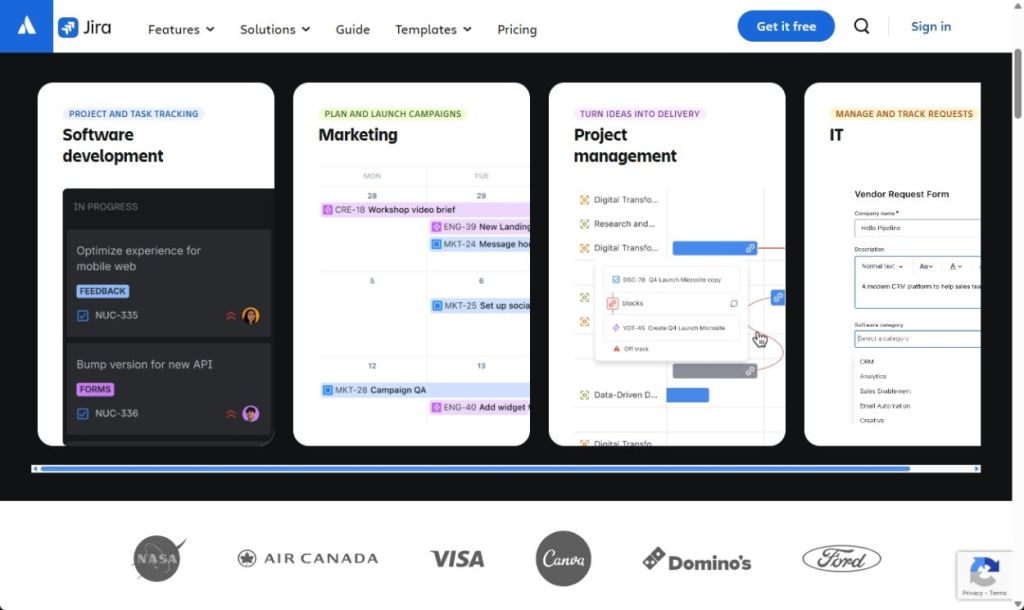
Next, JQL (Jira Query Language) lets you perform advanced filtering with unmatched reporting. For its software, Atlassian was named Gartner Magic Quadrant Leader for Collaborative Work Management. Apart from that, it has deep integration with Confluence, Bitbucket, and Loom for engineering organizations. And now Rovo AI helps break down initiatives and trends with ease. If your team is doing software development, I think Jira is the best choice out there for iterative project management.
Pros Cons Industry-standard for agile software teams Not for non-developers Powerful Scrum and Kanban board JQL reporting and filtering
Pricing: Free, Paid plan starts at $7.91 per month per user
monday.com — Cloud-Based Project Management Tool
monday.com has become an AI platform for cloud-based project management. It operates like a Work OS where you can access a centralized hub for marketing, product, HR, and CRM workflows. There are more than 27 project views, 80+ dashboard widgets, and 200+ integrations with multiple services. And you don’t have to be technical to use its automation build as it doesn’t require coding.
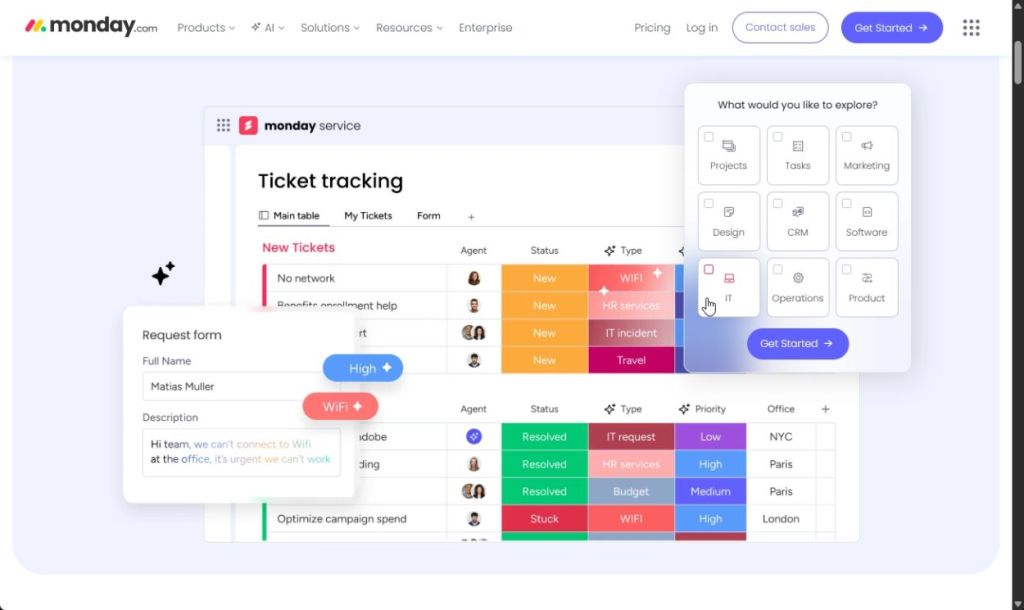
monday.com is also visually polished, compared to the competition. It’s much more easier to set up and use, and live chat support for complex issues has been praised by multiple teams. Note that calendar views and time tracking is locked to paid tiers and some features require a separate add-on. Despite all that, you can consider this project management software if you want a centralized hub to manage your team.
Pros Cons Highly polished, visual interface Calendar view locked to paid plans No-code automation Project views including Gantt and Kanban
Pricing: Free, Paid plan starts at $12 per month per user
Smartsheet — Project Management Software with Time Tracking
As the name suggests, Smartsheet brings the familiarity of spreadsheets with enterprise project management. For those who love to use Excel will find Smartsheet an excellent choice for project management. It’s used by teams in operations, finance, healthcare, and government. Smartsheet supports various views including grid, Gantt, Kanban, and calendar.
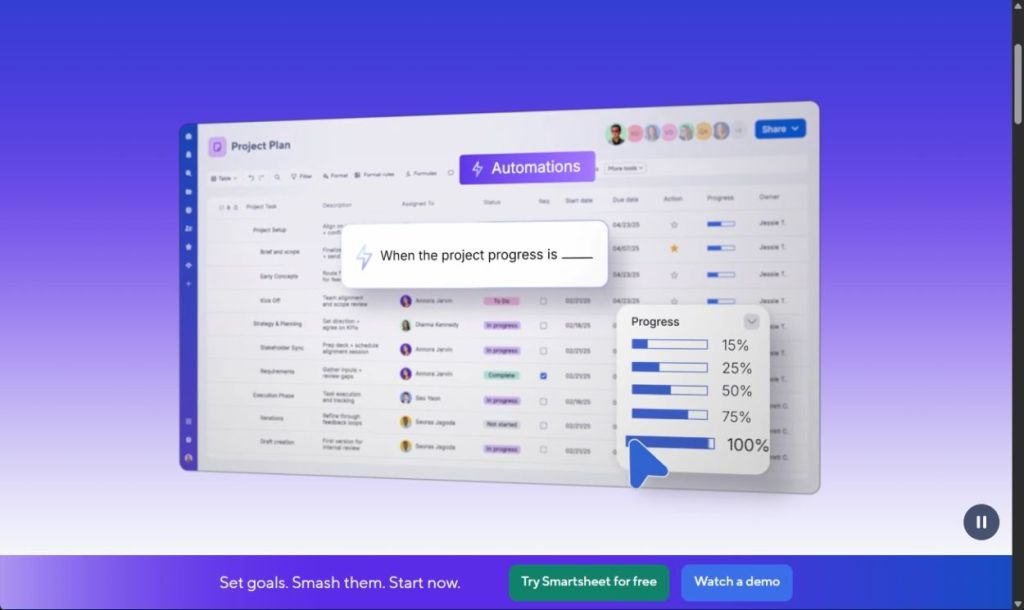
Best of all, it brings native time tracking and timesheet export for billing and payroll. Moreover, you get countless integrations including Salesforce, Microsoft Teams, Google Drive, and even Adobe Creative Cloud. That said, its Excel-style UI may not be for everyone, and for advanced reporting, it requires Power BI. To sum up, if you have a data-driven team, Smartsheet can turn out to be a great platform for project management.
| Pros | Cons |
|---|---|
| Spreadsheet-style interface for project management | Not for non-spreadsheet users |
| Great time tracking and timesheet export | |
| Excellent third-party integration |
Pricing: Paid plan starts at $9 per month per user
Specialized Tool for Project Management
For design-specific project management, we have chosen InVision as the best tool. It’s collaborative and built for designers to review and approve UI/UX mockups.
InVision — Best for Design Collaboration
InVision is strictly not a project management software, but it’s a great design collaboration platform for UI/UX teams. It’s a specialized workspace for creating interactive prototypes, wireframes, and high-quality mockups. Basically, it brings together designers and stakeholders where people can click on prototypes and share feedback instantly.
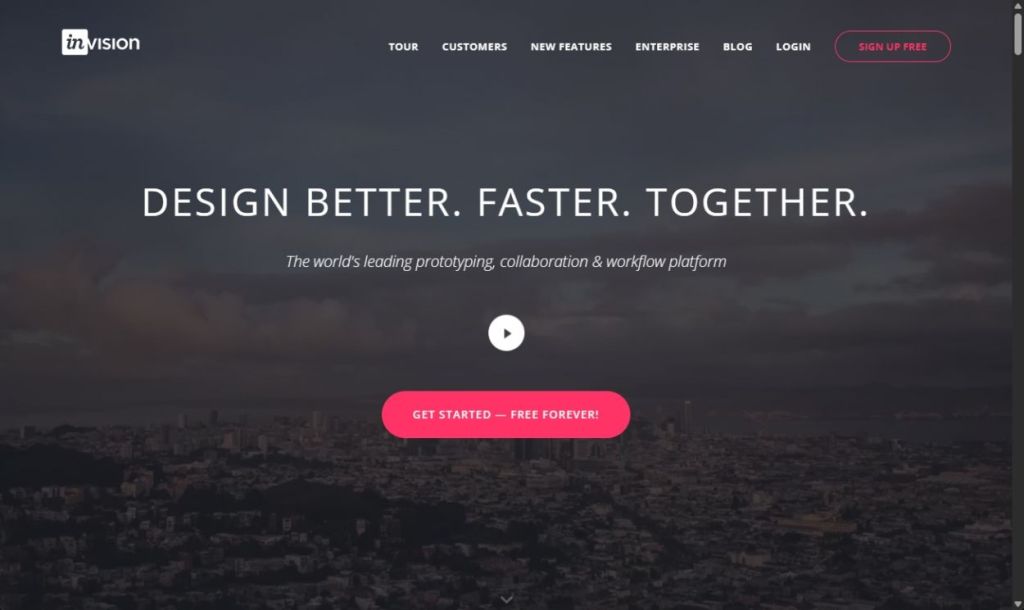
You can do in-line comments on design elements, collaborate and brainstorm using InVision’s infinite canvas, and do design sprints as well. It has integrations with Sketch, Figma, Adobe, and Jira for design review and approval. That said, it lacks task assignment and timelines so that is worth noting.
Pros Cons Best for interactive prototyping Not a project management tool Inline commenting on design elements Canvas for design sprints
Pricing: Free
How to Choose the Right Project Management Tool?
Before anything, the right project management tool depends on your team’s size. If you have a small team, you can get started with Trello or Basecamp within an hour. If you have a large team and you need extensive features, you can go for ClickUp or other enterprise solutions. Similarly, for engineering teams, I would recommend Jira as it has integrations with multiple coding platforms.
Further, if you want a project management software with native time tracking, Smartsheet is a great software you can consider. And finally, InVision is for designers where you can brainstorm, collaboratem and approve UI/UX mockups.
Scalability, Integrations, and UI/UX
Scalability is equally important while choosing a project management software. A tool can handle 10 users easily and can scale up to 100 members, but what if you team grows? In such a scenario, the whole platform hits the ceiling and you get degraded performance. For instance, Trello and Basecamp can easily handle 100 members, but beyond that, you should look for something like monday.com and ClickUp.
Apart from that, integration is very important if you want to create custom hooks or automation triggers with third-party services. Native support for two-way Slack sync is more important than various webhook connections. Similarly, you should look for other integrations, depending on what your team uses.
Finally, UI/UX is often underestimated, but for long-term adoption, you should pick a service which is visually polished. These tools must have less friction while onboarding and for regular workflows like creating a task, updating a status, logging time, etc. The fewer the clicks, the better for your team.
I would highly recommend ClickUp as it’s feature-rich and offers a great free tier. You can add unlimited members and assign unlimited tasks under the free plan.
Simply go for Asana if you are looking for the best project management software for small teams. Its visual Kanban board is the best among all the tools.
For individuals, you can go for Trello as it has a free plan, and you can invite up to 10 collaborators for free. You get unlimited cards, inbox, and integration with Slack.