
NYT Pips and Wordle are both daily puzzles from The New York Times, but that’s about the only thing they have in common. When it comes to format, game rules, and mechanics, these two puzzles could not be more different. Both scratch the same brain-teaser itch for millions of players daily, but you might not find a ton of overlap between their fanbases.
That being said, you might be wondering just how different these games are. So, we’ve compared NYT Pips vs Wordle across various parameters to nail down their key differences and uncover which puzzle is more difficult.
NYT Pips vs Wordle in a Nutshell
To keep things brief, NYT Pips is a visual logic puzzle based on domino tiles, while Wordle is about deducing a hidden word. Wordle is straightforward in terms of mechanics, while Pips is undeniably one of the most complex puzzles the NYT Games platform has to offer.
Here is a handy table that compares NYT Pips vs Wordle:
| Feature | NYT Pips | Wordle |
|---|---|---|
| Founder | Ian Livengood | Josh Wardle |
| Release Date | August 2025 | October 2021 |
| Objective | Place dominoes on a grid to satisfy regional logic and math rules | Guess the secret five-letter word |
| Attempts | Unlimited | Six guesses |
| Game Modes | Daily (Easy, Medium, Hard difficulty options) | Daily (Hard Mode available) |
| Feedback System | Color-coded grid with symbols that explain regional rules | Letters are color-coded and have visual cues |
| Paid or Free | Free | Free |
| Avg. Solving Time | 2-5 minutes | 1-2 minutes |
| Puzzle Archive | No | Yes (NYT subscription required) |
| Languages | English | English (Wordle Unlimited sites in other languages) |
NYT Pips vs Wordle: Key Differences Compared
With the basics out of the way, let’s compare the objectives, game mechanics, difficulty, and other factors for both puzzles:
Objective
| Feature | NYT Pips | Wordle |
|---|---|---|
| Goal | Place dominoes on a grid to satisfy regional logic and math rules | Find the secret five-letter word |
| Starting Info | A grid with pre-defined regions and specific logic constraints | No hints, submit a word to get feedback |
| Core Skill | Spatial pattern and mathematical logic recognition | Linguistic deduction and vocabulary depth |
The biggest difference between NYT Pips and Wordle is undoubtedly the core objective. One has you stacking a grid with dominoes, and the other is all about guessing a secret word.
Naturally, your approach to each puzzle is also noticeably different. You are likely to start Wordle by using the best Wordle starting words every single day, but in the case of NYT Pips, there is no set blueprint to solve the grid.
As you submit word guesses in Wordle, the game will deploy color-coded feedback to help narrow down your search.
NYT Pips, on the other hand, offers no such hints. It does show a red dot when you place dominoes incorrectly, as mentioned in our NYT Pips symbols guide. Apart from that, you simply have a set of regional rules and need to use your pattern recognition skills to figure out the right placements. This makes the domino-based puzzle less accessible by comparison.
Game Mechanics
| Feature | NYT Pips | Wordle |
|---|---|---|
| Feedback Type | Real-time feedback as dominoes are placed | Real-time color feedback to provide visual cues on letter position |
| Visual Cues | Color-coded sections that separate different regions | Color of the letter tiles (Green, Yellow, and Gray) |
| Grid Structure | Dynamic grids with varying regional shapes | Fixed 5 x 6 grid (5 letters, six attempts) |
| Input Method | Drag-and-drop or tap-and-rotate dominoes | Keyboard or on-screen letter typing |
| Clue Focus | No clues, only fixed logic depicted through symbols | Letter-based (position, adjacency, sequence) |
While Wordle relies on linguistic deduction and a guess-and-check method, Pips shifts the challenge toward mathematical logic and spatial reasoning.
In Wordle, you begin with a completely blank slate, using your vocabulary to narrow down a secret word through progressive, color-coded feedback. NYT Pips, by contrast, provides all the necessary constraints upfront via a grid of colored regions and symbols.
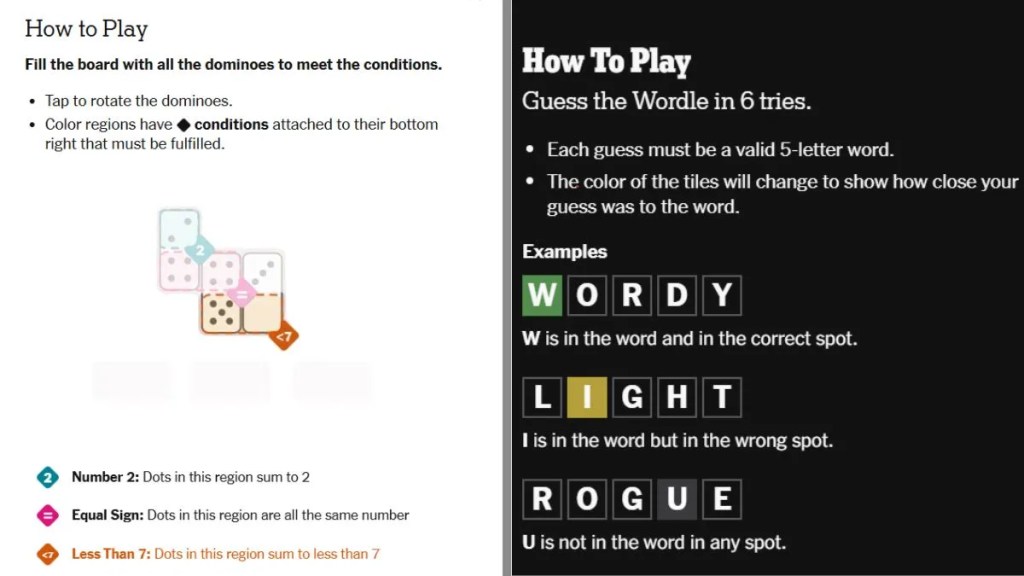
Instead of eliminating letters, you are arranging a set of dominoes to satisfy specific mathematical requirements, while ensuring they fill out every spot in the grid. This mechanic can seem complicated at first, and we highly recommend checking out our guide on how to play NYT Pips to get well-versed with the basics. You can also try the NYT Pips Unlimited free version to practice without waiting for the daily puzzle.
Error Tolerance
| Feature | NYT Pips | Wordle |
|---|---|---|
| Max Attempts | Unlimited moves | Six guesses |
| Penalty for Wrong Guess | None | Lose one of six guesses |
| Game Over Condition | No Game Over penalty, the solver can simply give up | Failing to guess the word within six tries |
| Pressure Level | Low (Puzzle is more difficult and complex, but no penalties mean no pressure) | Medium (Limited guesses but every word pushes you closer to the answer) |
This is another area where there’s a clear gulf between NYT Pips and Wordle. In Pips, you can keep chopping and changing the positioning of tiles as you see fit. There’s no timer forcing you to hurry up, and no penalties in case you place a tile incorrectly. It’s a relatively laid-back experience where the only source of pressure is the stress you put on your own abilities.
Wordle, by comparison, is significantly harsher on errors. You only have six guesses to find the secret word, and answering incorrectly can quickly deplete these “lives.” This is why it’s important to take note of the most common Wordle mistakes and avoid them at all costs. If you want an even stiffer challenge, Wordle Hard Mode forces you to use confirmed letters in every subsequent guess.
Difficulty
| Feature | NYT Pips | Wordle |
|---|---|---|
| Daily Variation | High, due to dynamic grid shapes for three different difficulty levels | Moderate, as you only have a 5-letter word every day |
| Learning Curve | Moderate, requires learning regional rules like sums and inequalities | Low, as color feedback is easy to understand, and there are only 5-letter words |
| Hardest Element | Complex overlapping regions with very tight logic rules | Obscure terms or words with repetitive letters |
| Skill Tested | Mathematical reasoning and spatial logic | Vocabulary and deductive reasoning |
Wordle offers a single daily linguistic challenge, with difficulty stemming from word complexity and limited attempts, while NYT Pips provides structured, multi-level mathematical and spatial logic puzzles.
The core difference lies in their focus: Wordle tests deductive vocabulary, whereas Pips requires strategic reasoning to solve complex regional requirements. If you need support, feel free to use today’s Wordle hints to guess the word and improve your vocabulary.
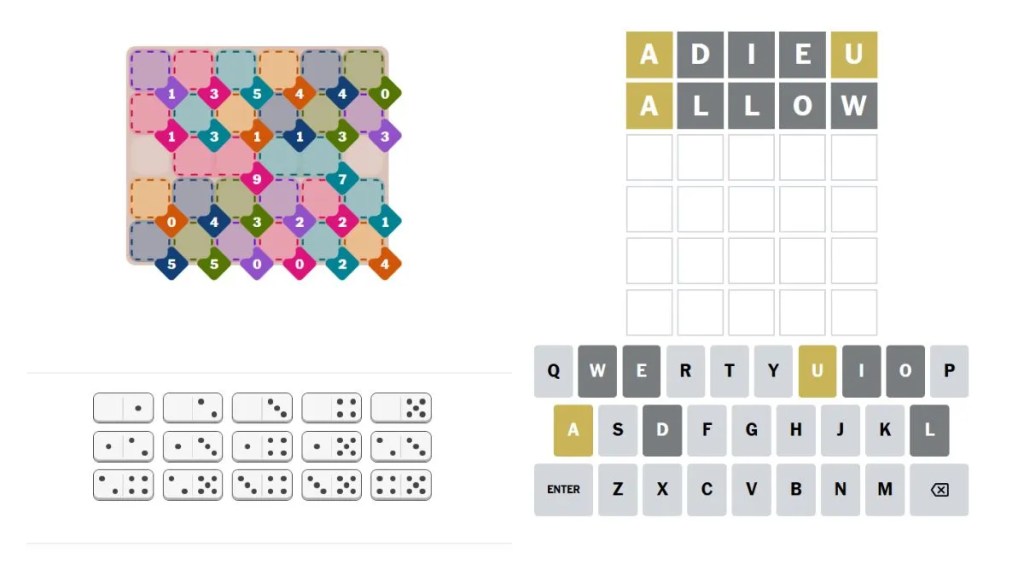
To put it simply, learning how to play Wordle is much, much easier than learning how to solve NYT Pips. But the latter isn’t rocket science by any means.
Time Investment
| Feature | NYT Pips | Wordle |
|---|---|---|
| Avg. Solve Time | 2-5 minutes | 1-2 minutes |
| Natural Time Cap | No | Yes, six incorrect guesses end the game |
| Daily Commitment | Moderate to High (Depends on chosen difficulty and skill level) | Low |
Wordle is generally a faster experience than Pips because it focuses on a single five-letter objective. Most players can wrap up their daily session in a few minutes, making it the perfect micro-break for a busy morning.
NYT Pips demands a more significant time investment since it offers three separate puzzles (Easy, Medium, and Hard) every single day. While the Easy level might be a quick solve, the Hard level can be time-consuming as you navigate complex mathematical constraints and overlapping regions.
Both games are excellent for a daily mental workout, though Wordle is better for a quick win while Pips is ideal for those who want to settle in for a longer logic session.
NYT Pips vs Wordle: Which Game Should You Play?
While both are challenging daily puzzles, the right pick depends entirely on your preferences. If you’re looking for accessibility and a bite-sized challenge, Wordle is the clear choice. Its format is incredibly easy to understand, and it gets very addictive once you get a streak going. Fans of similar word-based games should also explore our list of games like Wordle for more options in that vein.
Now, if you have more time on your hands and are craving a brain-teaser that demands all your attention, NYT Pips fits the bill. The visual logic puzzle will almost certainly bamboozle you at first, but once you leap over that hurdle, solving these grids is arguably more satisfying than finding the secret word. Why not check out today’s NYT Pips answers to get started?
If you enjoy comparing NYT puzzles, we also have dedicated breakdowns for Strands vs Wordle, Letroso vs Wordle, and Contexto vs Wordle, worth reading if you’re trying to figure out which daily puzzle suits you best.
Overall, we recommend giving both puzzles a try and comparing NYT Pips vs Wordle in the aspect that matters most: fun factor. So, which of the two did you enjoy more?
Yes, both NYT Pips and Wordle can be played for free via the NYT Puzzles website or the NYT Games app.
Yes, Pips is noticeably harder than Wordle, simply because there are more mechanics to understand, and the daily grids are also much more dynamic.
Wordle offers a maximum of six guesses, while you can make unlimited moves in NYT Pips.
Wordle is significantly more beginner-friendly. Its rules are simple, the color-coded feedback is intuitive, and most players can pick it up in minutes. NYT Pips has a steeper learning curve due to its regional logic rules and domino placement mechanics, making it better suited for players who already enjoy logic puzzles.
Yes. Both puzzles reset daily and are entirely independent of each other. You can play all three NYT Pips difficulty levels (Easy, Medium, and Hard) and complete your daily Wordle on the same day without any restrictions.
When Does NYT Pips Puzzle Reset?
 Daksha Gupta

NYT Pips Archive: How to Play Old Games?
 Arnamoy Das

NYT Pips Strategies for Every Difficulty Level
 Pranav Maytray
 Bipradeep Biswas
4 Common Mistakes to Avoid in NYT Pips
 Sanmay Chakrabarti

 Rishabh Sabarwal
What Is NYT Connections Bot, How It Works, and How to Read Its Analysis
Daksha Gupta
Connections Hints Today & Answers for October 21
Sanmay Chakrabarti
Wordle Hint Today - October 21, 2026 (Puzzle #1950)
Rishabh Sabarwal
Wordle vs Globle: Key Similarities and Differences Explained
Daksha Gupta