- Among the types of Artificial Intelligence technology, Narrow AI is the only AI system that exists today. From ChatGPT to self-driving cars, they can't operate beyond their domains.
- Artificial General Intelligence (AGI) is another type of AI, but it has not been achieved yet. It can match humans at cognitive tasks.
- Following that, Artificial Superintelligence is still a theoretical concept, but researchers say it can surpass the brightest human minds.
While ChatGPT revolutionized the world and brought us closer to AI, there are many different types of AI we are already using that we have no idea about. So, in this article, I have discussed various types of Artificial Intelligence technology, their applications, and current examples. From AI chatbots to email spam filtering algorithms, I have covered all of them. On that note, let’s learn about different types of AI technology.
1. Narrow AI (Weak AI)
Let’s start with Narrow AI, also called Weak AI, is a type of Artificial Intelligence technology that excels at specific tasks. These type of AI systems are designed to perform tasks for which they are trained and can’t operate beyond their capabilities. They don’t have the ability to learn new skills and transfer knowledge to different domains.
Narrow AI systems generally require human intervention for new tasks. To give you an example of Narrow AI, email spam filtering algorithms are trained to classify emails as important or junk. As you can notice, this kind of AI technology is only designed for spam filtering and it can’t do anything else. Similarly, facial recognition systems that rely on CNN (Convolutional Neural Network) can only identify and match individuals based on facial features.
While Narrow AI has a limited focus and different AI systems have to be trained for various tasks, they are still very powerful. It has transformed many industries including healthcare, and finance with a faster and more efficient performance.
2. Artificial General Intelligence (AGI)
Artificial General Intelligence or AGI is a type of AI technology that can match human cognitive abilities across a wide range of tasks. Unlike Narrow AI which can only do a particular task, Artificial “General” Intelligence is more general in a way that it can perform tasks for which it has not been explicitly trained. Basically, AGI systems can understand, learn, and apply knowledge across different domains.
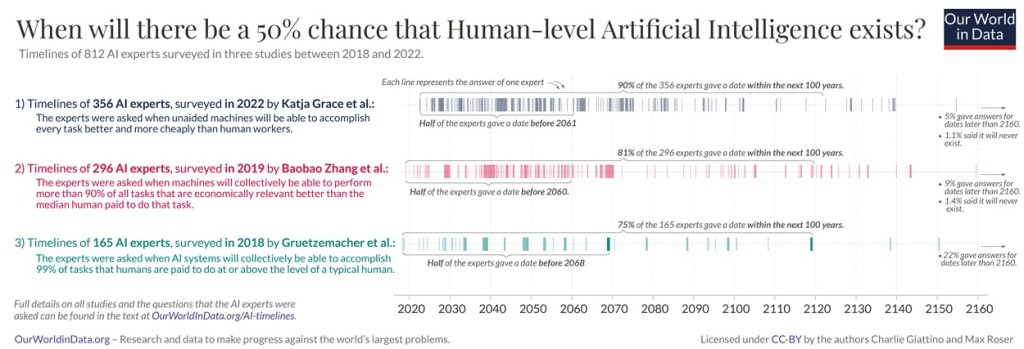
Note that this type of AI technology is still theoretical and researchers argue that in the next five to ten years, we may achieve AGI. Currently, large language models like ChatGPT and Gemini are still considered Narrow AI because they can’t learn new skills outside their training. In addition, they don’t truly understand the world like humans.
3. Artificial Superintelligence (ASI)
Artificial Superintelligence or ASI is the next type of Artificial Intelligence technology that can surpass human intelligence in every way. Basically, it’s the next step of AGI and can exceed human capabilities in terms of creativity, problem-solving, general wisdom, and more. ASI systems will have cognitive abilities that can match even the brightest human minds.
The key characteristic of ASI is self-improvement which means it can improve itself over time and acquire new skills. In the AI field, it’s called continual learning. Having said that, ASI is still theoretical and researchers say that once we achieve ASI, we can solve humanity’s biggest problems like climate change, diseases, poverty, etc. At the same time, many argue that ASI may pose existential risks to humanity and we must have conversations around ASI’s control.
Types of AI Based on Functionality
Besides broader types of AI, there are various AI systems that can be classified by their functionality. Here are those types of Artificial Intelligence technology.
1. Reactive Machines
Reactive Machines are the most basic types of AI which operate without memory. It doesn’t use past experience to decide future actions. They are programmed in such a way that they require specific inputs with predetermined outputs. Basically, they follow an input-output response pattern. Note that this type of AI can’t learn or adapt to new environments.

To give you an example, rule-based email filters are Reactive machines that check for specific patterns. Similarly, keyword matching systems aka basic recommendation engines are Reactive machines. The IBM Deep Blue AI system that defeated world champion Garry Kasparov in 1997 checked for millions of possible moves, but had no memory of previous games.
2. Limited Memory AI
Limited Memory AI systems are those type of AI technology that learns from historical data and use past experiences to decide future actions. Most current AI applications fall into this category. It stores temporary information, improves over time, and makes predictions based on past patterns. For instance, autonomous vehicles notice traffic, road conditions, and behavior of other vehicles to navigate safely.
Similarly, AI chatbots like ChatGPT learn from past conversations to provide better responses. Image recognition software are also trained on labeled images to identify new images. All these are examples of Limited Memory AI.
3. Theory of Mind AI
Theory of Mind AI is currently in the realm of fictional concept. It’s a type of AI technology that can understand human emotions, beliefs, and intentions. These AI systems would be able to recognize that people and animals have thoughts and feelings that affect their behavior. Based on this emotional context, AI systems can predict behavior.
AI labs are developing robots that can mimic human facial expressions based on the emotional state. New research also shows that they can change their voice tone and emotions. It could be useful for mental health support and educational AI systems that can adapt to student’s need.
4. Self-Aware AI
Finally, we come to Self-Aware AI which is an advanced type of artificial intelligence. This kind of machine will have consciousness and self-awareness. They will have their own internal desires, perception, and understanding of their own existence. Self-Aware AI can both process human emotions and also maintain its conscious state.
Currently, this is a hypothetical AI system, but it raises several questions about what it means to be alive and who are we as humans. Can machines ever gain consciousness like humans and will they have rights and moral responsibilities? That’s something we can only know in the future.
So these are the different types of Artificial Intelligence technologies that you can learn. At present, we have only experienced Narrow and memory-limited AI systems. However, the AI field is advancing rapidly and by all accounts, we may achieve AGI in the next decade.









 Anshuman Jain