
Every morning, millions of players open their phones to play the various puzzles in the NYT Games collection. Among these, Spelling Bee and Wordle are arguably the most popular ones. If you have ever wondered how Wordle and Spelling Bee compare, you are not alone both are crown jewels of The New York Times Games suite, yet they offer completely different ways to exercise your brain. We have compared Spelling Bee vs Wordle across every major parameter so you know exactly which game suits you.
Spelling Bee vs Wordle in a Nutshell
Wordle can be seen as a streamlined game of deduction that tasks you with finding a secret five-letter word in a maximum of six attempts. It is a game that relies on the process of elimination, with color-coded feedback to help you narrow down possible answers.
On the other hand, Spelling Bee is a test of vocabulary skills that asks you to find as many words as possible from a honeycomb grid of seven letters. The game also includes a hunt for the Pangram, a word that uses all seven letters, which can help you climb the ranks toward the Genius title. You can look at Wordle as more of a sprint and Spelling Bee as a marathon.
| Feature | Spelling Bee | Wordle |
|---|---|---|
| Founder | Frank Longo (Digital by NYT) | Josh Wardle |
| Release Date | 2014 (Print), 2018 (Digital) | October 2021 |
| Objective | Find as many words as possible from 7 letters | Guess a hidden 5-letter word |
| Game Rules | Must use center letter; words 4+ letters long | 6 attempts; color-coded feedback |
| Game Modes | Daily Puzzle | Daily Puzzle, Hard Mode |
| Paid or Free | Limited free tier (Paywalled after “Solid”) | Free to play |
| Past Archive | Available to NYT subscribers | Available to NYT subscribers |
| Languages | English | English (official), Wordle Unlimited in other languages |
Spelling Bee vs Wordle Compared
We have compared Wordle and Spelling Bee on multiple parameters, including game mechanics, difficulty, error tolerance, and more.
Objective
| Feature | Spelling Bee | Wordle |
|---|---|---|
| Goal | Reach “Genius” or “Queen Bee” rank | Solve the 5-letter word in less than 6 tries |
| Word Length | 4 to 20+ letters | Exactly 5 letters |
| Daily Puzzle | One set of letters per day | One word per day |
Wordle is built on the principle of deduction, working like a digital game of “Hot or Cold.” Every puzzle begins with thousands of possible five-letter words, and you have to use the three color feedback system to filter out unwanted letters until you find the secret word.
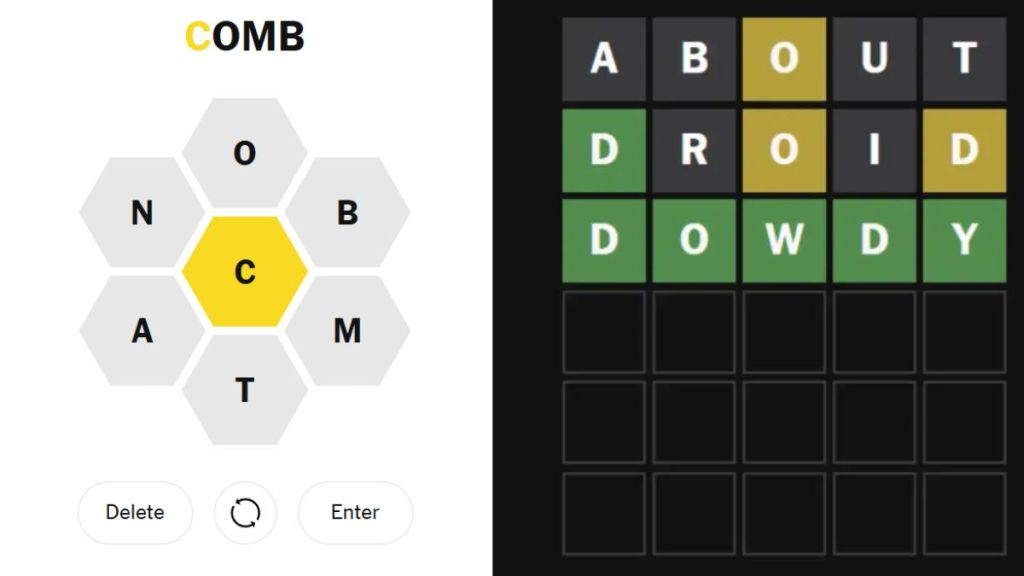
Spelling Bee, on the other hand, is more of a linguistic exercise. Players are tasked with building a list of words using a pool of seven letters. With only seven letters available, players need to find each possible combination, rather than look for a single, specific solution.
Game Mechanics
| Feature | Spelling Bee | Wordle |
|---|---|---|
| Color Feedback | None (Visual ranks only) | Green (Right), Yellow (Wrong Spot), Gray (No) |
| Visual Cues | Honeycomb letter grid | 5×6 letter grid |
| Grid Structure | Hexagonal | Square |
| Clue Type | None (Letter-set only) | Deductive (Previous guesses) |
Wordle has a reactive Mastermind-like feedback loop, where the game gives players clues after every guess. Players need to be careful with each guess, especially in Wordle Hard mode, if they want to receive the correct information with the green, yellow, or gray color tiles. This allows you to refine your strategy and narrow down your search for today’s Wordle answer.
By contrast, Spelling Bee has a simpler challenge for the player. The honeycomb structure provides no hints or feedback, and it just sits static until you successfully piece together and submit a valid word.
If you are still having a tough time getting started with either game, you can check out our guides on how to play Spelling Bee and how to play Wordle for some assistance.
Error Tolerance
| Feature | Spelling Bee | Wordle |
|---|---|---|
| Guess Limit | Unlimited attempts | Six attempts |
| Penalty for Wrong | None | One attempt lost |
| Fail Condition | None (Low score only) | “Game Over” after 6th guess |
| Performance Metric | Numerical score and Rank | Guess distribution (1/6, 2/6, etc.) |
Wordle can be a high-tension game. Because you have a finite number of attempts, you can actually lose and risk breaking a hard-earned streak with every game. You either manage to guess the correct word within 6 tries or accept failure for that day. It is a game that is made to be won or lost.
Spelling Bee, however, does not feature a “Game Over” screen. The honeycomb puzzle provides a low-pressure environment where you can stop playing if you run out of free time. While you can’t technically lose, there is a Spelling Bee ranking system that tracks your progress.
Reaching Genius rank can be a satisfying exit point. But for perfectionists, the invisible Queen Bee title is awarded only for finding every possible word in today’s puzzle.
Difficulty
| Feature | Spelling Bee | Wordle |
|---|---|---|
| Difficulty Curve | Increases as you hunt rare words | Increases as attempts decrease |
| Learning Curve | Low (Everyone knows how to spell) | Moderate (Requires strategy and starters) |
| Strategy | Finding suffixes and prefixes | Eliminating common consonants and vowels |
| Vocab Demand | High (Obscure words often required) | Moderate (Common 5-letter words) |
Wordle’s difficulty often comes down to luck and vocabulary traps. The hardest part is not knowing the words, but dealing with groups like LIGHT, NIGHT, and FIGHT. If you have only two guesses left and four possible words, you can easily lose by guessing the wrong one. This is one of the most common Wordle mistakes that can trap even experienced players. Using the best Wordle starting words can help you avoid these traps from the very first guess.
Spelling Bee’s difficulty is strictly about what you know. It does not have any traps or bad guesses, and the only wall you can hit is the limit of your own vocabulary. If the game needs a rare word like PHALANX and you have never heard of it, you simply won’t find it.
Spelling Bee simply tests how many words you have tucked away that you can use without relying on today’s Spelling Bee hints. If you want to improve, our guide on how to win NYT Spelling Bee covers the best strategies to reach Genius rank.
Time Investment
| Feature | Spelling Bee | Wordle |
|---|---|---|
| Avg. Session | 10–25 minutes | 2–5 minutes |
| Daily Commitment | High (If aiming for Genius) | Low |
| Replayability | High (Dozens of words to find) | Low (One-and-done) |
| Frustration Factor | Low (Can’t lose) | High (The “X/6” heartbreak) |
Wordle is built for the small break times in your day. Since you have a strict finish line, you have to either find the correct word or run out of tries. This usually takes no more than 2–5 minutes to complete.
It’s perfect for a one-and-done puzzle to solve while you are waiting for coffee to finish brewing or commuting to work. Once you are done, the game is over until the next day.
Spelling Bee, on the other hand, is a long-term investment designed for slow afternoons that give you time to linger. Since there is no time limit or guess limit and dozens of words to find, you can keep coming back to the same puzzle for hours. It is best for a long wait at the doctor’s office or a quiet evening on the couch, as you can look for words at your own speed.
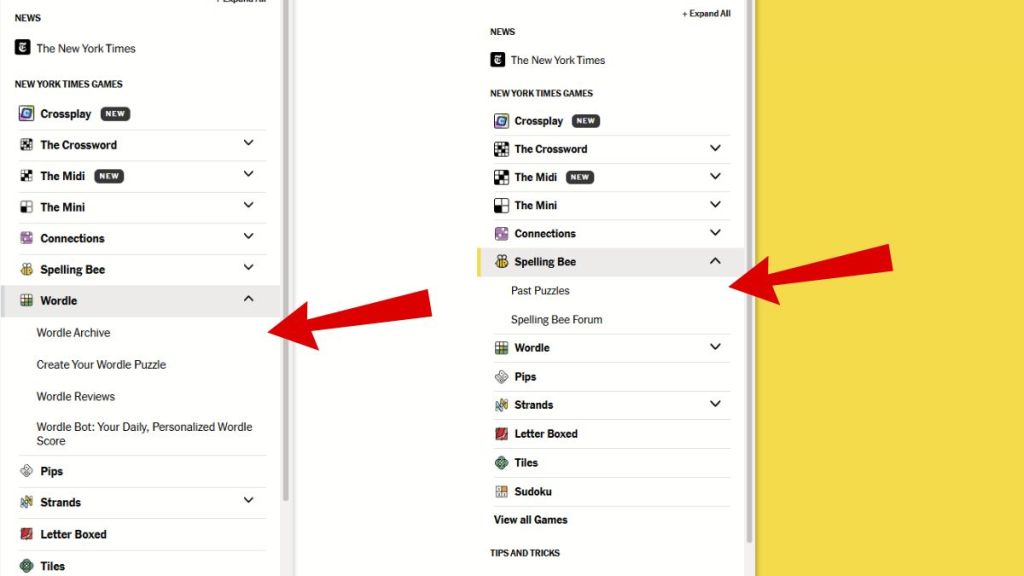
Moreover, as you can see in the image, both Wordle and Spelling Bee have past puzzles available to play with an NYT Games or All Access subscription.
Spelling Bee vs Wordle: Which Game Should You Play?
Deciding between Spelling Bee and Wordle comes down to what kind of brain workout you are looking for. If you want a quick, high-stakes logic challenge, Wordle is your best bet. If you prefer a relaxed, open-ended vocabulary hunt with no fail condition, Spelling Bee is the better fit.
Of course, for most NYT Games fans, the real answer is: why not play both? Each game exercises a different part of your brain, and together they make for a well-rounded daily puzzle routine. If you enjoy these kinds of comparisons, we have also covered Spelling Bee vs Wordle alongside other popular matchups like Wordle vs Connections and Wordle vs Crossword.
It depends on your strengths. Wordle is harder if you struggle with deductive logic and limited attempts. Spelling Bee is harder if your vocabulary is limited, since the game requires you to find obscure words with no hints or feedback to guide you.
The main difference is the objective. Wordle asks you to guess one secret five-letter word in six attempts using color-coded feedback. Spelling Bee asks you to find as many words as possible from a set of seven letters, with no guess limit and no feedback system.
Not entirely. Wordle is completely free to play on the NYT Games website. Spelling Bee offers a limited free tier but locks most of the puzzle behind an NYT Games subscription once you reach the Solid rank.
No. Spelling Bee has no fail condition. You can make as many attempts as you want and stop at any time without losing. Wordle, on the other hand, ends the game after six failed guesses, which can break your daily streak.
Wordle is the better choice if you are short on time. A typical Wordle session takes 2–5 minutes. Spelling Bee sessions usually run 10–25 minutes, especially if you are aiming for Genius rank.
When Does NYT Spelling Bee Reset?
 Daksha Gupta
All NYT Spelling Bee Badges and How to Earn Them (2026)
Daksha Gupta
NYT Spelling Bee Tips, Tricks, and Strategies to Win Every Day
 Ajith Kumar
Where to Play Spelling Bee Unlimited: 5 Best Websites and Apps
 Arnamoy Das
What Is Bingo in Spelling Bee? Explained
 Sanmay Chakrabarti

7 Best Globle Tips and Tricks to Find the Mystery Country Easily
Daksha Gupta
Connections Hints Today & Answers for October 16
Sanmay Chakrabarti
Wordle Hint Today - October 16, 2026 (Puzzle #1945)
 Rishabh Sabarwal

When Does Globle Reset? Find the Reset Time Here
Daksha Gupta
How Many Countries Are in Globle? A Full Globle Country List
Daksha Gupta