
Contexto is a daily word-guessing game that scratches an itch Wordle can’t even put its finger on. Instead of following the repetitive pattern of five-letter words and placement-centric feedback, this game embraces unpredictability by letting an AI pull the strings. With that being said, even the AI has a habit it frequently falls back upon – picking nouns as Contexto answers.
Be it the name of a place, occupation, object, or anything in between, you might have noticed that a majority of Contexto answers are nouns. In case you’re wondering why this is the case, we’ve broken down why Contexto answers are mostly nouns below.
How Does Contexto Rank Your Guesses
Players who know how to play Contexto will be familiar with its guess ranking system. Every word you type into the puzzle is assigned a number by the AI, indicating just how close or how distant it is from the answer. The only factor behind the ranking is the word’s meaning (semantic similarity).
Spelling or letter similarities do not matter; the Contexto AI cares only about the “context.”
Given its semantic focus, the puzzle is widely believed to use a Natural Language Processing (NLP) model, likely GloVe (Global Vectors for Word Representation). It is an open-source NLP model developed by Stanford University, but Daydash, the game’s creator, has yet to confirm this.
The GloVe AI model analyzes billions of lines of text from various sources on the internet to see which words are in contextual proximity. It maps every word into a multi-dimensional space as a mathematical vector. This process is called word embedding. Words that appear next to each other are often assigned similar vectors. Words that don’t share semantic similarity are ranked far apart.
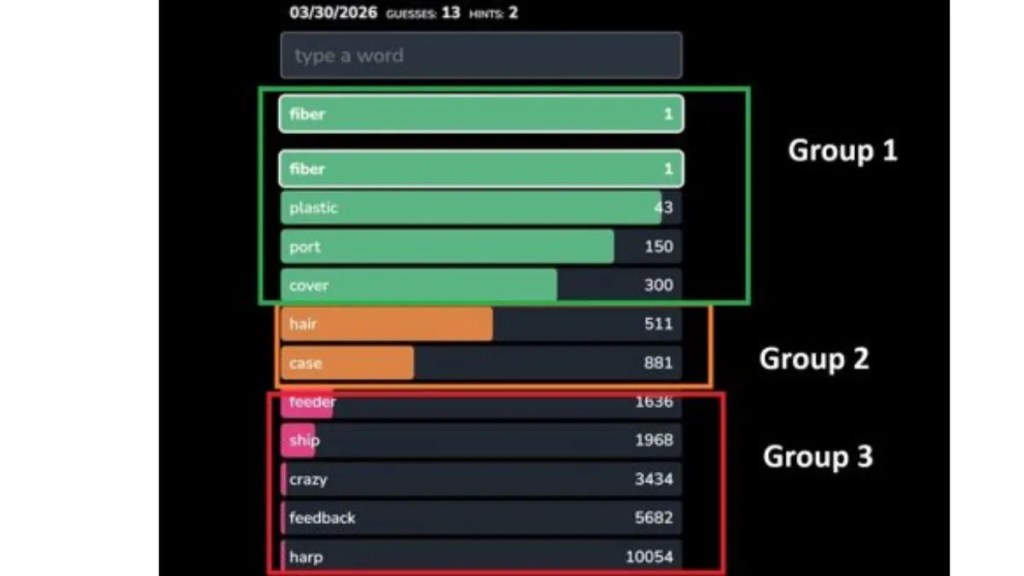
When you submit a guess, the game calculates the Cosine Similarity, aka the distance, between your guessed word and the secret answer.
You can think of this function as a language GPS. If the secret word is “Computer,” and your guess is “Smartphone,” then the AI will deem your answer to be much closer than something like “Digital.” It will recognize that the guess is in the same ballpark as the answer, and the Contexto scoring system will give the word a lower rank.
Why Contexto’s AI Model Gives Mostly Noun Answers?
If you check out today’s Contexto answer, you will likely find that the AI opted for a noun yet again. This tendency to pick “name” words isn’t some oversight in its algorithm, and instead, it’s part of why these puzzles are so satisfying and tricky in the first place.
Here are the biggest reasons why the Contexto AI algorithm uses nouns as answers:
Nouns Are a Larger Part of the Dataset
The Contexto AI learns by reading massive amounts of text from sources like Wikipedia and news publications online. Since these websites focus on explaining what objects and places are, the model naturally becomes an expert at identifying nouns. Unlike verbs or adjectives that can be employed in several ways, the usage of nouns is largely static due to their narrower meaning.
The AI is able to map the so-called “location” of these words quite easily since they have a more fixed definition. This makes nouns the most reliable picks for Contexto’s game of hot-and-cold, while other types of words are often too messy or vague to work as a daily answer.
Nouns Form Denser Semantic Clusters
As mentioned earlier, the Contexto AI maps every word as a numerical vector. The secret answer is treated as rank #1, while words with semantic similarities are assigned ranks depending on how closely related they are. Nouns are the perfect fit for this model because they tend to appear in very specific, consistent contexts.
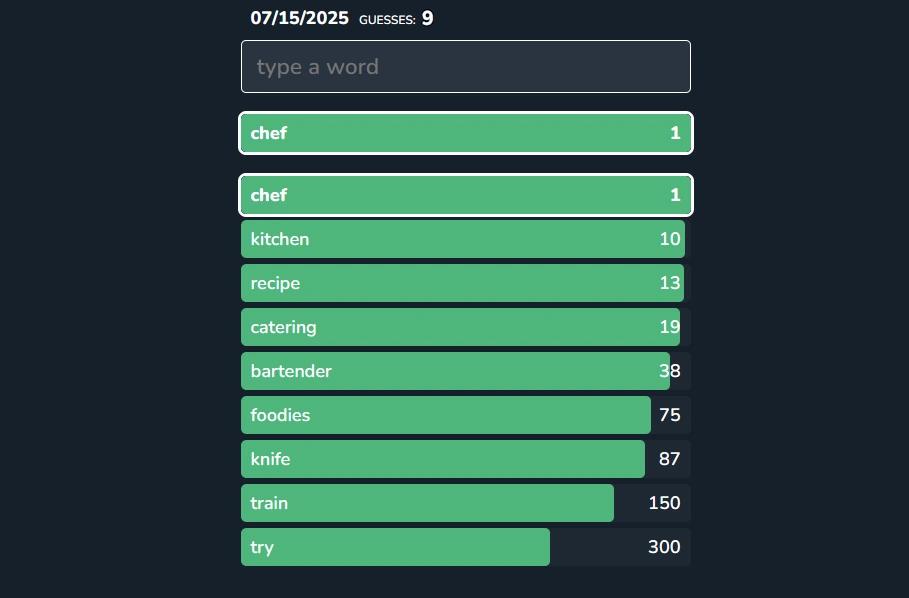
For example, the noun “Chef” organically bears close relations to words such as “Knife,” “Kitchen,” and “Recipe.”
These will likely be among the first words you think of while playing a word association game and solving for the secret word: Chef. These consistent relationships allow the AI to build incredibly tight, dense clusters of related words. When the secret answer is a noun, the semantic route to the target is clearer because the surrounding field of related words is so well-defined.
Verbs and Adjectives Can Be Ambiguous
Verbs and adjectives are more confusing for the Contexto AI algorithm to rank because they are context-dependent. A verb like “run” can relate to an athlete, a faucet, a political campaign, or even a computer program. Similarly, an adjective like “cold” could describe the weather, a person’s personality, a viral infection, or a literal glass of water.
Since these words can be used in so many unrelated ways, the AI has a harder time building a tight-knit and predictable word cluster around them. This naturally makes adjectives and verbs an almost “slippery” target for a proximity-based game. And it’s a big reason why Contexto answers are mostly nouns.
Have Contexto Answers Ever Been Adjectives or Verbs?
Yes, Contexto answers have been adjectives and verbs in the past, but these examples are extremely limited. In 90% of cases, you’ll find that the secret word is a noun. However, there absolutely have been puzzles where the Contexto AI picked an adjective such as “Beautiful,” or a verb like “Drop.”
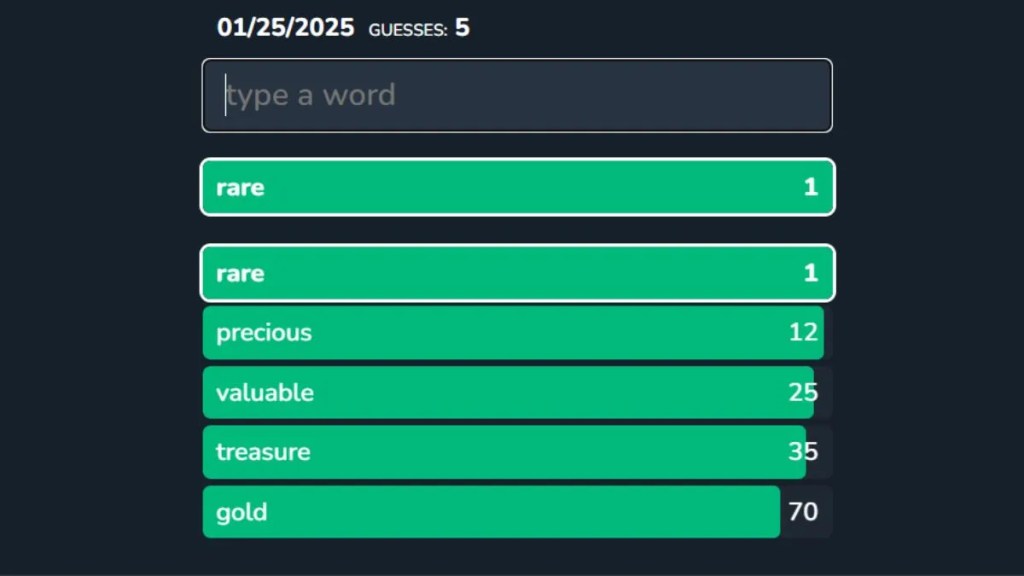
That said, the adjectives and verbs it uses can easily be perceived as nouns. This is tied to the ambiguity surrounding these words that we mentioned earlier. For example, names of colors such as Pink, Yellow, and Blue have all been featured as the answer, and all three words can be classified as both adjectives and nouns.
There are very few clear-cut adjectives and verbs that have been used as the Contexto answer. After some digging, we found every instance of the Contexto AI not using a noun as the secret word:
| Word | Contexto Edition |
|---|---|
| BEAUTIFUL | Contexto #22 – October 10, 2022 |
| SWEET | Contexto #371 – September 24, 2023 |
| GUIDE | Contexto #746 – October 3, 2024 |
| IMPOSSIBLE | Contexto #766 – October 23, 2024 |
| QUIET | Contexto #811 – December 7, 2024 |
| START | Contexto #826 – December 22, 2024 |
| COLOSSAL | Contexto #855 – January 20, 2025 |
| RARE | Contexto #860 – January 25, 2025 |
| RUSTIC | Contexto #861 – January 26, 2025 |
| CLASSICAL | Contexto #880 – February 14, 2025 |
| DROP | Contexto #916 – March 22, 2025 |
| INSTANT | Contexto #917 – March 23, 2025 |
| TRAP | Contexto #1107 – September 30, 2025 |
How Does This Affect Your Gameplay?
By knowing that the Contexto answer has a 90% chance of being a noun, your guesses can be fine-tuned to be more precise.
For starters, you can easily sidestep one of the most common Contexto mistakes and not attempt adjectives and verbs randomly. Instead, you can treat those words as stepping stones to help find the answer. Here’s a closer look at how your gameplay strategy should be:
- Stick to nouns: If you get a high-ranking adjective like “Delicious” or a verb like “Cook,” don’t just guess more describing words. Immediately pivot to the nouns associated with them, such as “Stew,” “Chef,” or “Dinner.” These are much more likely to be the secret answer.
- Use verbs and adjectives strategically: Since these words have a small chance of being the answer, your usage of verbs and adjectives should serve a tactical purpose. We recommend using them to narrow down the context of the answer and pivoting to nouns once you start seeing green-colored guesses.
- Use concrete nouns: Avoid guessing abstract terms like justice early on. Stick to concrete nouns – things you can see, touch, or visit – as they have the most stable mathematical vectors in Contexto AI’s language map.
Best Contexto Starting Words
Unlike the best Wordle starting words, where you are looking to find the correct letters, the best Contexto starting words are far more fluid.
While you can reliably use “Adieu” or “Slate” to start every Wordle puzzle, Contexto’s answers can vary heavily in both length and meaning. This means that you’ll need to pick a starting word from a category-wise cluster and keep switching until the AI confirms that you’re heading in the right direction.
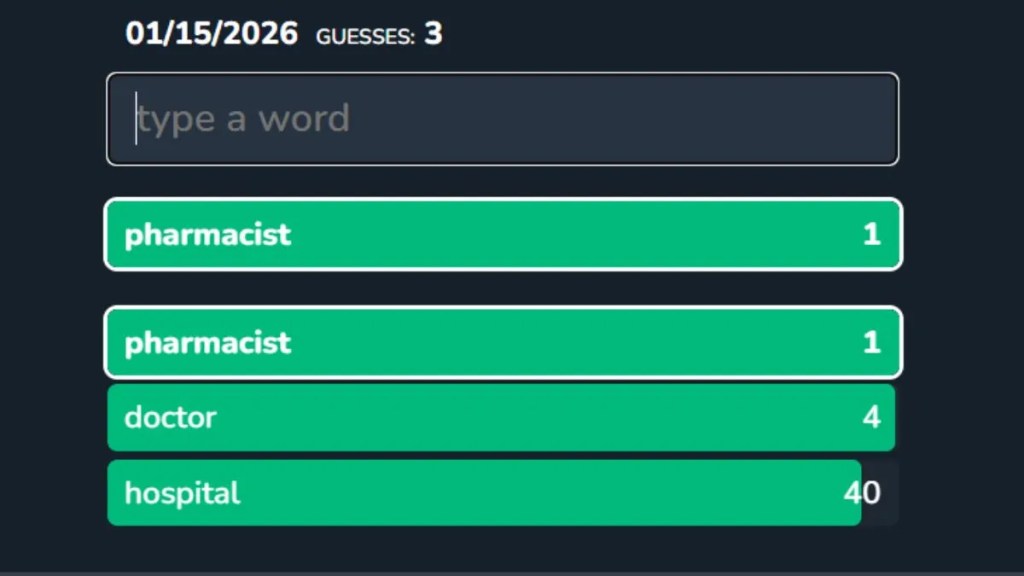
In practice, this would mean starting the puzzle with words such as “Worker”, “Athlete”, or “Doctor” to check if the secret word is linked to an occupation. If you strike out, you can move on to location-based starting words such as “Hospital”, “School”, or “Church.” As you pivot to different categories, you’ll eventually land in the correct ballpark.
We hope that now you have a clear understanding of why Contexto answers are mostly nouns. This will help sharpen your strategy going forward.
Yes, Contexto answers can be adjectives or verbs. However, this is extremely rare, and the AI mostly uses nouns.
The Contexto AI algorithm analyzes massive amounts of text available online to determine the semantic similarity between words. It maps words into a mathematical space where words used in similar contexts are placed closer together.
When Does Contexto Reset? Here's When You Can Play the Next Puzzle
 Daksha Gupta
Contexto vs Wordle: Key Similarities, Differences, and Detailed Comparison
 Bipradeep Biswas
 Anmol Sachdeva
 Arundhati Medda

Common Mistakes in Contexto and How to Fix Them
Bipradeep Biswas

How Many Countries Are in Globle? A Full Globle Country List
Daksha Gupta

Globle Hints and Answer Today for October 13, 2026
Daksha Gupta

How to Play Globle: A Step-by-Step Guide for Beginners
Daksha Gupta
Wordle Bot: What It Is, How It Works, and How to Use the Tool to Get Better at Wordle
Daksha Gupta
NYT Games Reset Time Guide: When Do Wordle, Strands, Connections and Other Games Reset?
Daksha Gupta