Ever since Wordle exploded in popularity among puzzle enthusiasts, the landscape of digital word-guessing games has seen a vast array of variants and challengers land on the scene. While many of these games follow the same format as Wordle, Letroso has become a worthy contender and captured the attention of puzzle fans who want a deeper layer of strategy.
While both games may seem similar at first glance, thanks to the familiar aesthetic of colourful tiles and hidden vocabulary, they offer different mental exercises. If you are looking to understand what sets Wordle and Letroso apart, here is a breakdown of all of their key differences.
Letroso vs Wordle In a Nutshell
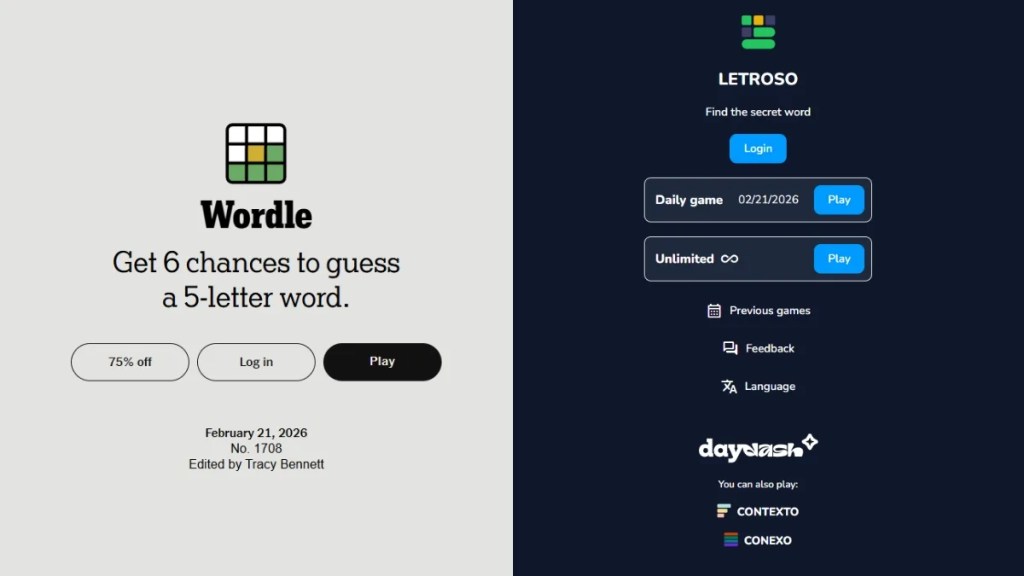
Even though they work on a similar core gameplay mechanic of word-guessing, Wordle and Letroso are both popular daily puzzles that have grown to be a popular avenue for puzzle-solving aficionados. Here’s a little background on Letroso and Wordle:
| Details | Letroso | Wordle |
|---|---|---|
| Founder | Daydash (Brazil) | Josh Wardle and The New York Times |
| Release Date | August 2024 | October 2021 |
| Objective | Guess the correct word between 3 and 10 letters in unlimited guesses | Guess a five-letter word in a maximum of six guesses |
| Game Rules | Three color feedback, word adjacency, flexible grid length, and rounded corner clues | Three color feedback and fixed grid length |
| Game Modes | Daily and Unlimited | Daily and Hard |
| Paid or Free | Free to play | Free to play |
| Past Puzzle Archive | Accessible for free | Requires NYT Subscription to access |
| Languages | English, Spanish, Portuguese | English |
If you’re here as a fan of Letroso, you should check out today’s Letroso answers and hints to solve the daily puzzle easily.
Letroso vs Wordle Compared
Both Letroso and Wordle are daily word-guessing puzzles that test your vocabulary. However, the way each game delivers that challenge is fundamentally different. Here’s a detailed comparison between how both puzzles work.
Objective
| Feature | Letroso | Wordle |
|---|---|---|
| Goal | Guess the secret word of variable length | Guess a hidden five-letter word |
| Word Length | 3 to 10 letters (changes daily) | Always exactly 5 letters |
| Daily Puzzle | One new word per day + Unlimited mode | One new word per day |
In both games, the core objective is the same: figure out the secret word. Wordle always tasks you with a five-letter word, which gives it a focused, consistent feel. Letroso shares that goal but raises the stakes by hiding a word that can be anywhere from 3 to 10 letters long. Since you don’t know the word length going in, every Letroso puzzle requires you to figure out not just the letters but also the size of the word you’re looking for. Both games release one new puzzle per day, but Letroso also offers an Unlimited mode for extra practice. Check out our how to play Wordle guide to get an in-depth insight into the popular puzzle.
Game Mechanics
| Feature | Letroso | Wordle |
|---|---|---|
| Color Feedback | Green, yellow, and grey tiles | Green, yellow, and grey tiles |
| Additional Visual Cues | Rounded corners, letter connections, and disconnected letter indicators | None beyond color-coded tiles |
| Grid Structure | Dynamic grid that adjusts to the word’s length | Fixed 5×6 grid (5 letters, 6 rows) |
| Clue Type | Relational clues showing how letters connect within the word | Positional clues showing if a letter is in the correct spot |
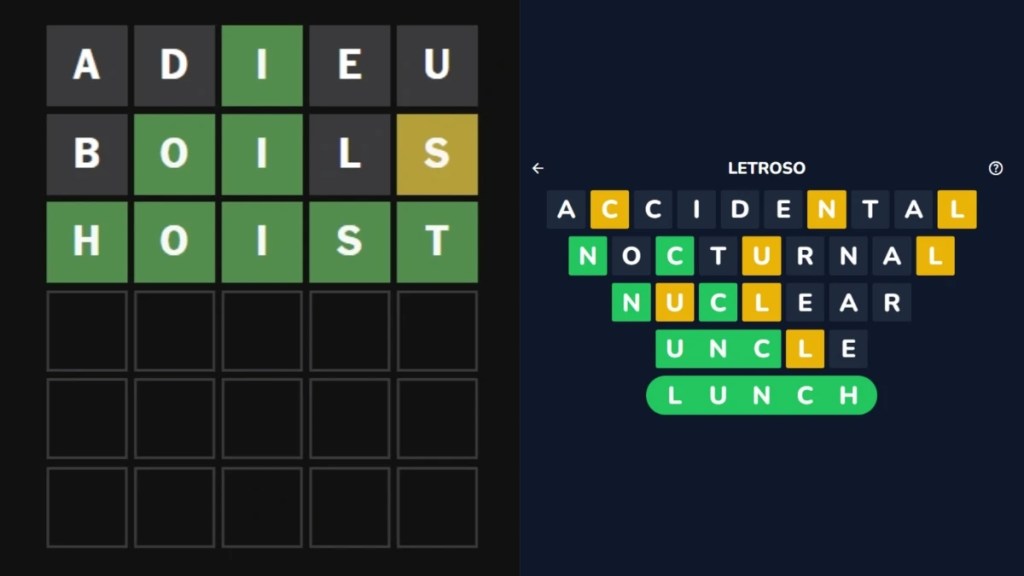
Both games use the familiar green, yellow, and grey color-coded feedback system. In Wordle, each letter is treated independently: a green tile means the letter is correct and in the right position, a yellow tile means it is a part of the final word but belongs elsewhere, and a grey tile means it isn’t in the final word at all.
Letroso uses the same color-coded feedback but brings an add-on of relational visual cues on top. When a correctly placed letter sits at the start or end of the word, its tile displays rounded outward corners to confirm that position. When two green letters appear next to each other in the final word, the game visually connects their tiles, revealing a confirmed fragment of the word. If green letters appear visually separated, it signals a gap where another letter needs to fit between them. These relational cues reward players who can read structural patterns rather than just checking off individual positions.
Error Tolerance
| Feature | Letroso | Wordle |
|---|---|---|
| Guess Limit | Unlimited guesses | Strictly 6 attempts |
| Penalty For Wrong Guesses | No penalty; each guess reveals more clues | One attempt consumed per wrong guess |
| Fail Condition | None; you can always keep guessing | Answer is revealed after the 6th guess |
| Performance Metric | Fewest guesses possible (self-tracked) | Solving within 6 tries; streak tracking |
This is one of the sharpest contrasts between the two games. Wordle gives you exactly six attempts to guess the five-letter word. If you don’t crack it by the sixth guess, the game reveals the answer, and you’re done for the day. This hard cap forces players to think strategically about each guess, often spending early turns on letter elimination rather than shooting for the answer directly.
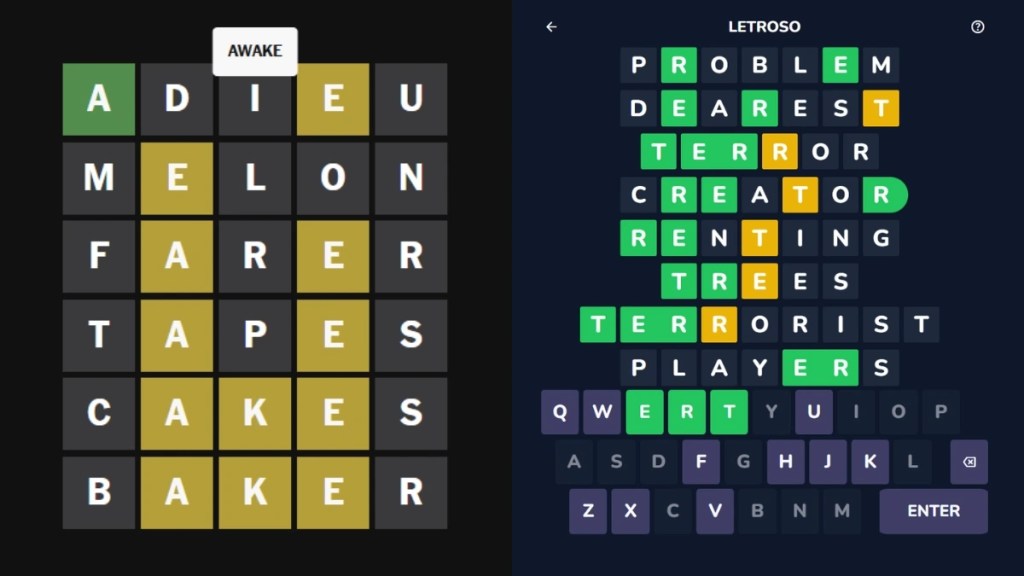
Letroso takes the opposite approach by offering unlimited guesses with no fail condition. You can experiment freely without the anxiety of running out of tries. However, the game still tracks how many guesses you use, so the real challenge shifts from can you solve it at all to how efficiently can you solve it. The unlimited format makes Letroso more forgiving on the surface, but the pursuit of a low guess count provides its own form of pressure. Check out common Letroso mistakes that players often make while solving the puzzle.
Difficulty
| Feature | Letroso | Wordle |
|---|---|---|
| Difficulty Curve | Fluctuates daily based on word length and complexity | Relatively consistent but varies rarely day to day |
| Learning Curve | Steeper as it requires understanding visual cue system beyond color tiles | Gradual, as most players learn the mechanics in one or two games |
| Strategy | Deductive reasoning using relational and positional clues together | Letter elimination and opener word strategies |
| Vocabulary Demand | Higher as words can be uncommon and up to 10 letters | Moderate as limited to commonly known 5-letter words |
Wordle’s difficulty stays relatively steady because every answer is a five-letter word. Over time, players develop reliable opener strategies and letter-elimination patterns that work almost every day. The learning curve is gentle, and most people pick up the mechanics within a game or two.
Letroso’s difficulty fluctuates daily. You might face a snappy 3-letter word one day and wrestle with a 9-letter word the next. Shorter words can be surprisingly tricky since there are fewer letters to work with and less feedback per guess, while longer words demand a broader vocabulary. The learning curve is also steeper because you need to master not just the color feedback but also the visual cue system of rounded corners, letter connections, and disconnected tiles. That said, if you’re struggling, you can head over to our how to play Letroso guide for an easier understanding of the game.
On the other hand, check out today’s Strands answers, which is one of the most forgiving NYT games as it lets you earn hints by finding non-theme words.
Time Investment
| Feature | Letroso | Wordle |
|---|---|---|
| Average Session Length | 2-15 minutes depending on word length | 2-5 minutes for most players |
| Daily Commitment | One daily puzzle + optional Unlimited mode | One daily puzzle only |
| Replayability | High as unlimited mode and a free puzzle archive available | Lower as one puzzle per day with no replay available |
| Frustration Factor | Lower on a per-puzzle basis (unlimited guesses) but longer words can be demanding | Can be frustrating if you fail within 6 tries |
Wordle is built to be a quick daily ritual. Most experienced players finish in under five minutes, and even newcomers rarely spend more than ten. With only six guesses and a fixed word length, sessions are naturally short. This makes it extremely practical as an everyday habit, the kind of game you knock out with your morning coffee.
Letroso’s time investment varies more. A short 3 or 4-letter word might take just a couple of minutes, while a 7 to 10-letter word can stretch into a longer session as you piece together the visual clues and test different letter arrangements. The unlimited guesses mean you’re never abruptly cut off, but they also mean there’s no built-in signal to stop when you’re stuck, so some puzzles can eat up more time than anticipated.
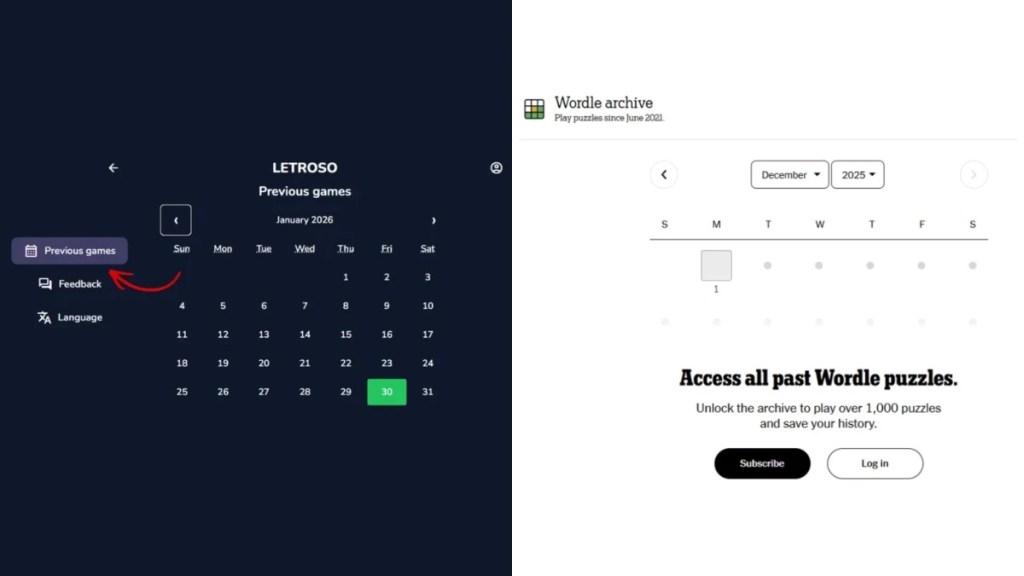
On the upside, the Unlimited mode and a free archive of past puzzles mean you can play as much or as little as you want beyond the daily challenge. The daily variety in word length keeps things fresh and prevents the repetitive feel that a fixed-format game can sometimes produce over time.
Thankfully, you’re not playing today’s NYT Spelling Bee, which takes the most time as it keeps going as long as you’re willing to hunt for more words, and chasing the Queen Bee rank, which can easily eat up to 20-30 minutes or more on a tough day. At the same time, it is also the game that rewards your vocabulary the most, as it revolves around pulling as many valid words as you can from a set of seven letters.
Letroso vs Wordle: Which Game Should You Be Playing?
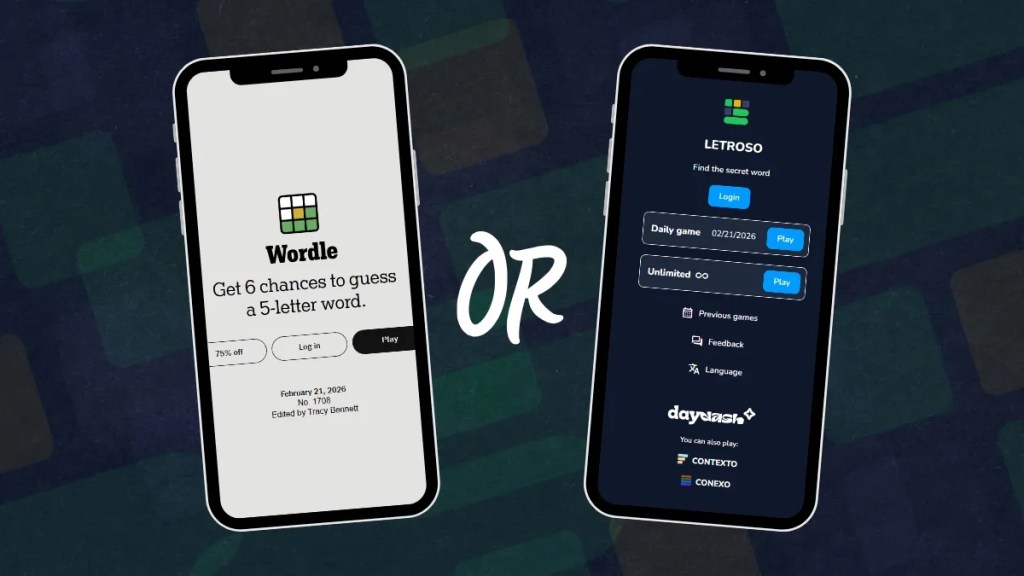
Honestly, you don’t have to pick just one. Both Letroso and Wordle are lightweight daily puzzles that exercise your vocabulary and logical reasoning without demanding much of your day. Playing them back-to-back takes roughly ten minutes, which is a solid return on investment for a mental warm-up. That said, each game scratches a different itch. You can also check out games similar to Letroso that you should try your hand at.
If you prefer a clean, predictable routine where you can refine a strategy over time, Wordle is hard to beat. The fixed five-letter format lets every game feel familiar, and the six-attempt limit gives each guess a sense of weight that keeps things engaging. Check out today’s Wordle answer to get a glimpse of exactly what we’re referring to here.
Letroso is the better pick if you crave variety. Since the word length changes each day and the visual clues work differently, you can’t rely on the same starting strategy as each puzzle feels like a fresh challenge. It is more mentally stimulating on average, and the unlimited guesses make it forgiving if you find Wordle’s attempt cap stressful.
Our recommendation? Play both. Start with Wordle for something structured and quick, then jump into Letroso for a less predictable challenge. Together, they offer a well-rounded daily brain exercise that stays fresh without eating into your schedule. Also, don’t forget to check out yesterday’s Letroso hints to get a dive into how we solved the daily puzzle.
So now that you know the difference between Letroso and Wordle, which puzzle game are you going for? Or you’d rather play them both? Let us know in the comments below!
Yes, both games are entirely free to play in any web browser. Letroso also offers a free Unlimited mode for extra practice beyond the daily puzzle.
Wordle gives you exactly six attempts, while Letroso offers unlimited guesses. The challenge in Letroso is solving the puzzle efficiently rather than within a fixed number of tries.
On average, yes. Wordle’s fixed five-letter format keeps difficulty steady, while Letroso’s variable word lengths (3-10 letters) and layered visual clue system make it more challenging, especially on longer-word days.