The NYT Spelling Bee is one of the most popular and difficult word games online. This game, like a few others, has a unique scoring system. Learning about how the game scores the word guesses can make climbing ranks and gaining points much easier. There is one primary factor that determines your score, and we discuss that in detail in this Spelling Bee scoring system guide.
How are Points Calculated in NYT Spelling Bee?
The NYT Spelling Bee game awards points based on the number of letters in the words you guess. But there is an exception to this rule, especially for base four-letter words.
That said, here are some points that you need to remember about the Spelling Bees scoring system:
- You get only one point for every four-letter word.
- You earn one point per letter when the words are longer than four letters. For example, a six-letter word will reward you with six points.
- Each puzzle includes at least one “Pangram,” which is worth seven points. These 7 points are in addition to the points you are rewarded based on the letters in the Pangram.
The scoring potential for players in the Spelling Bee game isn’t always the same, as the honeycomb can be unpredictable. This means the difficulty level is random. The puzzle can be easy or difficult depending on the letters in the hive, which influences how quickly you can score points and achieve the Genius rank.
Four-Letter Words Score Less
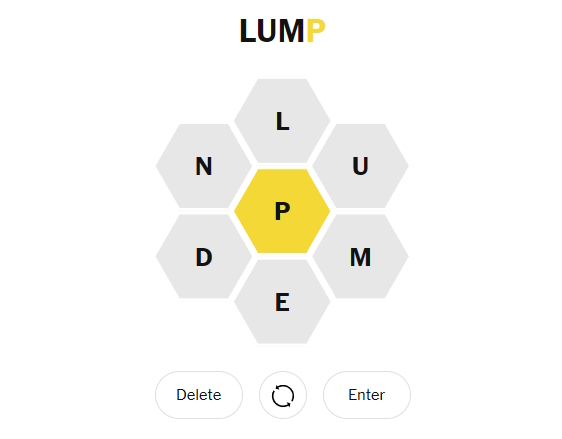
As is the case with all Spelling Bee words, even four-letter words must include the central letter, which is yellow colored. Each four-letter word will always reward you with one point.
Here are some examples of 4-letter words from past and yesterday’s Spelling Bee answer: Heap, Neap, Pain, Papa, Pipe, Yipe.
One Point Per Letter Rule
Each 4-letter word you find will always yield one point each, not more than that. However, if there’s a word with more than four letters, you will be rewarded 1 point for each letter. The 1-point per letter rule is only applicable for words with 5 or more letters. This makes hunting for larger words a challenge, but you do get more points.
For example, a five-letter word like SLATE gives you 5 points, a six-letter word (say Papaya) gives you 6 points, and so on.
By now, you must have understood that the length of the words determines how many points you’ll receive in the Spelling Bee scoring system. Four-letter words are an exception, as they only give you one point for a word.
The Pangram Bonus: Scoring Big with All Seven Letters
Pangrams are words that make use of all seven letters in the hive atleast once. What makes a Pangram so special is that it gives you a bonus of 7 points on top of the standard letter-based points awarded for making the word.
For example, THEMATIC is a Pangram (for the Feb 19th puzzle) that uses eight letters and rewards a total of 15 points (8 points per letter + 7 bonus points).
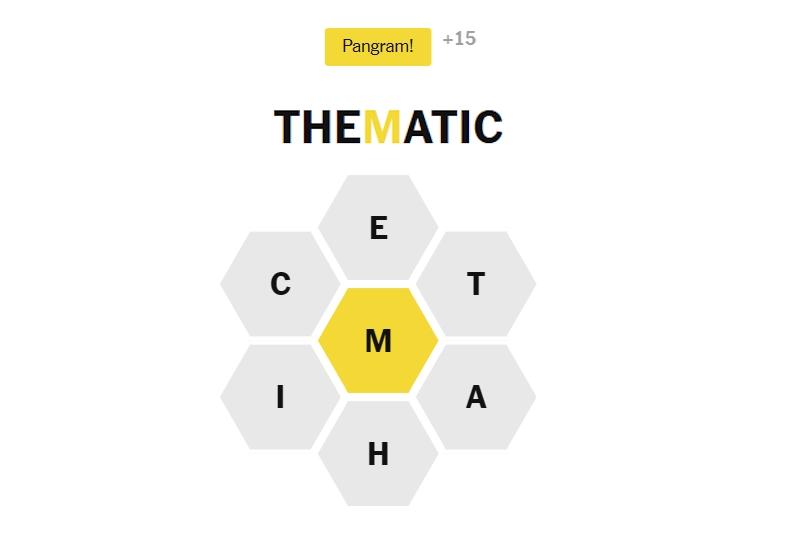
The Pangram needs to include all seven letters in the honeycomb grid, but there will be instances where it includes more letters – repetition is allowed, awarding you more points. If you are unsure, learn how to play Spelling Bee using our dedicated, in-depth guide.
Understanding Spelling Bee Ranks and Thresholds
Now that you know how the scoring system works, let’s look at Spelling Bee ranks and the points thresholds for them. Each Spelling Bee puzzle has a certain number of words in it, and there is a maximum point allocation based on the words.
From Beginner to Genius: The Percentage Breakdown
The NY Times reveals that each rank is based on the percentage of total points earned of the maximum possible score. For example, if you score 140 points out of 200, you will have attained 70% points and easily reach the Genius rank.
Here is the complete breakdown of Spelling Bee ranks and their score percentage thresholds:
- Beginner: 0% of points
- Good Start: 2% of points
- Moving Up: 5% of points
- Good: 8% of points
- Solid: 15% of points
- Nice: 25% of points
- Great: 40% of points
- Amazing: 50% of points
- Genius: 70% of points
- Queen Bee: 100% of points
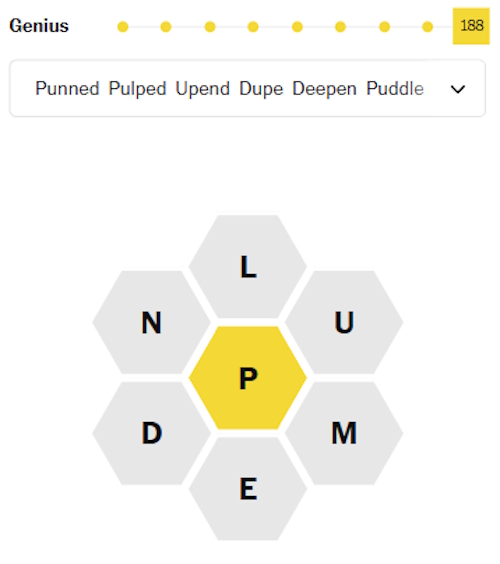
What is the Queen Bee in Spelling Bee?
Queen Bee is the highest level rank in the NYT Spelling Bee that you unlock after finding all the words in the puzzle.
To reach Queen Bee, you must find all the valid words that exist in today’s Spelling Bee puzzle. It basically means that you are trying to match the list of valid words that the puzzle creators have incorporated.
Strategies to Maximise Your Spelling Bee Score
Want to increase your Spelling Bee score and reach the Genius Level or shine as the Queen Bee? Here are some strategies that will help you maximise your Spelling Bee score:
- Start hunting the pangram early: Searching for Pangrams early on can give you a much-needed confidence boost, while also opening the path for new words. Since the Pangram gives you bonus points, this can be an effective way to get a head start.
- Use the shuffle button more often: Shuffle the letters; this will force your brain to see new patterns. This reveals combinations you didn’t notice before.
- Start hunting for common prefixes and suffixes: Common prefixes are: re, un, and pre, whereas common suffixes are ing, ed, and er. Another helpful habit is to look for word families, like- sing, singing, and singer.
- Finding patterns, staying patient, and practising will make you good at the NYT spelling Bee game. It’s not only about the vocabulary knowledge you carry.
- Experiment with words: Experimenting is key. Try out odd combinations and swap letters. Many surprising words pop up this way.
- Take a short break if you are stuck: A short break will refresh your brain. Then, it will be easier for you to find a new word.
Finding Multiple Pangrams
Each NYT Spelling Bee puzzle has at least one Pangram. They use all seven letters in the hive, and mostly contain 7+ letters. However, sometimes a puzzle can have two or more Pangrams, and finding them can be fun and rewarding. Here are some easy ways that can help you spot a Pangram in the puzzle.
- Pangram Training Tools and Solver: Finding the Pangram by yourself can be satisfying. But sometimes a little help doesn’t hurt. If you’re facing problems with finding a Pangram then there are several free tools online that can help you practice Pangrams by generating solutions from letters. Use them for training, not for actual puzzles, as it could ruin the fun.
- Increase Vocabulary: Read dictionaries, books, and articles to better your vocabulary and quickly find words in the Spelling Bee hive. This can sharpen your skills and make you better at finding Pangrams.
Utilising Suffixes and Compound Words
When searching for a Pangram, look for suffixes such as -ing, -ed, -er, -ful, -on, and -est, and prefixes such as re-, un-, pre-, dis-, in- and im-. You can test out various combinations with the words you’ve already found, and work around them. For example, if the letters of the hive are A, B, C, I, L, N, O, the Pangram might end with “-ING” and “-TION.”
You should also keep an eye out for compound words that use two distinct words to form one. Here are some examples of compound words that are also Pangrams:
- Airplane (7 letters: A, I, R, P, L, N, E)
- Backing (7 letters: B, A, C, K, I, N, G)
- Hairband (7 letters: H, A, I, R, B, N, D)
- Mailbox (7 letters: M, A, I, L, B, O, X)
Spelling Bee Scoring Calculator and Daily Limits
Now that you know about scoring in Spelling Bee, here’s a Scoring Calculator that will help you summarize the Scoring System of Spelling Bee puzzles.
- 4-letter words: 1 point each
- 5-letter words: 5 points each
- 5+ letter words and longer: 1 point per letter (e.g., a 7-letter word is 7 points)
- Pangram bonus: An extra 7 points added to the word’s base score.
- Total Points: The sum of all points from valid words.
- Maximum Points: Multiply the points required to reach Good Start by 50, Moving Up rank by 20, Nice rank by 4, or Amazing Rank by 2.
Spelling Bee Puzzles have a daily limit, which means that you cannot complete the full puzzle until you have a New York Times Games or All-Access subscription. Non-subscribers can play a limited version of the game, while subscribers enjoy an unlimited, full access to the NYT Spelling Bee game, including past puzzles.
A Pangram in Spelling Bee is worth 14 points or more.
You need 70% of the maximum points of a Spelling Bee puzzle to reach the “Genius” level.
“Queen Bee” is higher than the Genius rank in Spelling Bee.
Four-letter words only give 1 point to encourage players dive deeper into the game and unlock difficult words with more letters.
To calculate the total possible score for the day, multiply the points required to reach Good Start rank by 50 or Amazing Rank by 2.