If you have ever played Contexto, you should probably know the drill. As you type in a word and hit enter, a score appears below the text box. A random color is also displayed, and depending on that, you must make your subsequent guesses. At times, these scores can be extremely high, which is not a good sign.
What makes Contexto equally confusing and addictive is that, unlike traditional word games, you don’t rely on spellings or definitions, but on how a word is used and its relationship with other words in daily life. So, check this guide to learn about how the Contexto scoring system and Contexto ranking system work, and what those numbers and colors really mean.
How Does Contexto Score and Rank Words
At the core mechanics, Contexto doesn’t just rate you based on how diverse your vocabulary is. Instead, the Contexto scoring system is based on contextual intuition. Your guess gets a score or a number based on how close it aligns with the answer’s meaning and usage with it.
For example, if the Contexto answer of the day is “plane“, then it can align close to the word “helicopter” as both may be used in the same conversation quite often. Whereas, another word, “king,” may shoot up your score since it is not at all related to planes or helicopters.
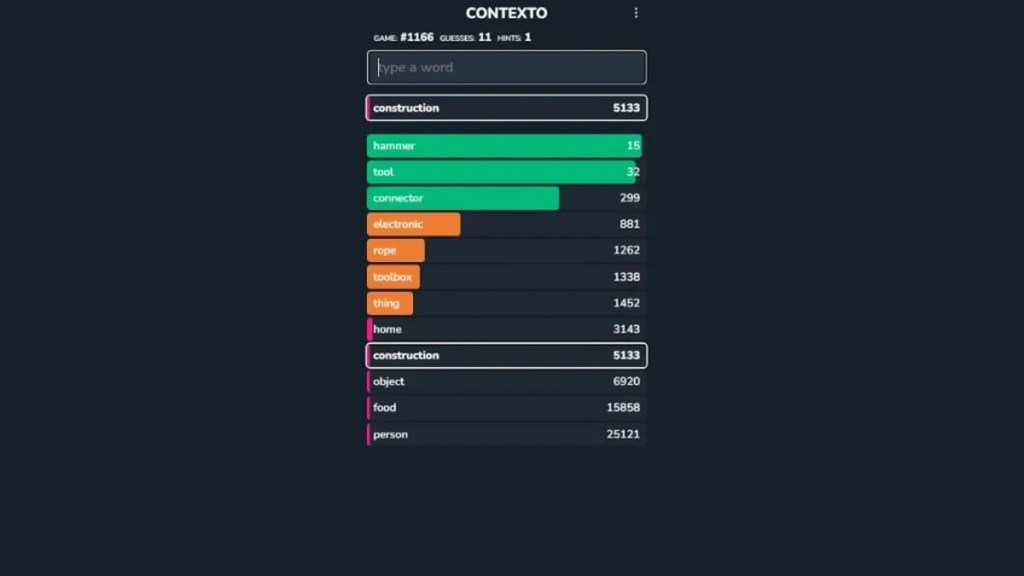
The Contexto scoring system denotes the rank of the word in relation to the context for today’s answer. The secret word or the answer of the day is always ranked #1, and it means that the word holds the highest position in the Contexto ranking system. Now, here is where the players get confused:
- Higher numbers like 3000 mean that the words have low Contexto ranks and are far away from the answer.
- Whereas lower numbers like 23 mean that the words have high Contexto ranks and are very close to the answer.
So, the Contexto scores you see on the screen represent the word’s position in the database for a specific puzzle. Check out yesterday’s Contexto hints to find out how we use ranks to find the answers.
How AI Understands Contexto Words
The real magic of Contexto lies in how machines understand language. Hence, rather than an existing set of rules about the words, some patterns link them with each other. The AI models learn language by going through massive amounts of text and observing how words appear together. This way, it creates a map to bring in words closer that often seem to appear together.
This is where things get a bit weird and fun. Just because two words are commonly paired together doesn’t guarantee that they’re going to be ranked close. The game’s AI also takes this into account. If the broader usage of the words differs, Contexto separates them.
That is why some guesses might seem to have an obvious relation to the answer in your mind, but in reality, they receive lower Contexto ranks. A prime reason can be that the AI model is simply thinking statistically instead of emotionally, and doesn’t know how real people connect those words. To know more about how this puzzle game works, you can check out our guide on how to play Contexto as well.
Understanding the Color Codes in Contexto

While numbers drive the Contexto ranking system, most puzzle solvers are often drawn towards visual cues and colors. And, Contexto’s color system helps players with this visual shortcut to progress in the game. To make things simpler, there are only three primary colors for the Contexto scoring system as follows:
- Red Zone: Red means that you’re guessing words in the wrong neighborhood, and the guesses share very little context with the actual answer. This is a sign for you to redirect your thinking to other contexts.
- Orange Zone: The Orange zone is a sweet spot when you’ve made a ton of wrong guesses. With this color, you’re slowly getting an idea of the answer, but not hitting the core concept. This is where you must try guessing more specific words rather than vague ones.
- Green Zone: Green means that you’re really close, and at this point, try making small adjustments or using words that go together to get the answer.
If you’re a fan of puzzles that rely on color-coded feedback, check out today’s Letroso answer to see the puzzle solving using visual cues in action.
High Rank vs. Low Rank: Which One Wins in Contexto?
When you type a word in Contexto for the first time, the biggest confusion may arise about whether a higher rank is good or bad. Where the traditional games work on higher scores equal better performance or ranks, Contexto is the complete opposite. Here is what high and low ranks mean in Contexto.
Low Rank Explained
If your guesses show a number around 3000, 5000, or let’s just say it’s more than 1500, then your guess is far away from the answer of the day. In terms of contextual similarity, the AI believes that this guessed word rarely appears alongside the actual answer. In simple terms, having a higher number means your guess got a lower rank.
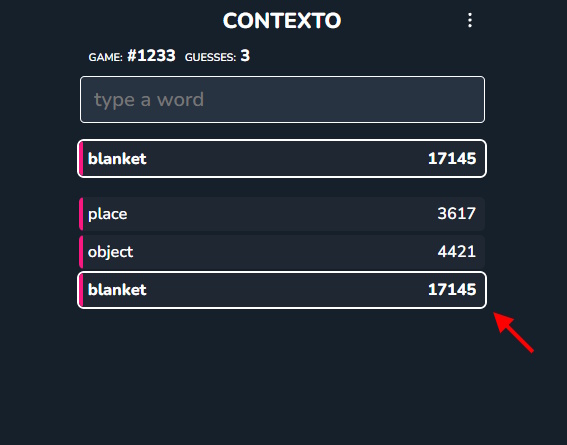
For instance, if the answer is “Chemistry“, guessing the word “blanket” can give you an immensely low rank. This high score signals that you must change the neighborhood of your guesses and think differently.
High Rank Explained
A low number in Contexto means that you’re getting closer to the actual answer. The ideal higher ranks start below 300. Whereas if you get something between 300 and 1500, it means that it is a bit close to the answer but not directly related to it. In simple words, getting a lower number means that your guess has high Contexto rank.
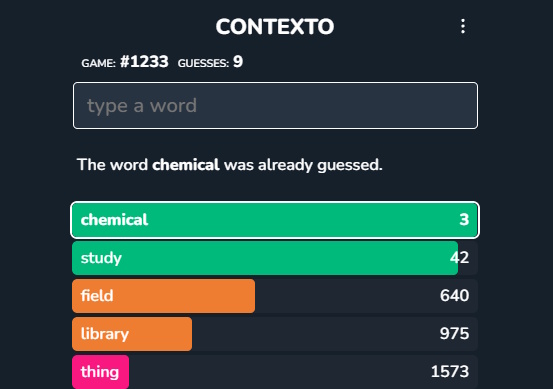
Similarly, when the answer is “Chemistry“, guessing the word “chemical” can give you one of the highest ranks. Since both words are closely related and often appear together in sentences. So, if you see the numbers dropping from 3000 to 1000 to 50, understand that you’re moving up the Contexto ranking system.
If you like solving puzzles that pose quite a challenge, like Contexto, check out today’s Letter Boxed answers and find out how you can test your skills even further.
How to Guess High Ranking Contexto Words Like a Pro
One of the most exciting moments is when your Contexto score jumps by hundreds or even thousands as well. This usually happens when you finally get in the right semantic cluster around the Contexto answer.
You can consider this a hiking journey, and finding the right trail gets you closer to the peak faster. At times, you might guess words that seem to appear together or even have a similar meaning, but get a lower rank. These can throw you in a loop of mediocre guesses, and therefore, you need to step out of this by thinking about a different context.
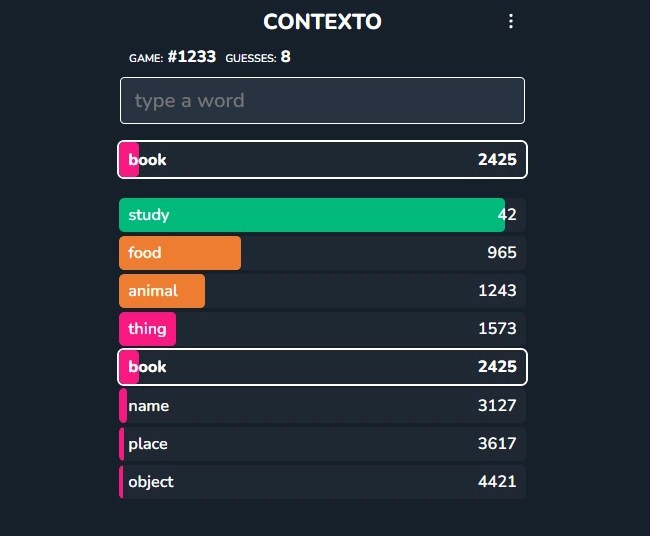
To put it simply, every word has a neighbour, and you need to guess which ones are near your green word guesses. Once you find a strong neighbor, the rest becomes easy to uncover. Also, check out today’s Wordle hint to see how a green visual cue guides us to guess the correct answer every day.
Tips to Improve Your Contexto Strategy Using Scores and Ranks
Improving your game in Contexto isn’t about having a good grasp of your vocabulary. Instead, it’s how you get the score feedback in your head. So, here are a few tips to improve your strategy using the Contexto scores besides your guesses:
- Read and observe the Contexto scores: Rather than fixating your guesses around a single word, notice how the score changes. If they seem to shift towards green color and get high Contexto ranks, you’re doing well. If you feel stuck, it’s time to shift your thinking.
- Choose the right follow-up guesses: Try guessing the right starter words and something that states what the context will be for the next ones. A few examples include profession, thing, animal, or food to understand what your next guess will be.
- Common mistakes to avoid: While playing the game, don’t go overboard with overly generic words, as in the point stated above. Once you get the context, dive more into specifics to get high Contexto ranks. Try not to chase a single idea for long, and understand the color feedback to get the answer quickly.
And that is how the Contexto scoring system works. It’s definitely not unfair, but a reflection of how words have relationships and contexts. Let us know more about some problems you face while playing Contexto in the comments!
Higher ranks are always better in Contexto, and it means that the guess is closer in contextual meaning to the answer.
It may be because Contexto AI model measures the patterns of how two words are used in texts, and this is why related ideas may not connect.
The Green zone indicates that your guess is really close to the Contexto answer for today.
Yes, Contexto uses the same scoring system every day, but the answer changes daily.
Yes, the Contexto ranks are hints to predict the target word’s category.