Wordle and Connections are popular puzzles from the NYT Games portfolio, but for very different reasons. Millions play both puzzles daily, training their vocabulary and pattern recognition skills. But what are the key differences between the two games? If you are starting out with either of the two, this is likely the question you are searching for an answer to. So, let’s compare NYT Wordle vs Connections across various parameters to find out the similarities and differences between these puzzles.
Wordle vs Connections in a Nutshell
If we talk about the core mechanics, Connections and Wordle are quite different puzzles. While the former tackles word association, the latter focuses on word finding.
Wordle also has a minimalist design and requires little time investment daily. Compared to that, Connections is moderately complicated and can be stressful at times.
Here is a brief comparison of the Wordle and Connections puzzle games:
| Feature | Wordle | Connections |
|---|---|---|
| Founder | Josh Wardle | Wyna Liu |
| Release Date | October 2021 | June 2023 |
| Objective | Guess a secret 5-letter word | Make groups of four words using 16 words based on their connection |
| Word Length | 5 Letters | Not Applicable (16 individual words) |
| Attempts | Six guesses allowed | Four mistakes allowed |
| Game Modes | Daily (Hard Mode available) | Daily (No Hard Mode) |
| Feedback System | Letters are color-coded and have visual cues | Difficulty-based color coding |
| Paid or Free | Free | Free (Unlimited is Paid) |
| Avg. Solving Time | 1-2 minutes | 2-5 minutes |
| Puzzle Archive | Yes, requires NYT subscription | Yes, requires NYT subscription |
| Languages | English (Wordle Unlimited sites in other languages) | English |
You will see Wordle and Connections have more differences than similarities as you go through this post. But if you want a game like Wordle, you should read our Letroso vs Connections guide to learn how NYT’s word guessing game inspired Letroso.
Wordle vs Connections Compared
Objective
| Feature | Wordle | Connections |
|---|---|---|
| Goal | Guess a single secret word | Form four categories with four words each from 16 different words |
| Starting Info | No hints, decide your first word to get clues | All 16 words are shown from the beginning |
| Core Skill | Deduction, vocabulary, and quick thinking | Pattern recognition and word association |
The biggest difference between Wordle and Connections is that you have a clean slate when starting Wordle. Your first word determines which clues you will receive going forward. That’s why using apt Wordle starting words is so important while solving the puzzle. Once you start solving, you have six attempts to guess the secret 5-letter word for Wordle today.
On the other hand, Connections already provides you with a 4×4 grid of 16 words to group into four distinct groups based on common themes. Only during specific events will you find the words in Connections to be hidden behind clues, like the April 1st puzzle.
Selecting the correct words will cluster them together and show their difficulty color. This will leave you with a smaller pool of words to pick from until you find all the groups.
Game Mechanics
| Feature | Wordle | Connections |
|---|---|---|
| Feedback Type | Color-coded feedback to provide visual cues on letter position | Difficulty of the category is color-coded |
| Visual Cues | Color of the letter tiles (Green, Yellow, and Gray) | ‘One Away’ message appears when 3 out of 4 selected words are correct |
| Grid Structure | Fixed five-letter grid | Fixed 4×4 grid of 16 words |
| Input Method | Type full words as guesses | Select four words and submit |
| Clue Focus | Letter-level (position, adjacency, sequence) | Word-level (thematic grouping) |
Wordle uses color-coded visual feedback to help players identify if the letters and their positions are correct. The game uses green to indicate correct letters in the correct place, yellow for correct letters in the incorrect place, and gray if the letter isn’t part of the secret word.
You have to continue guessing words until you have found all the letters (meaning some are yellow), or found the secret word. While guessing words, make sure to avoid these common Wordle mistakes to solve the puzzle quicker.
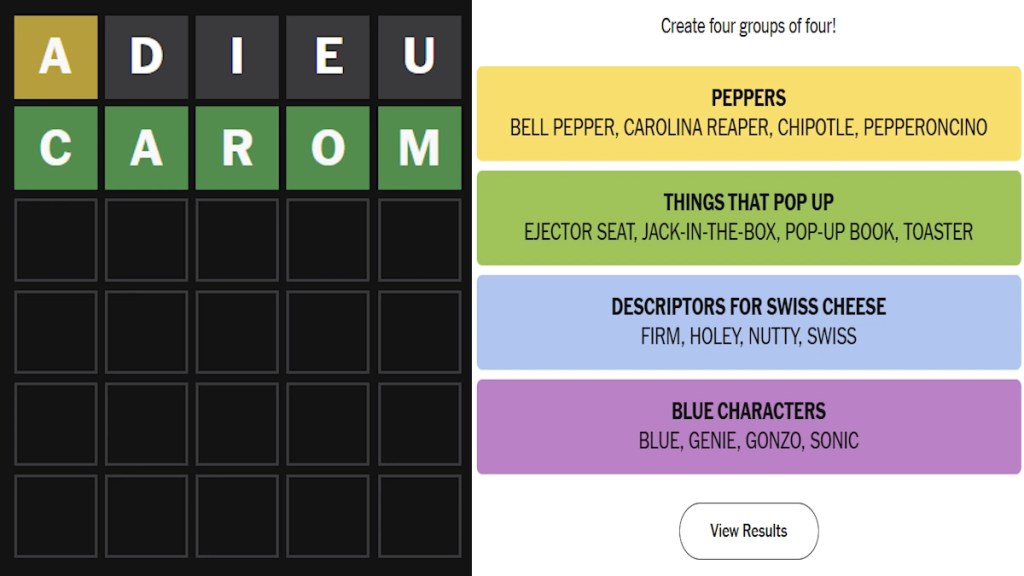
Compared to that, Connections only shows the difficulty color of a category after you’ve grouped the words correctly. The only official help you get in NYT Connections is the ‘One Away’ message, which tells you when you have chosen three out of four words correctly.
To fully solve the Connections puzzle, you need to select four words with a shared theme and submit them to make groups. The game ends when you successfully find four distinct word groups, or when you run out of the four attempts you’re given. Check out today’s Connections hints if you are feeling stuck.
Error Tolerance
| Feature | Wordle | Connections |
|---|---|---|
| Max Attempts | Six guesses | Four attempts |
| Penalty for Wrong Guess | Lose one of six guesses | Lose one of four chances |
| Game Over Condition | Not finding the secret word on the sixth guess | 4 wrong words group submissions |
| Pressure Level | Medium, as you have limited guesses, but each guess can give you enough confirmed letters | High, as every submission counts, and you get very few hints on selecting words |
Both Wordle and Connections give limited chances to the player. Wordle is a bit more tolerant towards errors, as picking the wrong word may still show green and yellow-colored tiles, which act as hints. Moreover, you have to enter a real word to have it count, which means no loss of guesses due to typos here.
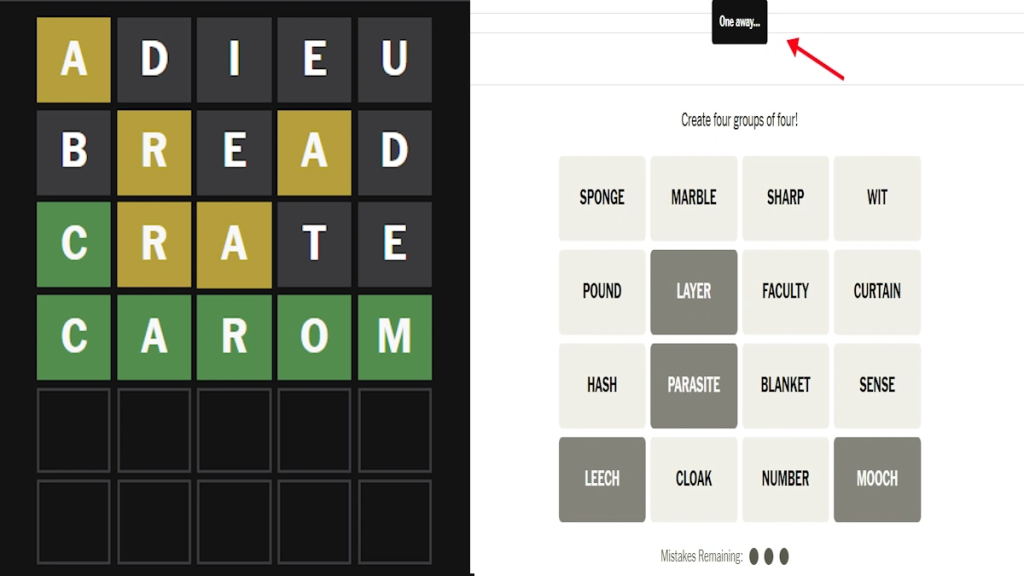
On the other hand, NYT Connections not only gives four chances, but it also provides no hint on making an incorrect submission. If you are lucky enough to get the ‘One Away’ message, only then will you know that you’re on the correct track. However, not getting this hint can completely throw you off. So, check out the common mistakes in Connections to avoid them daily.
Difficulty
| Feature | Wordle | Connections |
|---|---|---|
| Daily Variation | Moderate, as you only have a 5-letter word every day | Moderate to high, as it depends on word choices and category themes |
| Learning Curve | Low, as color feedback is easy to understand, and there are only 5-letter words | Easy to understand, but difficult based on the puzzle’s theme |
| Hardest Element | Lesser known words | Wordplay and indirect connections |
| Skill Tested | Vocabulary and deductive reasoning | Pattern recognition and word association |
Wordle is among the easier puzzles from The New York Times, as you’re limited to five letters only. Moreover, as we mentioned before, making errors is okay as they reveal hints, giving you enough clues until you figure out the answer.
Picking the correct starting word can get you multiple green letter tiles early on, making it easier to find the secret word. Learn how to play Wordle correctly if you’re having trouble solving the puzzles daily.
On the contrary, the difficulty in Connections is subjective. While the Purple category is the hardest in Connections, oftentimes you will discover it first compared to the Yellow category. This is because the difficulty of NYT Connections is decided not based on the words, but on how each is connected.
Time Investment
| Feature | Wordle | Connections |
|---|---|---|
| Avg. Solve Time | 1-2 minutes | 2-5 minutes |
| Short Word Days | Fixed five words (so N/A) | Fixed grid format (so N/A) |
| Long/ Hard Word Days | Fixed five words (so N/A) | Can appear |
| Natural Time Cap | Yes, as six guesses end the game | Yes, as four mistakes end the game |
| Daily Commitment | Low | Low |
Wordle is much easier to complete than Connections, as it only has five letters that you have to find. With six guesses available, you have enough opportunities to find the final word.
Connections can take a bit longer than Wordle, as you have to form four groups of four words each. Thankfully, the final group is automatically revealed after you have correctly picked the other three categories. As long as you know how to play Connections and the best tips and tricks to improve, it won’t take much time to solve.
Both puzzles require a fairly low time investment and are quite practical for a daily habit, allowing you to flex your brain muscles.
Wordle vs Connections: Which Game Should You Play?
Both Wordle and Connections are worth your time and perfect for practicing both your vocabulary and pattern recognition skills.
Both games require little time investment, so you can complete both daily even when short on time.
But if you can only pick one puzzle game to play daily, then I suggest choosing Wordle if you want to practice your vocabulary. It is not just quick to solve but also more relaxing than NYT Connections, even on difficult days.
However, if you want to practice your pattern recognition or word association skills, there isn’t any puzzle better than Connections. The best part about Connections is that it not only sharpens your mind but also trains your vocabulary daily. So you get to practice both by playing it.
But solving Connections can be quite challenging on some days due to its four-guess limit and the puzzle holding back on providing more hints. Sports fans can try their hand at Sports Connections, which is a variant of the standard Connections, but all words are sports-themed.
We recently compared Connections vs Sports Connections to help you understand the differences between the two, so do give it a read before you hit it out of the park.
We recommend that you practice both puzzles daily, or at least try both before you decide which suits your liking and time commitment. Which of these two NYT puzzles do you like more?
Yes, you can play both Connections and Wordle for free. But you need the NYT Games Subscription to get access to the archives, which lets you play the old puzzles.
Connections only give you four attempts at grouping four of the correct words, while Wordle gives six guesses to find the secret word.
Yes, Connections is generally considered harder than Wordle, as it has 16 words to choose from with varying lengths. Compared to that, Wordle has fixed 5-letter words every day.