If you have spent any time on social media over the last few years, you have likely seen the grid of green and yellow emoji squares. They signal your friend has completed their daily Wordle, a game that has turned a simple five-letter guessing game into a global morning ritual. Recently, a brand-new challenger has appeared on the scene with Strands. Wondering how Wordle vs Strands are similar or different? Let’s find out.
Both puzzles come from the New York Times Games portfolio, but they offer completely different ways to exercise your brain. If you want to understand how Strands and Wordle differ, we have explained the objective, game mechanics, and more here.
Strands vs Wordle in a Nutshell
Wordle features a minimalist, stripped-back design. The beauty of this game lies in its simplicity, as it doesn’t give you any hints or themes to start with. It’s a pure game of deduction, where you have to guess different words before you land on the right answer.
On the other hand, NYT Strands feels like a more evolved version of the classic word search game. However, while you are looking at straight lines in a traditional word search, Strands features a snaking mechanic that makes it much more challenging. The letters of a theme word can twist and turn horizontally, vertically, or diagonally in any direction.
Here is a comparison of the Wordle vs Strands puzzle games in brief:
| Feature | Wordle | Strands |
| Founder | Josh Wardle | Juliette Seive (Pitch) Tracy Bennett (Editor) |
| Release Date | October 2021 | March 4, 2024 (Beta) September 2024 (Official Release) |
| Objective | Guess a secret 5-letter word | Find all theme-related words in a grid |
| Game Rules | Six tries to find one word. Green, yellow, and gray color feedback. | Connect letters in any direction to find theme words and fill the grid |
| Game Modes | Daily (Hard Mode available) | Daily |
| Paid or Free | Free | Free |
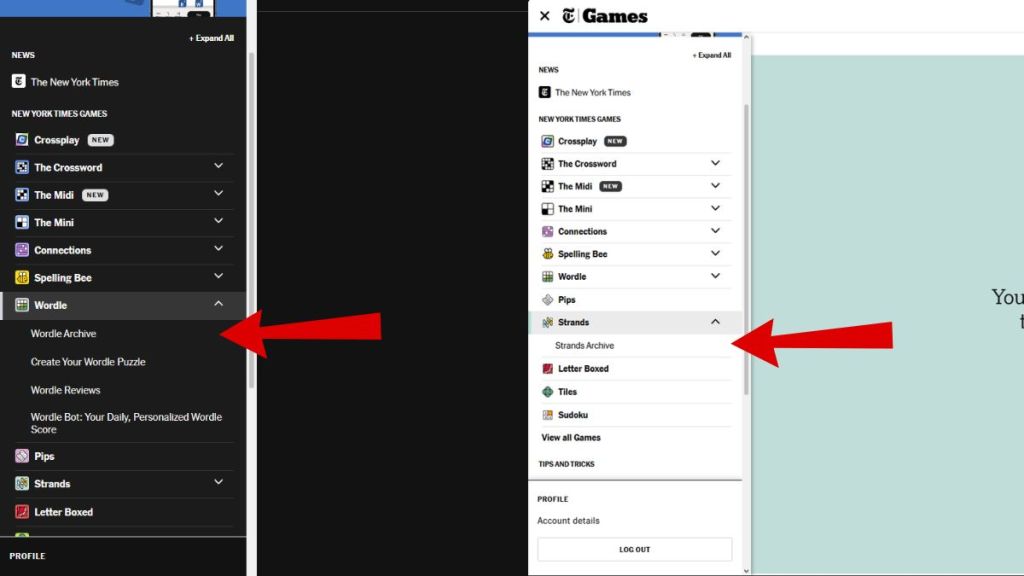
| Puzzle Archive | Yes, requires NYT Subscription | Yes, requires NYT Subscription |
| Languages | English (Wordle alternatives in other languages) | English |
Strands vs Wordle Compared
Objective
| Metric | Wordle | Strands |
| Goal | Identify the hidden 5-letter word | Use all letters to find theme words + Spangram |
| Word Length | Strictly 5 letters | Varies (4+ letters) |
| Daily Puzzle | One per day | One per day |
The NYT Wordle is an exercise in deductive reasoning. You start with a blank slate of six rows with five tiles each, with every guess working as a filter that strains out unneeded letters.
Your success depends on how quickly you can find a single, five-letter word from thousands of possible words. Since you are limited to only six attempts, every guess is risky.
If you often find yourself getting stuck, check out how to play Wordle to get an in-depth idea of the strategies you can use to crack this popular puzzle.
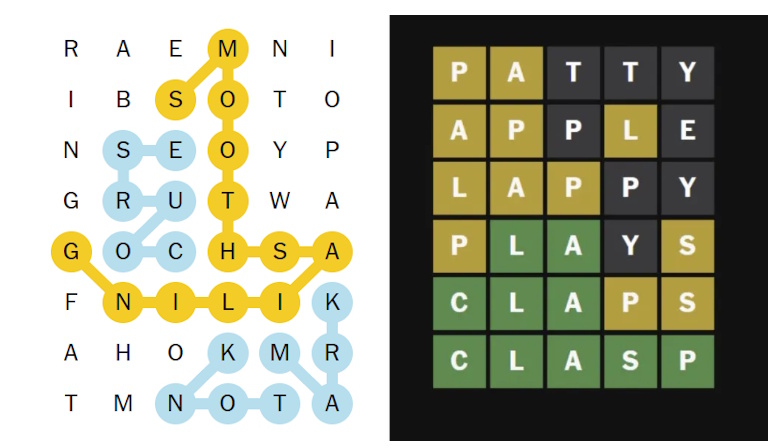
As for Strands, you are tasked with finding meaningful theme words using a 6×8 grid of forty-eight letters that are already present. All the letters on a Strands board are a vital piece of the puzzle. You have not truly finished the puzzle until every letter on the grid is highlighted and creates a word.
The theme words in Strands are highlighted in blue, while the Spangram is highlighted in yellow. It is not the only mechanic in place, so learn how to play Strands if you are just starting out with this NYT puzzle.
Game Mechanics
| Feature | Wordle | Strands |
| Color Feedback | Green (correct letter, correct position) Yellow (correct letter, wrong position) Gray (not present in word) | Blue (theme word) Yellow (spangram) |
| Visual Cues | Keyboard updates with used letters | Letters highlight as you drag/ connect |
| Grid Structure | 5 x 6 (5 letters, 6 attempts) | 6 x 8 (Total of 48 letters) |
| Clue Type | None | Cryptic theme hint (e.g., “Home stretch?”) |
Wordle employs a three-color feedback system to help players guess the five-letter word. The tiles turn green if your guessed letter is correct and in the right spot. They turn yellow if the letters are correct but are in the wrong spot. And gray tiles mean that the letter is not part of today’s Wordle answer.
Using these colored tiles, Wordle gives you a hint to get you closer to the answer every time you make a mistake. Much like the Mastermind board game, your previous failed guesses are actually your most reliable tool.
On the other hand, Strands is about winding paths. Instead of typing words into a box, you have to trace them through a grid of letters. It features a connected-path mechanic where words can bend, snake, and double back in any direction.
In Strands, the challenge is not knowing the word, but rather seeing how all of the letters in the grid flow together. Additionally, there is a unique mechanic called Spangram in NYT Strands that can help you identify the core theme of the puzzle if you find it.
Error Tolerance
| Metric | Wordle | Strands |
| Guess Limit | 6 attempts | Unlimited |
| Penalty | Game Over after 6th fail | No penalty |
| Fail Condition | Running out of guesses | None (Infinite time/guesses and a hint mechanic) |
| Performance Metric | Guess count (1/6, 2/6, etc.) | Hints used vs Perfect solve |
Despite being a simple word game, Wordle can be surprisingly stressful. It’s one of the few puzzles where you can actually fail. You might have a certain puzzle where you are already on your fifth guess, yet all you have on your screen are gray tiles. If you fail to guess the word by the sixth try, it’s game over for you.
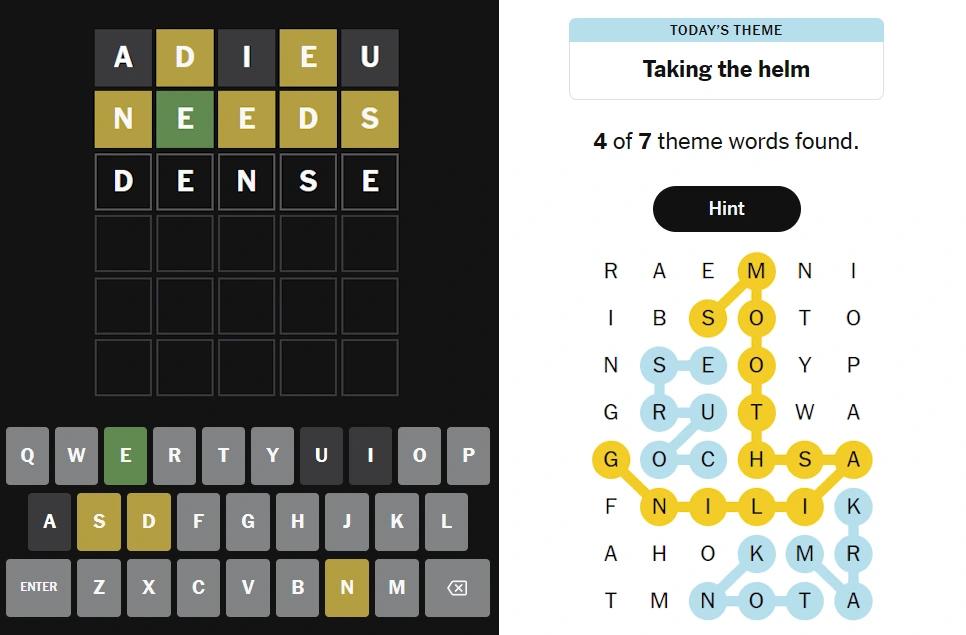
Meanwhile, Strands is a much more relaxing (sometimes irritating) experience. Since it features no guess limit, you literally cannot lose, and the puzzle will sit there patiently until you find every last theme word.
Instead of worrying about a game over, your primary focus in NYT Strands is on the efficiency and how cleanly you can solve today’s Strands hints.
Difficulty
| Aspect | Wordle | Strands |
| Difficulty Curve | Low to High (based on word rarity) | Medium (finding the Spangram is key) |
| Learning Curve | Very Low (simple logic) | Low (requires adjusting to non-linear words) |
| Strategy | Vowel-heavy starters (e.g., ADIEU) | Finding “non-theme” words to earn hints |
| Vocabulary Demand | High (5-letter common usage) | Medium (Theme-dependent) |
Since you only have six guesses in Wordle, you can find yourself in an alphabetical nightmare where you know four out of five letters, but a ton of possible words can be the answer. For example: you’ve figured out that today’s answer is _IGHT. Now, this means the answer could be LIGHT, RIGHT, or even FIGHT.
Despite this, players can come up with opener strategies that they can employ over time. There isn’t a sharp learning curve, and if you play Wordle regularly, the game becomes much more adaptable.
The difficulty in Strands vs Wordle is much more spatial. You don’t have to guess what the word is, but rather you have to essentially “un-see” the grid and find the path. Since words can zig-zag, turn corners, or wrap around other words, you might see a word right in the middle of the grid but miss a crucial letter tucked away in the corner.
Time Investment
| Factor | Wordle | Strands |
| Session Length | 2–5 Minutes | 5–15 Minutes |
| Daily Commitment | Minimal | Moderate |
| Replayability | Low (One-and-done) | Low (One-and-done) |
| Frustration Factor | High (Losing is possible) | Low (Hints are always available) |
NY Times Wordle is built to fill those little pockets of free time in your day. You can play it while waiting for the bus, in line for coffee, or simply sitting in a waiting room. Since the grid is small and the rules are not too hard to grasp, you can knock out a game of Wordle in under two minutes. It doesn’t demand your full, undivided attention, serving as a quick daily ritual that fits perfectly into an otherwise busy schedule.
On the other hand, Strands is more of a sit-down commitment. This puzzle requires a much deeper level of visual focus because you aren’t limited to looking at five tiles. Instead, NYT Strands is about scanning a grid of 48 letters all at once. To find a single word, you need to mentally connect potential paths.
To complete Strands, you need to settle in for five or ten minutes to get into a flow state where the hidden words start to pop out at you.
Strands vs Wordle: Which Game Should You Be Playing?
Choosing between Wordle and Strands usually comes down to how much time you have and what kind of mental exercise you are looking for. Neither of these puzzles is objectively better, but they definitely appeal to different mindsets.
If you have only a couple of minutes while your coffee brews in the morning, Wordle should be your go-to choice. It is a perfect puzzle for people who love logic, deduction, and the thrill of a challenge that gives you limited chances. Because you can actually lose at Wordle, every guess you make feels important. If you like starting your day with a quick, punchy win, you can go with Wordle.
On the other hand, if you want to sit down and completely dedicate yourself to a puzzle for ten-odd minutes, Strands should be your go-to puzzle. It is the ideal choice for fans of classic word searches who want something with a modern twist to it.
Since there is no way to fail, Strands is a much more relaxing experience that rewards creativity and playfulness. Even if you find a word that is not a part of the theme, Strands will reward you with a hint rather than punishing you.
At the end of the day, you could always play both of these brain-teasing puzzles. You can reserve Wordle for your early morning brain tease, and delegate Strands to when you have some time to spare so you can really exercise your brain.
Now that you know the difference between Strands and Wordle, which puzzle game are you going for? Or would you rather play them both?
Yes, both Strands and Wordle are free to play for all players. They do not require a New York Times Games subscription to play the game, but it is required to access the archives.
No. Wordle ends after six wrong guesses, but Strands has no guess limit.
Compared to Wordle, NYT Strands takes longer to finish, usually from 5 to 15 minutes.
Wordle only gives you hints through color-coded tiles – green, yellow, and gray. Meanwhile, Strands allows you to earn “hints” by finding three non-theme words.