Connections is one of the New York Times’ most popular puzzle offerings, giving players a satisfying brain teaser every single day. Such is the popularity of this word-association game that The Athletic eventually made a sports-themed equivalent, aptly named Connections: Sports Edition. While both games share obvious similarities, some key differences help them stand apart. If you’re wondering how these puzzles stack up against each other, we have got you covered with a NYT Connections vs Sports Connections comparison.
NYT Connections vs Sports Connections in a Nutshell
Both Connections and Sports Connections are word-association games where players need to find groups of four connected words. The words are laid out across a 4 x 4 grid, and you simply have to select four words before hitting submit to check if your pattern recognition skills were spot on. If correct, a small animation will reveal the category theme and color in NYT Connections. But if you strike out, you will lose one of your four attempts.
The primary difference between the two puzzles comes down to the theme. While NYT Connections includes themes from pop culture, media, literature, and just about anything under the sun, Sports Connections focuses solely on the world of sports.
This means that the NYT puzzle is a lot more accessible for the general audience, while the daily sports-theme game from The Athletic requires more specific knowledge.
Here is a brief NYT Connections vs Sports Connections comparison:
| Feature | NYT Connections | Sports Connections |
|---|---|---|
| Founder | Wyna Liu | Mark Cooper (The Athletic) |
| Release Date | June 12, 2023 | September 24, 2024 (Beta) February 9, 2025 (Official Release) |
| Objective | Organize a grid of 16 words into four connected groups | Organize a grid of 16 words into four connected groups |
| Game Rules | Four attempts to find the four word groups Groups are color-coded to represent difficulty No time limit | Four guesses to find the four connected groups Groups are color-coded to represent difficulty No time limit |
| Game Modes | Daily Unlimited (Requires NYT Subscription) | Daily |
| Paid or Free | Free | Free |
| Puzzle Archive | Yes, requires NYT Subscription | No |
| Languages | English | English |
Connections vs Sports Connections: The Similarity in Core Mechanics
As mentioned earlier, the core premise behind NYT Connections and Sports Connections is largely the same. In both games, you’ll be presented with a 16-word grid that must be organized into four groups based on common themes. These connections can be thought of as a general theme that ties those specific words together.
You’ll have four attempts to organize the 4×4 word grid. Failing to do so results in NYT Connections answers today being revealed automatically.

Besides the fundamental structure, Connections and Sports Connections also share the “One Away” notification, which indicates that you’re within reach of solving a category.
Moreover, both puzzles even have the same “Shuffle” button that quickly shakes up the grid and changes the original placement of words. In fact, if you know how to play NYT Connections, you’re basically ready to take on Sports Connections as well.
Key Differences Between Connections and Sports Connections
Now that we’ve established just how similar both games are, it’s time to check out the other side of the coin. Here are the differences that set Connections vs Sports Connections apart:
Knowledge Base and Subject Matter
The most obvious difference between these word games is the core subject matter. Connections gathers terms from the English vocabulary, pop culture, and everything in between, whereas Sports Connections focuses squarely on the world of sports.
In a standard Connections word game, you will come across terms related to movies, synonyms for a specific object, or references to an event. However, in Connections: Sports Edition, every single term will be linked to sports in some manner.
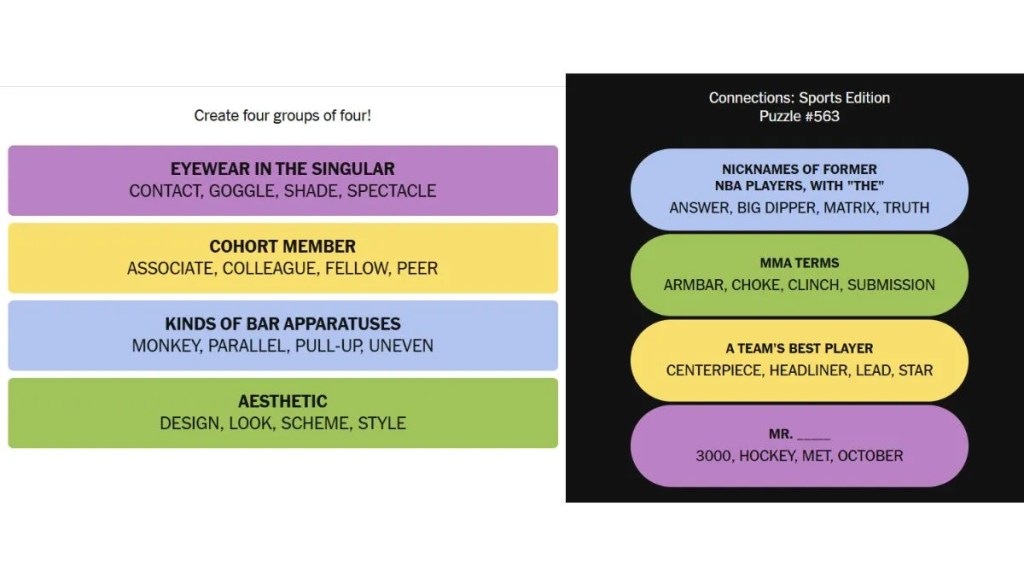
Naturally, this means that the knowledge base needed to solve Connections is more general, while Sports Connections requires extensive sporting expertise, especially as the puzzle borrows from nearly every major sport.
Wordplay vs Trivia
Both word games try to feature niche categories to catch solvers off guard. That said, the original Connections leans heavily into wordplay, using puns, homophones, synonyms, and more across the grid.
In contrast, Sports Connections leans more into trivia, grouping words by specific facts that only true fans will immediately recognise. This means that the Sports Edition puzzle regularly brings categories based on historical stats, jersey numbers, team rosters, and niche terminology.
Integrated Timer in Sports Connections
Sports Connections features an optional timer that players can turn on to raise the stakes. By placing solvers in a race against the clock, the puzzle captures the competitive nature of real sports culture, while also giving them a yardstick to measure their speed and accuracy.
In contrast, NYT Connections follows a standard win/ lose outcome with no extra modifiers.
UI and Visual Design
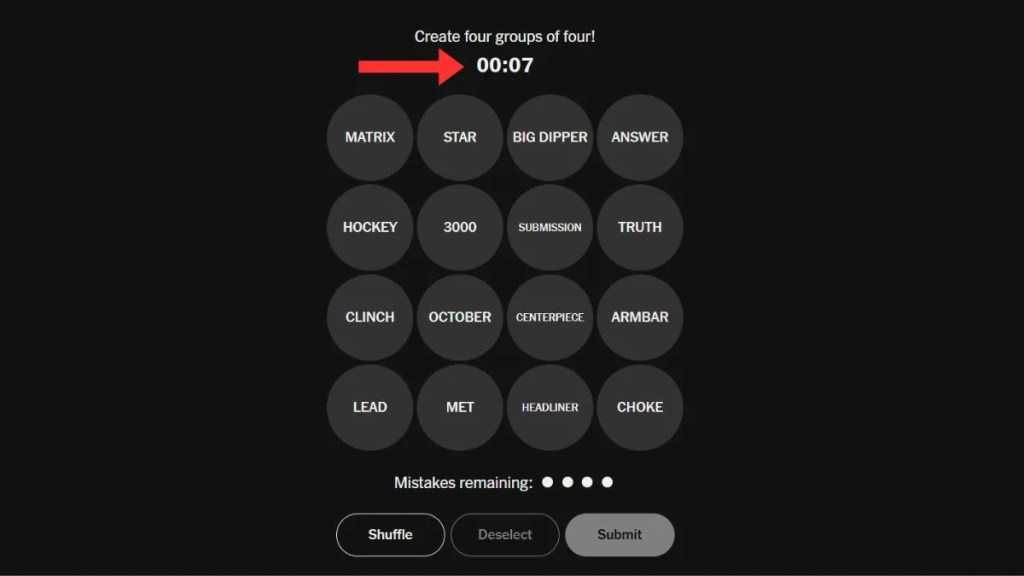
If you compare NYT Connections against its sports counterpart, you will notice a visual difference between the two puzzles instantly. While their 4 x 4 grid and gameplay mechanics are similar, their visual representation is noticeably unique.
The original Connections has a clear white color palette with rectangle-shaped boxes, while the Sports Connections grid has circle-shaped boxes against a black background. This is purely a cosmetic difference, of course, but it’s still worth noting.
Platforms and Editorial Teams
Another major difference in our NYT Connections vs Sports Connections is all about their respective platforms.
Connections is one of the New York Times’ flagship games and can be played on the NYT website or via the NYT Games app. On the other hand, Sports Connections is created and managed by The Athletic and can be accessed via the publication’s official website or app.
Connections vs Sports Connections: Which One is Harder to Solve?
The original Connections is undoubtedly the more accessible game because it relies on general vocabulary and pattern recognition skills. You don’t necessarily need to be a history buff or even a cinephile to solve the puzzle; you just need to spot linguistic patterns like hidden words or common prefixes.
In comparison, Sports Connections deals in subject matter that is far more niche and specific. Its categories often ask players to recall sporting events from years prior or check if they’re caught up on modern-day athletes and franchises.
Some categories can be so niche that they’re almost impossible to solve without making some calculated guesses. For these reasons and more, Sports Connections is harder to solve than NYT Connections. Speaking of which, be sure to check out today’s Sports Connections hints if you’re struggling with the latest puzzle.
Common Strategies to Solve Connections and Sports Connections
Despite the differences in subject matter, the best strategies for solving Connections and Sports Connections are largely the same. That’s thanks to their shared gameplay foundation.
So, here are the best tips and tricks to keep in mind while approaching these word association puzzles:
Use the Shuffle Feature
Soon after loading up today’s puzzle, you are likely to spot related words sitting right next to each other. This is something that you’re bound to notice almost every day. Well, that’s exactly what the puzzlemasters want, as these seemingly related words are typically grouped together to create red herrings. Their intentional placement is designed to trick you into selecting them and wasting an attempt.
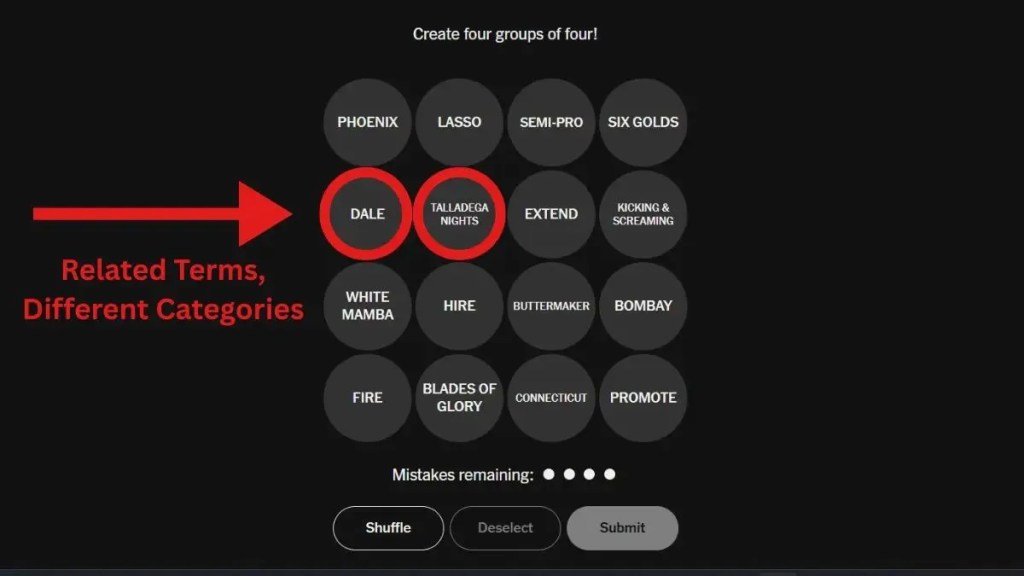
To sidestep this trap, we highly recommend shuffling the board after taking an initial look. This will quickly get rid of any misleading word placements and lower the odds of you falling for them.
Focus on Narrow Terms
Both Connections and Sports Connections feature terms that have multiple meanings or could slot into a wide range of categories. Establishing links while focusing on these words can eat up your time and attempts. So, we recommend honing in on terms that could only have one possible meaning or association.
For instance, a word like “Saxophone” is far less flexible when compared to something like “Apple.” As such, you can use “Saxophone” as the anchor word for a category that will likely be tied to names of musical instruments. By finding these anchor words, you’ll also be reducing the remaining pool of words and gradually making the puzzle easier.
Use “One Away” Mindfully
If you receive a “One Away” notification, do not immediately start swapping individual words. This can burn through your four guesses quickly. Instead, step back and look at the remaining 12 words to see if the fourth missing piece belongs to another potential category you haven’t identified yet.

We would even suggest ignoring the notification altogether if you fail your second try because falling for the “One Away” message is one of the most common mistakes in Sports Connections.
Connections vs Sports Connections: Which Should You Be Playing?
Choosing between NYT Connections vs Sports Connections ultimately comes down to your personal interests and how you prefer to challenge your brain.
If you enjoy wordplay and the satisfying mental click of identifying a pattern, then Connections is the perfect game for you. But if you’re a sports buff that takes pride in being a trivia machine, look no further than Sports Connections for a genuine challenge.
Those are all the similarities and differences between Connections and Sports Connections. Which word association puzzle is your go-to?
The main difference between Connections and Sports Connections is their respective subject matter. The former is a wordplay-heavy puzzle that uses general terms, while the latter is a sports-centric puzzle that features niche, trivia questions.
Yes, both Connections and Sports Connections are free-to-play games from The New York Times and The Athletic, respectively.
While difficulty is subjective, Sports Connections will be more difficult for most players since it requires extensive sports knowledge. In comparison, NYT Connections focuses on general word association, making it more accessible.
Unlike the original Connections puzzle, Sports Connections does not have an archive.