Beebom Score
The year 2026 was supposed to belong to the heavyweights. Rockstar’s long-awaited GTA 6, Bungie’s ambitious extraction shooter Marathon, Pearl Abyss’ grandiose open world Crimson Desert, and RPGs with names you can’t pronounce – the entire circus was booked. Nobody penciled in a black and white cartoon mouse with a revolver and a cigar habit as a serious contender to outweight the AAA games this year.
And yet, here we are. MOUSE: P.I. For Hire went viral with its first tech demo in 2023 when Fumi Games showcased the 1930s rubber hose animation style first-person shooter, and it bounced around the internet like a stray bullet in a saloon. The game sounded like a novelty or a cheap parlor trick at first, which was just an experiment; you know, the kind of thing that demos at a showcase, collects applause, and shelves in the dark?
But after a 90-minute demo I played last month and 15 hours deep into the full game, I’m not laughing anymore. Well, to be honest, I am at the game’s silliness, jokes, and its characters, but definitely not its ambitions. This thing is phenomenal; it’s the real deal, and it might just be the game of the year for me. So, here’s my MOUSE: P.I. For Hire review, which might just convince you to bet on it once.
The Name is Jack, Jack Pepper: Private Eye for Hire
Set in the 1930s, MOUSE is a grimy, jazz-soaked tale of detective Jack Pepper, who is a private eye and an ex-war hero who fumbles through the rotting underbelly of a town called Mouseburg. Yep, even the town is named after the game. The city is so rotten and deeply rooted in corruption that it makes Gotham look like a wellness retreat.
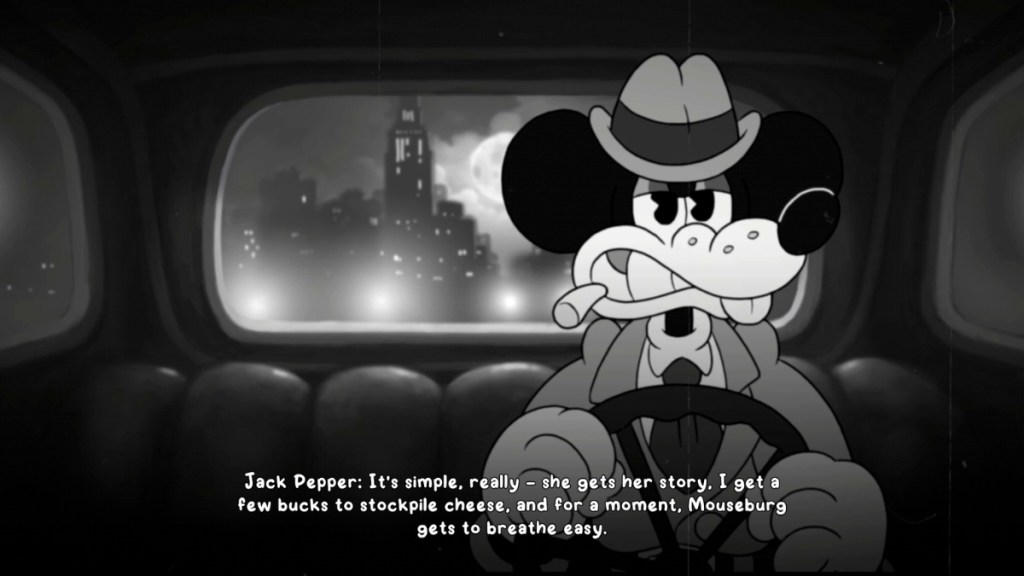
Jack is also a former cop, which makes him excellent at investigating cases, but at the same time he’s morally conflicted and makes some bad financial decisions. Troy Baker voices Jack, and as always, he’s cooking! That low, gravely voice delivers each line with such grit and emotion, you’d not want to skip a single dialogue. As I was playing as Jack, I did not skip his lines even once – those who know me may call it a miracle as I’m famous for skipping dialogue in games like this one.
The moment Troy hums the game’s theme as you boot it up and the Fumi Games logo shows up, I was instantly hooked. I didn’t feel like Jack at that point; I was Jack. That’s just good casting doing what good casting does.
The supporting cast of characters who are Jack’s aides have their own unique personalities. Whether it’s Tammy Tumbler obsessing over her weapons or tech stuff and just making you feel stupid, or Wanda Fuller, who leads you to solving your cases, everyone pulls their weight around the story. And then there’s Cornelius Stilton, who is Jack’s old war buddy who traded his uniform for a politician’s demeanor and smile. I literally spent the entire game figuring out whether he was an ally or the guy who’s going to stab me in the back.
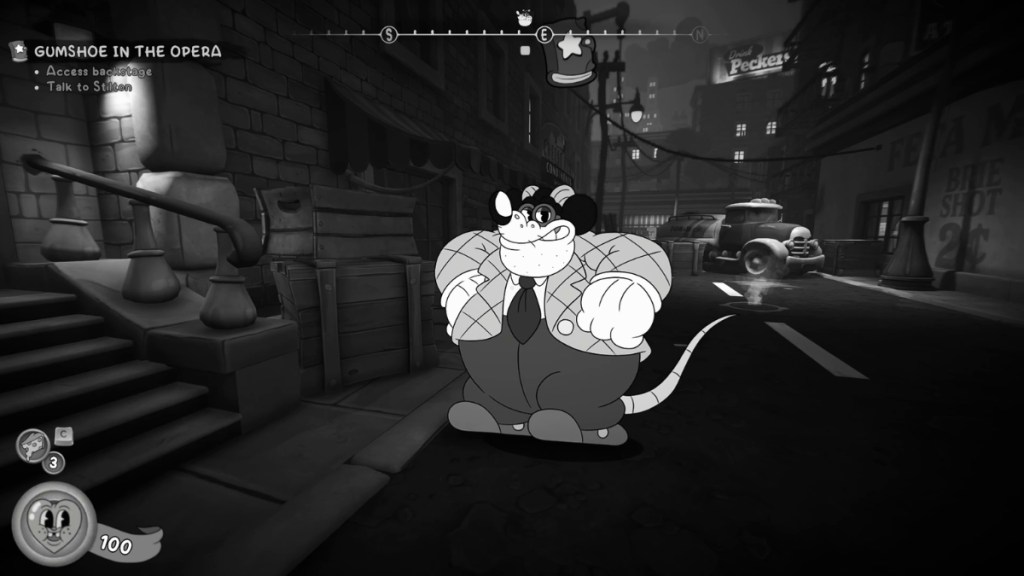
What really pulled me in, though, is how the story and main missions moved. I wasn’t dropped into a 15-minute cutscene at the beginning of the game or a 20-minute tutorial course on how to move around, none of that crap. The game opens with a chase sequence that immediately tells me that this thing has places to be.
After that, the cases stacked on top of each other – a missing magician here, a murder cover-up there – each one pulling at threats that connect to something much bigger. The clue board where I pinned my clues showed a clear path of where my leads will take me as I piece the mystery one clue at a time. That little detail with storytelling went a long way for me, something that most “detective” games often miss. It’s structured like a stupendous detective noir novel where you’re always holding at least a couple of clues, zero answers, and the slow reveal is deeply satisfying.
A Visually Stunning Rubber Hose World Built Frame by Frame
It’s time to talk about the elephant in the room – or rather the 40,000 hand drawn frames in the room. While half the game studios are caught between the dilemma of the use of AI in gaming, Fumi Games devs sat down and drew every single frame by hand, and animated it in 3D on computers. The result is a city that breathes like a 1930s noir world and not just the city; every single area I’ve been in during my playthrough has felt uniquely different.
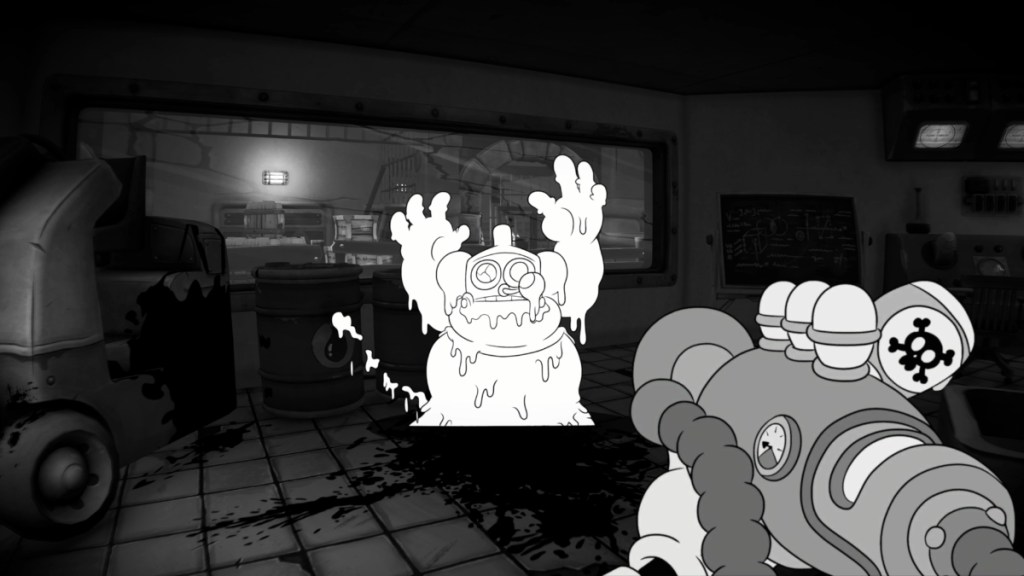
Characters wobble and bounce with that rubber hose elasticity, enemies ragdoll into exaggerated death spirals, and melt like ‘Who Framed Roger Rabbit?’. The entire game carries that energy that no amount of procedural generation can replicate, and the world-building is truly a piece of art. The world of Mouseburg is so dense that the main cases push the narrative forward, but the side cases overflow with personality.
One job has you rescuing Shrews from an evil lab, while another has you locating a lost friend who sleeps with fish. I mean–what even? This tonal swing between the gritty noir and Sunday morning newspaper cartoon absurdity, which shouldn’t work, perfectly goes hand in hand. Pop a can of spinach mid-fight, and you turn into Popeye, using your bare knuckles and beefed-up arms to beat up enemies. Drink a cup of coffee, and your fingers turn into actual cowboy six-shooters.
Environmental storytelling gets a similar treatment where skeletons frozen in compromising poses – where one was penning a poem and got shot midway – tell little stories about their final moments, and I found myself stopping for a second and laughing my a** off at these dark visual gags more often than I’d like to admit.
Even The Guns Have Personality Not to Be F**ked With
So what makes MOUSE “that good” from just a simple gimmick is its weapon design. The shooting in this game isn’t like your usual FPS games; it’s inspired right from the T. Each weapon has its own signature sound, animation, and even bullet design that is yanked right from the vintage era cartoons.
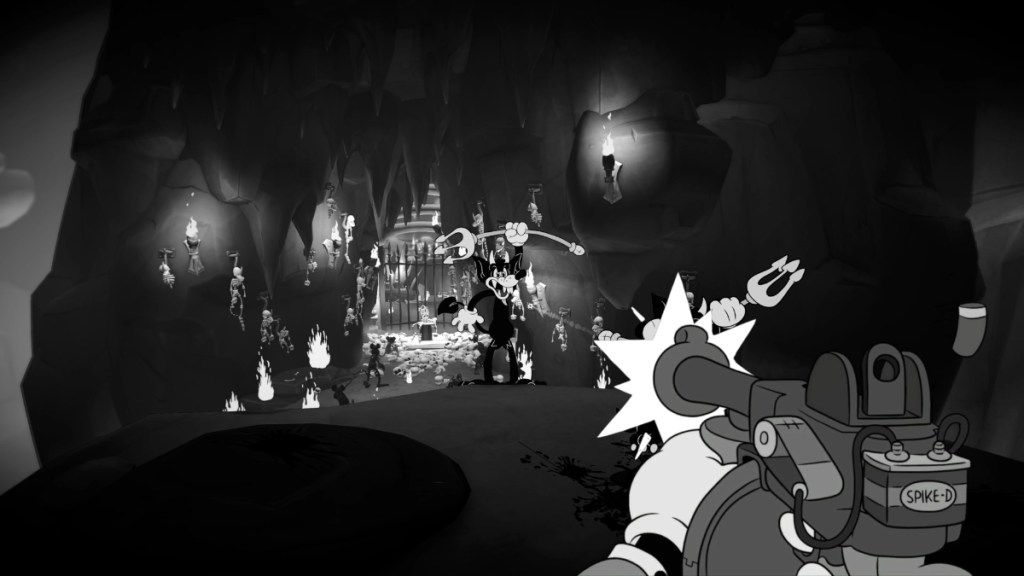
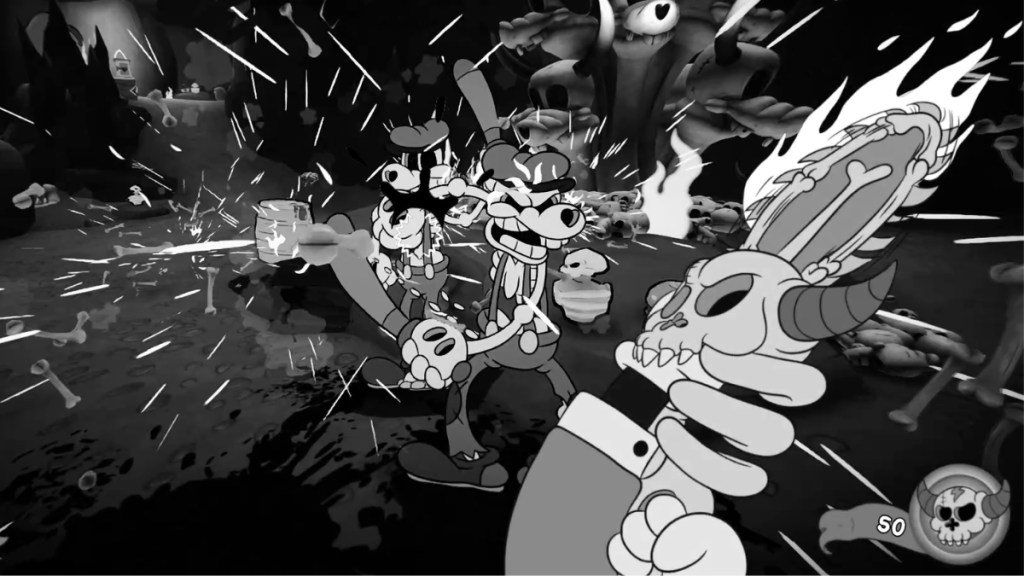
Enemies, when shot or killed, react to your hits like they’re putting on a performance, even when they’re on fire. When skeleton bones rattle in front of you, it sounds like a low note of a Xylophone that feels oddly satisfying. And the best of all, the Turpentine melted goons that leave googly eyes and black ash, are just pure chef’s kiss. I mean, it beats Doom’s glory kills in every possible way.
The Micer is your trusty pistol with a punchy burst alt-fire mode and is best suited for mid to long range. I used this the most to get those flying buggers off my back or to take down enemy marksmen. Then you’ve got the Devarnisher, which is your turpentine gun, and it’s my second-favorite weapon of the game since it melts enemies in a single shot and deals damage over time.
The Boomstick is a standard single barrel pump action shotgun, best for close-range kills and one-shot enemies. The Kiss Kiss is a double-barreled explosive shotgun that fires explosive shells and deals fire damage. The James Gun, which is basically a Tommy Gun, is my favorite from the game since I used it the most during my combat, and it’s perfect across all ranges, as the ammo for the weapon was easily accessible across areas.
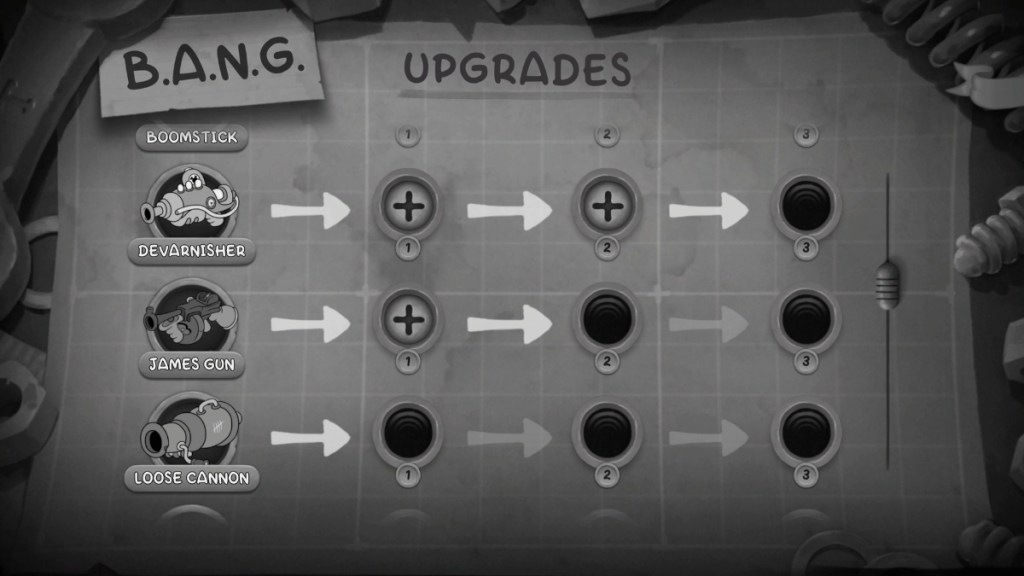
The Loose Cannon fires actual cannon balls and explodes on impact, breaking walls or clearing off crowds. Then D-Namite sticks are your standard TNT, which are throwable explosives. The Jar Head is a stun gun that stuns enemies, also perfect for crowd control and stunning heavy brutes.
Then there’s a gun that freezes enemies like a freeze ray (a weapon that I hadn’t unlocked yet), and finally a Hellrazer, which is a chainsaw and deals fire damage when used from mid-range to rip enemies just like Doom Slayer. But the underdogs of combat are your punches, which are called Mitts or Kicks that you use to shove enemies away, where reload is not an option.
Every weapon in the game upgrades through Tammy’s B.A.N.G workshop using schematics you find hidden in secret areas. The upgrade system is neat, meaningful, and gives you reasons to find these schematics in every corner of the map. Beyond the combat, small touches add up to the game’s beauty.
The movement deserves its own point in this review, as it shows Fumi clearly spent actual thought into it. The dodge dash is snappy and precise, but the real fun is in the tail mechanics. Yes, you’re a mouse, and you’ve got a tail, so use it! It becomes a grappling hook, and it also doubles as a helicopter blade for short hovers. Paired with wall running, double jumps, and air vents you find across maps, you’re basically Spidey with a Tommy Gun and a cigar habit.
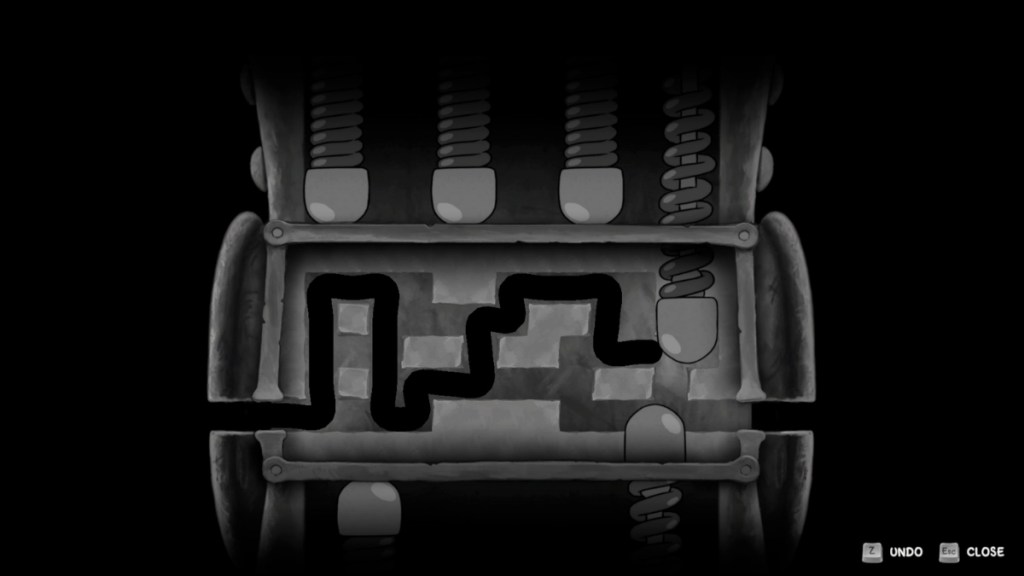
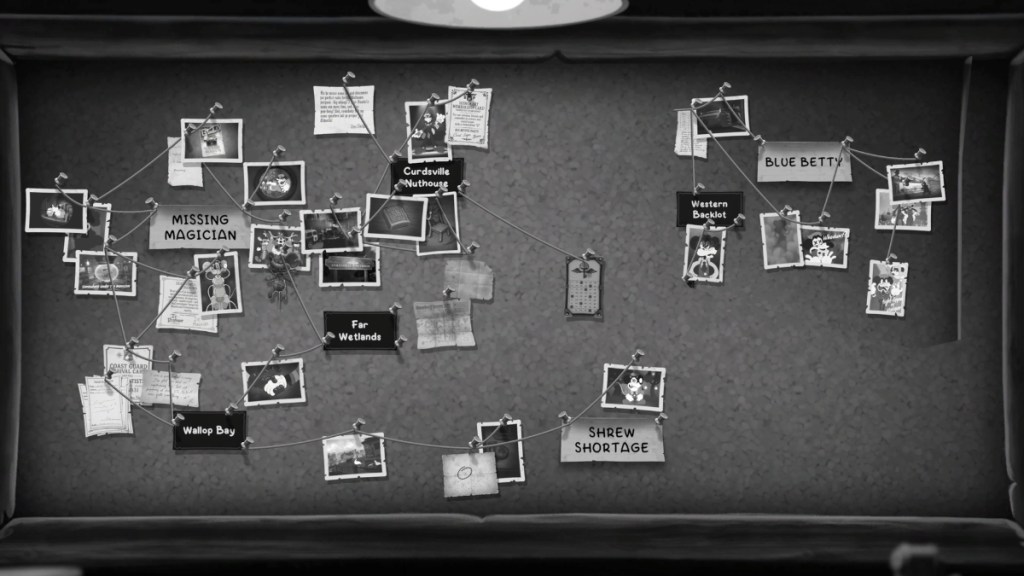
The lockpicking mechanic is inspired and has been reimagined as a clean maze puzzle instead of the usual bobby pin stereotype. You can shoot hanging pianos and anvils into enemies for environmental kills, and trust me, each time I came across one, I shot it down. Your detective brush highlights clues and footsteps when you’re stuck. Even cheese and heal bottles feel on point, which act as consumables that made me chuckle each time I popped them.
Boss fights are a highlight too, and without spoiling too much, one involves a crocodile with a gatling gun, and if this doesn’t sell you on MOUSE, I don’t know what will.
A Richly Detailed World That Feels Alive Beneath Its Cartoon Surface
A gorgeous art style in a video game only gets you so far, but what makes MOUSE genuinely impressive is how this isn’t just a cheap graphical trick in the book; it’s well thought out and planned. The level design in the game uses the cartoon logic to its advantage: vents act as vertical launchers, warp pipes teleport you across sections, and hidden platforms reveal themselves when you shoot targets. Nothing feels random. There’s an intentionality to every corridor, every shortcut, every secret room that speaks to obsessive craft.
Most of the areas are tightly paced and easy to navigate between, except the Tinsel Studios map, which left me hunting the right path, even when my detective brush was going crazy across the floor. Too ambitious, maybe? Well, it doesn’t diminish the effort that has been put into MOUSE’s world-building.
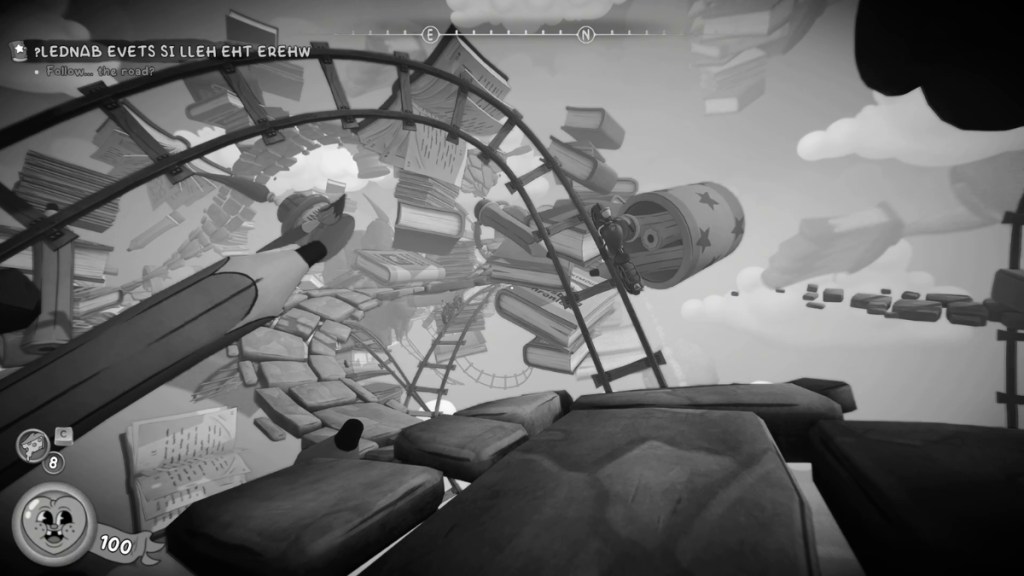
The real showstopper is a sequence where you chase a magician through a dimension-bending fever-dream, which looks straight out of a Spider-Verse film. Structures floated in impossible angles, perspectives shifted as I moved around, and the whole sequence left me in an absolute gobsmacking wonder. It’s the kind of level design that reminded me why I loved games in the first place.
Even though it’s through and through black and white, for a single second, I never felt like I’m playing a damn shooter in monochrome. Well, one level does bring in the color, but I won’t spoil that for you. Still, the art style has enough teeth for you to bite into the game this year.
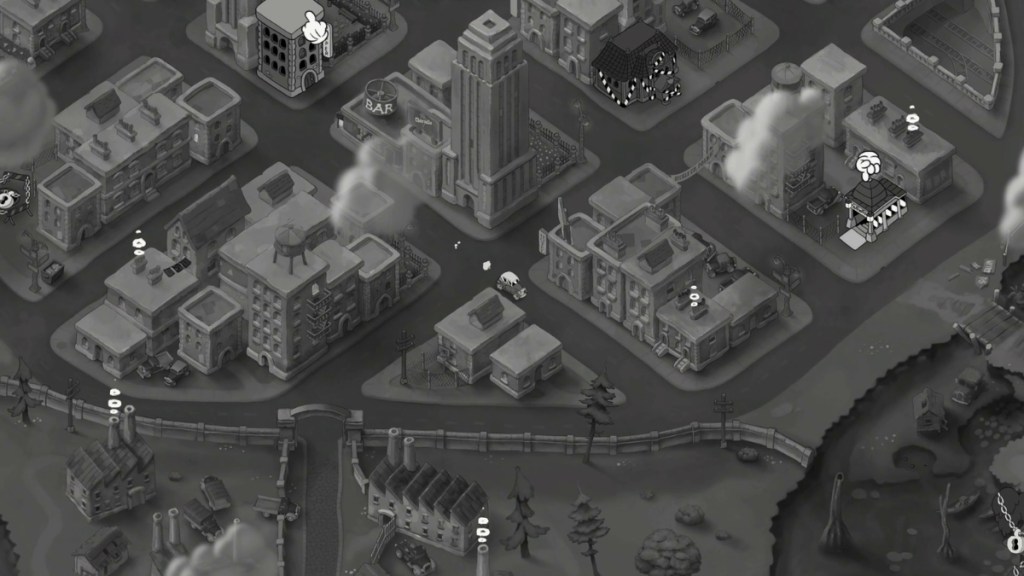
There’s also a charming top-down driving view when you travel between Mouseburg’s districts – your tiny car zipping through hand-drawn streets from a bird’s-eye perspective. It’s a small thing, but it breaks up the pace between missions beautifully and adds yet another layer of personality to a game already drowning in it.
Performance: Smooth, Stable, and Clean as a Mouse With Nothing to Hide
For a game juggling over 40,000 hand drawn frames in black and white, MOUSE runs like a dream – so smooth like slicing butter with a hot knife. I played on my PC with max settings, DLSS set to Quality, locked at 160 FPS, and the damn thing never flinched or dropped a frame!
My Setup:
CPU: Intel i7 14700K 3.40 GHz
CPU Cooler: CORSAIR H150 RGB 360mm
Motherboard: MSI Z790 Pro Wifi
GPU: Gigabyte RTX 4060 Ti 16GB
RAM: Crucial (2x16GB) 5200MHz DDR5
SSD: Kingston 3 TB NVMe SSD
Monitor: 1440p @ 160Hz
Not during the intense crowd-heavy combat scenarios, not even in ‘that dream sequence’. Zero frame drops, no stutters, absolutely no screen tears either. Load times between areas are brisk, and the control scheme is intuitive, easy to understand, and highly accessible whether you’re on keyboard and mouse or a controller.
Since the game is already launching on handhelds like Nintendo Switch 2 and Steam Deck, alongside PS5, Xbox, and PC, it’s no wonder that Fumi spent so much time optimizing this game so well that it can offer the same quality experience no matter what device you’re playing MOUSE on.
A Hesitant Moral Core Keeps It From True Greatness
Now that you’ve heard all the praise, time to come to the one thing that’s stopping me from giving it a perfect Beebom score: it’s too damn nice!
Look, Jack Pepper is a good dude. Like, a genuinely good dude. He fights corruption, protects the innocent, and most of the time, makes the right call. In your ideal detective story, that’s fine, I don’t mind an all-out positive protagonist at all. But this is the era of noir fellas. Noir era lives and dies on the murkiness where the moral scales tip and protagonists scare you a little. This is where there is no “right” answer, and there’s always a gnawing feeling that maybe our hero isn’t so heroic after all.
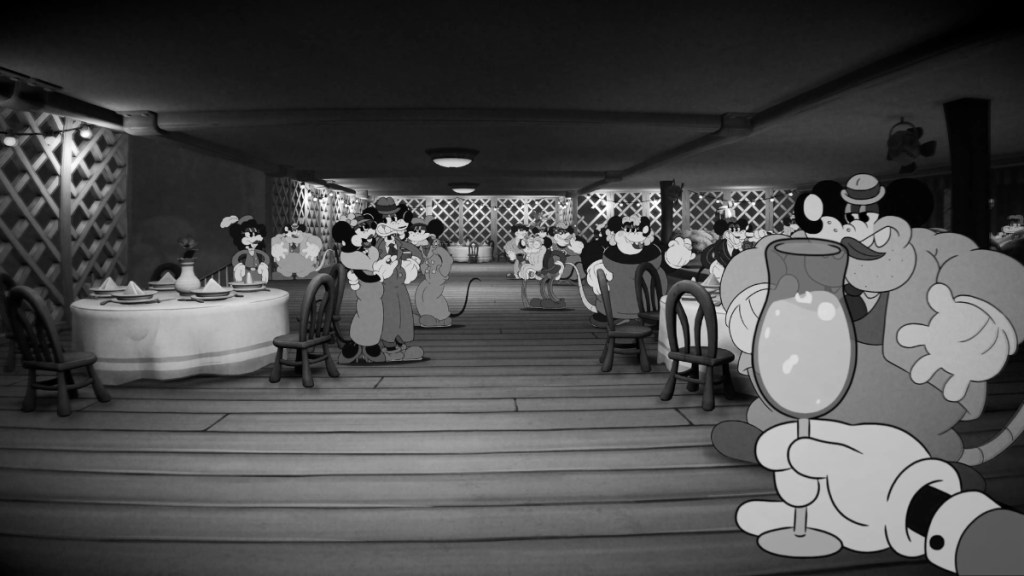
MOUSE: P.I. For Hire mostly sidesteps that moral dilemma. Jack is never really pushed into a corner where you’d question his integrity, nor is there a central villain who gets under your skin. Sure, there’s plenty of entertaining baddies and bosses in the game, and they’re all amusing to fight against. But there’s no Moriarty to Jack’s Sherlock, or no Joker to his Batman, who makes the conflict feel personal.
If you’re one who hoped that the noir wrapper covering MOUSE would come with some genuine narrative teeth, I’d say you’d find the bite a bit soft and undercooked.
Verdict: A $30 Game That Deserves to Be in Every Video Game Library
MOUSE: P.I. For Hire is that one rare thing that’s a passion project turned into a game, and somehow, despite all odds and naysayers questioning its actual functionality, it works like a “field of dreams.” It delivers on every ounce of that passion that Fumi Games put into it, positioning the game against the AAA juggernauts filling every pre-order library with.
In a landscape bloated with extraction shooters and open-world RPGs that cost hundreds of dollars, MOUSE costs $30, and for this price, it offers far more creativity, personality, and joy than games that are the “one more thing” at award shows.
To sum it up, 40,000 hand-drawn frames, an arsenal where every weapon is a punchline and a threat, and a detective tale to keep you on your toes, MOUSE is an absolute bang for your buck.
Yeah, GTA 6 is coming in 2026, and the big dogs will have their day. But MOUSE is proof that you don’t need a blockbuster budget or an “exclusive publisher” to make something people will remember. You just need someone to be passionate enough to pursue a bold idea, a talented team, and apparently some weird obsession with Steamboat Willie or Mickey Mouse to draw cartoon mice shooting, blowing s**t up, and smoking cigars.
I’d bet on MOUSE any day of the year, and if you’ve been on the fence for buying this $30 wonder, I’d say get off it and just buy the game. It’s the year’s biggest surprise you never saw coming.


 Ishan Adhikary
 Ishan Adhikary
![[EXCLUSIVE] "Pure Body Horror and Graphic Stuff" – ILL's Creator on Building the Game That Knows Exactly What Scares You](https://static.beebom.com/wp-content/uploads/2026/06/Beeboms-ILL-interview-with-Maxim-Verehin.jpg?w=300&quality=75)
 Sanmay Chakrabarti